


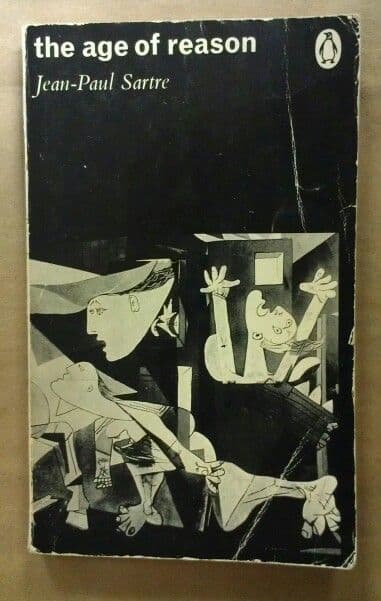
The Roads to Freedom (trilogy)

Sartre's unfinished novel trilogy—The Age of Reason (1945), The Reprieve (1945), and Troubled Sleep (1949)—follows a network of characters in the late 1930s as they confront the collapse of their private certainties and the approach of war. Its central mechanism is the testing of Sartre's philosophy of freedom against historical circumstance: characters who believe themselves free discover that their freedom is entangled with others, with institutions, and with the 'practico-inert' of a society drifting toward catastrophe. The trilogy's distinctive achievement is its formal experimentation, particularly The Reprieve's simultaneous narration, which renders the interdependence of separate lives in a single temporal frame.
Key Insights
✦What is the central argument of the trilogy, and how does it test Sartre's philosophy of freedom?
The trilogy tests Sartre's claim that humans are radically free by placing characters in situations where freedom seems impossible. Mathieu, the central figure of The Age of Reason, believes himself free because he refuses commitments, but his freedom is revealed as a form of bad faith: he is free only in the abstract, and his refusal to act is itself a choice that defines him. The later volumes, particularly The Reprieve and Troubled Sleep, expand the frame from individual consciousness to collective history, showing characters whose fates are intertwined by forces they did not choose. The trilogy's arc suggests that freedom, if it is real, must be exercised in history rather than outside it, and that the individual's freedom is inseparable from the freedom of others.
✦What formal innovation does The Reprieve introduce, and what does it accomplish?
The Reprieve is written in a technique of simultaneous narration: sentences are sliced together to present multiple characters' experiences occurring at the same moment, without chapter breaks or transitions. The effect is to render the simultaneity of separate lives—a conversation in Paris, a military mobilization in the provinces, a diplomatic crisis in another country—as a single, continuous present. The technique is not merely experimental; it enacts the trilogy's philosophical claim that individual lives are interdependent, that what happens to one character is bound up with what happens to others. The Reprieve is often considered the most formally ambitious volume of the trilogy, and its technique has been compared to cinematic cross-cutting and to the modernist innovations of Dos Passos and Joyce.
✦How does the trilogy relate to Being and Nothingness, and does it illustrate or complicate the philosophy?
The trilogy is often read as a fictional illustration of Being and Nothingness, but it is more accurately a testing of that philosophy under conditions the earlier work did not fully theorize. The Age of Reason is the most direct illustration: Mathieu's bad faith, his denial of his own freedom, and his eventual recognition of his responsibility follow the pattern laid out in the treatise. But the later volumes complicate this picture, showing that freedom is not merely a matter of individual consciousness but is constrained by material conditions, political forces, and the weight of history. The trilogy thus anticipates the turn toward the practico-inert and collective action that Sartre would develop in the Critique of Dialectical Reason. Reading the trilogy alongside the philosophy reveals that Sartre's fictional project was not merely illustrative but exploratory.
✦Why did Sartre leave the trilogy unfinished, and what does the incomplete fourth volume reveal?
Sartre had planned a fourth volume, La Dernière Chance (The Last Chance), which he never completed; fragments were published posthumously, but the novel remains unfinished. The reasons are both personal and philosophical. Sartre's political commitments after the war, particularly his turn toward Marxism, made the novel's individualist framework seem inadequate to the historical problems he wanted to address. The unfinished fourth volume would have carried the characters into the postwar period, and its incompleteness suggests that Sartre could not reconcile his philosophy of individual freedom with the historical reality of collective politics. The trilogy's open ending has been read as an admission that the novel form could not contain the problems Sartre had set for it.
✦How has the trilogy been received critically, and why is it less read than Nausea?
The trilogy was initially received as a major event, and The Age of Reason was a bestseller in France. But critical attention has since focused disproportionately on Nausea, which is shorter, formally complete, and more accessible as a philosophical statement. The trilogy's length, its unfinished status, and its dense historical engagement with the late 1930s have made it less attractive to students seeking an introduction to Sartre's thought. The Reprieve's experimental technique has attracted scholarly interest, but the trilogy as a whole remains relatively neglected. This neglect is unfortunate because the trilogy is Sartre's most sustained attempt to think freedom historically, and its characters' struggles with commitment, cowardice, and solidarity are more ethically complex than the schematic figures of his earlier fiction.
Wealthy Psyche is an intellectual archive. We do not host, distribute, or sell book copies — physical or digital. We provide structured knowledge to help you think better, faster.