


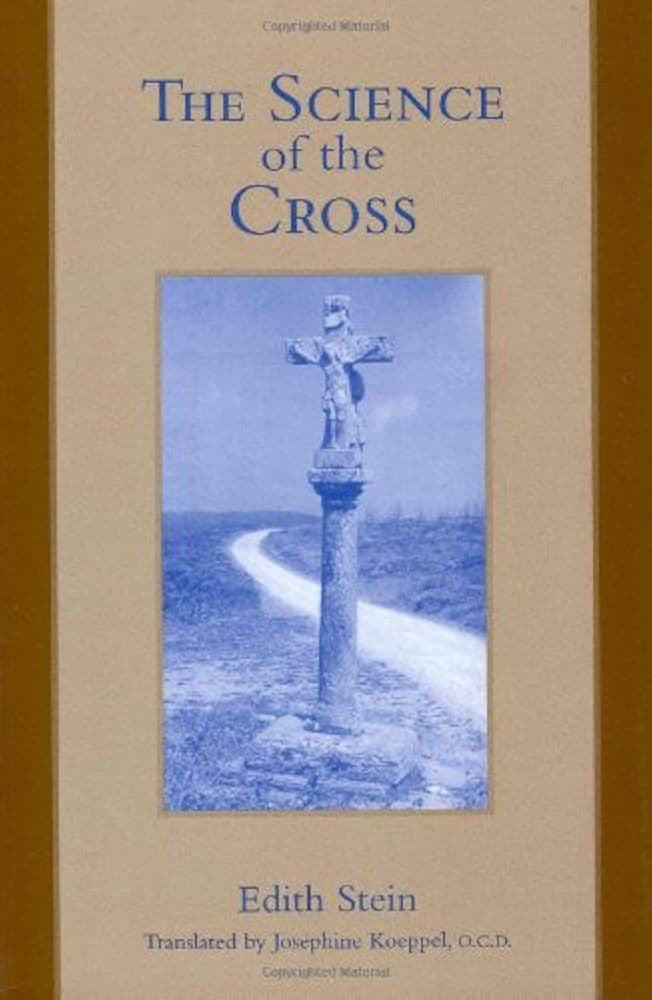
The Science of the Cross

Stein's final work applies her phenomenological training to the mystical theology of St. John of the Cross, arguing that the 'science of the cross' is a rigorous knowledge won through suffering, not abstract speculation. She analyzes John's symbols of cross and night, showing how entering the dark night is synonymous with carrying the cross, and traces the soul's passage through the active and passive nights of sense and spirit toward unitive contemplation. Written in the Carmel of Echt under threat of Nazi persecution, the study fuses phenomenological description with Thomistic precision to map the soul's transformation in love.
Key Insights
✦What is the central claim of The Science of the Cross, and what does it reject?
Stein's central claim is that the 'science of the cross' (scientia crucis) is a genuine form of knowledge, but one that can be gained only by undergoing the cross radically—not by detached speculation . She uses her phenomenological training to analyze John of the Cross's symbols of cross and night, arguing that entering the night is synonymous with carrying the cross and that this passage through darkness is the necessary path to unitive contemplation . She rejects any account of mystical theology that would reduce it to mere sentiment or abstract doctrine. The work fuses phenomenological description of inner experience with Thomistic conceptual precision, treating the dark night as a rigorous discipline of transformation rather than a vague spiritual metaphor .
✦What is the publication history of the work, given that Stein died in Auschwitz?
Stein wrote The Science of the Cross in the Carmel of Echt in Holland between late 1940 and 1941, after her superiors assigned her the task to mark the fourth centenary of St. John of the Cross's birth in 1542 . She was arrested by the Gestapo in August 1942, and the nuns found the manuscript lying open in her room . The work was published posthumously in 1950 as Kreuzeswissenschaft by Editions Nauwelaerts in Louvain and Herder in Freiburg . The first English translation, by Hilda Graef, appeared in 1960 under the title The Science of the Cross: A Study of St. John of the Cross, published by Burns & Oates in London and Henry Regnery in Chicago .
✦How does Stein's phenomenological method shape her reading of John of the Cross?
Stein's phenomenological training leads her to attend to the structures of lived experience as they are given in consciousness. In her analysis of John's symbols, she does not treat 'cross' and 'night' as mere literary devices but as descriptions of distinct experiential realities. The cross is a sign that has earned its meaning through effectiveness and history; night is a natural phenomenon that wraps around us and is nearer to us than all things and forms . She uses this precision to clarify John's accounts of the active and passive nights, the purgation of the senses and the spirit, and the soul's progressive detachment, showing how these are not vague metaphors but maps of actual transformations in the interior life .
✦What role did the circumstances of persecution play in shaping the book?
The circumstances of persecution are inseparable from the book's argument. Stein's superiors assigned her the study partly to distract her from the threat facing Jewish converts in Nazi-occupied Holland . But the subject of the cross could not have been merely therapeutic for her. As one scholar notes, she discovered in the cross a central viewpoint for grasping John's unity of being, and her own situation of danger and displacement gave her a lived entry into the doctrine she was expounding . The work remained unfinished at her arrest, and she died in Auschwitz in August 1942, a fate that interpreters have inevitably read back into the manuscript as its final, unwritten chapter .
✦How was the English translation received, and how does it relate to later editions?
The 1960 Hilda Graef translation was published simultaneously in London and Chicago and remained the standard English version for decades . It was later superseded by the 2002 ICS Publications edition, translated by Josephine Koeppel, OCD, as volume 6 of The Collected Works of Edith Stein . The Koeppel translation runs 408 pages and includes editorial apparatus by L. Gelber and Romaeus Leuven, the Carmelite editors who also oversaw the German critical edition . Both translations are serviceable, but the ICS edition is the standard scholarly version in English, with fuller notes and a more contemporary rendering of Stein's technical vocabulary.
✦What is a common misconception about the book's relationship to John of the Cross?
A frequent misconception is that The Science of the Cross is simply a commentary on John of the Cross, a work of exposition rather than original philosophy. In fact, Stein's study is highly creative. She acknowledges in her preface that the 'science of the cross' itself originates not with John but with Christ, and that her more original sections—such as the transitional chapter 'The Soul in the Realm of the Spirit and of Spirits'—are less directly dependent on John's texts . One scholar notes that it is difficult to say precisely how John influenced Stein's thought, except in general terms; he provided her not so much with a new conversion as with the opportunity to reflect more deeply on issues already central to her phenomenology . The book is a fusion, not a paraphrase.
Wealthy Psyche is an intellectual archive. We do not host, distribute, or sell book copies — physical or digital. We provide structured knowledge to help you think better, faster.