


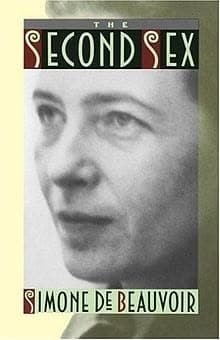
The Second Sex (Le Deuxième Sexe)

Beauvoir's 1949 study argues that 'woman' is not a natural fact but a historical situation: one is not born a woman but becomes one, through the internalization of a patriarchal gaze that defines femininity as lack, immanence, and otherness. Its distinctive mechanism is the application of existentialist categories—transcendence and immanence, subject and object, freedom and facticity—to the lived experience of women across biology, history, myth, and social roles. The book's central claim is that women's oppression consists in being consigned to immanence while men monopolize transcendence, and that liberation requires economic independence and the assumption of freedom.
Key Insights
✦What is the central argument of The Second Sex, and what does it reject?
The central argument is that 'woman' is not a natural or eternal essence but a historical situation produced by patriarchy. Beauvoir's famous formulation—that one is not born but becomes a woman—rejects the idea that femininity is a biological destiny or a psychological given. Drawing on existentialist categories, she argues that women have been consigned to immanence, the repetitive, inward-looking maintenance of life, while men have monopolized transcendence, the projection toward projects and freedom. What the book rejects is both biological determinism and the complacent humanism that treats 'Man' as the universal subject while relegating women to the status of the Other. Liberation, for Beauvoir, requires economic independence and the assumption of freedom, not merely formal legal equality.
✦How did the first English translation distort Beauvoir's argument, and what did the 2009 retranslation change?
H. M. Parshley's 1953 translation was severely abridged, cutting roughly a third of the original text, and his rendering of Beauvoir's existentialist vocabulary was often imprecise. The 2009 translation by Constance Borde and Sheila Malovany-Chevallier was presented as the first integral English version, reinstating the excised material, particularly in the History and Myths sections . The retranslation also sought to correct Parshley's handling of philosophical terms, though it has itself drawn criticism for inconsistency in rendering intertextual references and for a prose style that some reviewers found stilted . The translation history matters because the book's reception in the Anglophone world was shaped for over half a century by an abridged and philosophically imprecise version.
✦How has The Second Sex been critiqued by Black feminist and postcolonial scholars?
Kathryn Sophia Belle's Beauvoir and Belle argues that while The Second Sex was comparatively well received by radical Black women, Beauvoir's framework was marred by its acceptance of a neo-Kantian separation of oppressions along lines of race, sex, and class. By treating sexual oppression as a discrete analytical lens, Beauvoir inadvertently reinforced the frameworks she sought to abolish, fragmenting an experience that Black feminist thinkers had long understood as unified . Belle contends that had Beauvoir engaged with the theoretical writings of her contemporaries Claudia Jones and Lorraine Hansberry, The Second Sex would have been conceptually stronger and might have preemptively challenged the racist assumptions white American feminists brought to second-wave movements.
✦What is the most common misreading of 'one is not born, but rather becomes, a woman'?
The most persistent misreading takes the phrase as a celebration of gender as a free-floating performance, as if Beauvoir were claiming that women can simply choose their identity. But the 'becoming' in Beauvoir is not voluntary; it is the process by which a girl is shaped by external forces—family, education, myth, social expectation—into the situation of womanhood. The sentence appears in a chapter on childhood, describing how a girl is taught to see herself as the Other, as relative to men. A related error treats the book as a straightforward proto-constructionist manifesto, when Beauvoir's argument depends on the tension between facticity and freedom: one becomes a woman under conditions one did not choose, and liberation consists in taking up those conditions rather than escaping them.
✦How does The Second Sex relate to Sartre's philosophy, and does Beauvoir merely apply his categories?
Beauvoir draws heavily on Being and Nothingness, but the relationship is one of critical appropriation rather than simple application. Sartre's ontology treats freedom as a universal structure of consciousness, but Beauvoir shows that freedom is differentially situated: women have been denied the conditions under which transcendence is possible. This is a substantive revision, not an illustration. As one scholarly analysis notes, unlike Being and Nothingness, The Second Sex does not postulate an absolute human freedom disconnected from social realities; for the woman Beauvoir describes, it makes a real difference whether she scrubs pots or writes, creates, or engages in political action . The book thus transforms existentialist categories by embedding them in a historical and material analysis of oppression.
✦What was the book's initial reception, and why did it take decades for its philosophical rigor to be recognized?
The book was an immediate commercial success in France, selling 20,000 copies in its first week, but its reception was marked by scandal and condescension . Hannah Arendt, asked to report on it for an American publisher, admitted she did not like the book and predicted it would succeed only because it filled a demand for a 'Kinsey report on the female' . Arendt's complaint that the philosophical categories functioned like 'preconceived notions' was, as later scholarship has noted, partly a product of Parshley's inability to render Beauvoir's philosophical vocabulary in English . The book's philosophical dimensions were long overshadowed by its reputation as a scandalous bestseller about sex, and serious scholarly engagement with its existentialist framework lagged behind its popular influence.
✦What is the significance of the book's structure, moving from biology and history to myth and lived experience?
The structure is argumentative, not merely organizational. Beauvoir begins by dismantling the purported biological, psychoanalytic, and historical materialist explanations of woman's 'nature,' showing that each mistakes a situation for a destiny. The section on myths examines how literature and culture have constructed woman as the eternal Other—the muse, the femme fatale, the mother—revealing that these images serve masculine fantasy rather than describing women's lives. Only after this demolition does Beauvoir turn to 'lived experience,' the concrete accounts of childhood, marriage, motherhood, and old age that constitute the book's most original contribution. The sequence enacts the book's method: before women's experience can be described, the accumulated weight of myth and pseudo-science must be cleared away.
Wealthy Psyche is an intellectual archive. We do not host, distribute, or sell book copies — physical or digital. We provide structured knowledge to help you think better, faster.