


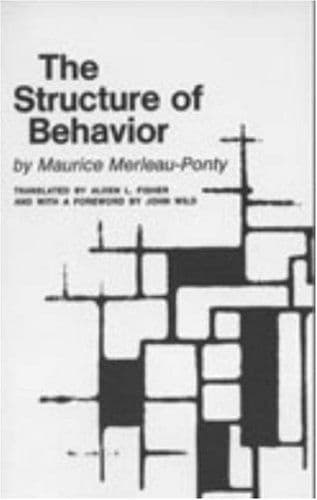
The Structure of Behavior
Merleau-Ponty's first book argues that behavior cannot be explained by either physiological mechanism or intellectualist consciousness, but must be understood as a structured, meaningful whole. Drawing on Gestalt psychology and the neurological evidence of his time, he shows that the organism and its environment form a dialectical relation: behavior is neither a sum of reflexes nor a product of pure thought, but a form that organizes itself in response to situations. The book's central claim is that there are three irreducible orders—physical, vital, and human—each with its own structure, and that the human order emerges through the integration of the lower ones without being reducible to them.
Key Insights
✦What is the central claim of The Structure of Behavior, and what does it reject?
The central claim is that behavior is neither a sum of reflex mechanisms nor a product of a constituting consciousness, but a structured, meaningful whole that organizes itself in relation to an environment. Merleau-Ponty argues that there are three irreducible orders—the physical, the vital, and the human—and that each exhibits a form or structure that cannot be reduced to the one below it . He rejects both classical reflex physiology, which treats behavior as a chain of isolated stimulus-response pathways, and intellectualist psychology, which treats it as the imposition of mental categories on chaotic sensation. The organism's relation to its milieu is dialectical: the environment solicits a response, but the response reorganizes the organism's situation, and the form of this interaction is what behavior is.
✦What role does Gestalt psychology play in the book's argument?
Gestalt psychology is the book's primary scientific interlocutor and the source of its central concept of form. Merleau-Ponty draws on the Gestaltists' demonstrations that perception and behavior are organized wholes, not aggregates of discrete elements, to argue that structure is a fundamental feature of reality rather than a subjective construction . However, he criticizes the Gestaltists for reifying forms as transcendent realities rather than treating them as phenomena of perceptual consciousness . The Gestaltist's fundamental error, on Merleau-Ponty's reading, is to treat forms as things in the world rather than as the very structure of the organism-environment relation. His appropriation of Gestalt theory is thus critical and transformative, not merely receptive.
✦How does the book's account of the three orders relate to later phenomenology?
The three orders—physical, vital, and human—provide the ontological framework that Merleau-Ponty would develop throughout his career. The human order is not a separate substance but an integration of the vital, which in turn integrates the physical; each higher order reorganizes the lower without abolishing it. This structure of hierarchical integration anticipates the account of the lived body in Phenomenology of Perception (1945), where the body is both a physical organism and the subject of perception . It also anticipates the ontology of the flesh in The Visible and the Invisible, where the intertwining of body and world is generalized into a conception of being as a single fabric with multiple levels of structure . The Structure of Behavior is thus the seedbed of Merleau-Ponty's entire philosophical development.
✦What is the publication and translation history of the work?
The Structure of Behavior was first published in French as La Structure du comportement by Presses Universitaires de France in Paris in 1942 . The first English translation, by Alden L. Fisher, was published by Beacon Press in Boston in 1963 . A paperback edition from Beacon Press followed in 1967, and Duquesne University Press issued a reprint in 1983 . The English edition runs xxviii + 256 pages and includes Fisher's introduction . The translation made Merleau-Ponty's first book accessible to Anglophone readers, though it has been criticized for occasionally obscuring the technical precision of the French original. The work remains less widely read than Phenomenology of Perception but is increasingly recognized as essential for understanding Merleau-Ponty's philosophical development.
✦How was the book received, and what is its place in Merleau-Ponty's oeuvre?
Reception was initially modest, as the book was Merleau-Ponty's doctoral thesis and was overshadowed by the phenomenology of perception that followed it. Taylor Carman notes that Merleau-Ponty's influence on philosophy, psychology, and cognitive science has been 'solid and steady,' and that his descriptions of perceptual and bodily phenomena in terms of 'structures' begin with this first book . Recent scholarship has increasingly recognized The Structure of Behavior as crucial for understanding Merleau-Ponty's critique of both mechanism and intellectualism, and his appropriation of Gestalt theory . Francisco Varela conceived his theory of embodied cognition as an elaboration of Merleau-Ponty's phenomenology, and the early book's account of the organism-environment relation anticipates enactivist themes .
✦What is a common misconception about the book's relationship to behaviorism?
A frequent misconception is that the book's title signals an endorsement of behaviorism, the psychological school that restricts psychology to observable behavior. Merleau-Ponty's target is precisely the behaviorist reduction of behavior to stimulus-response mechanisms. He is interested in behavior as a meaningful structure, not as a collection of conditioned reflexes. The book's engagement with figures like Watson and Pavlov is critical: Merleau-Ponty argues that even the simplest reflex is conditioned by the global state of the organism and its relation to a situation, and that the linear model of stimulus-response cannot account for the variability and adaptability of behavior . The title's 'structure' is meant to displace the behaviorist vocabulary of stimulus and response with a vocabulary of form and meaning.
Wealthy Psyche is an intellectual archive. We do not host, distribute, or sell book copies — physical or digital. We provide structured knowledge to help you think better, faster.