


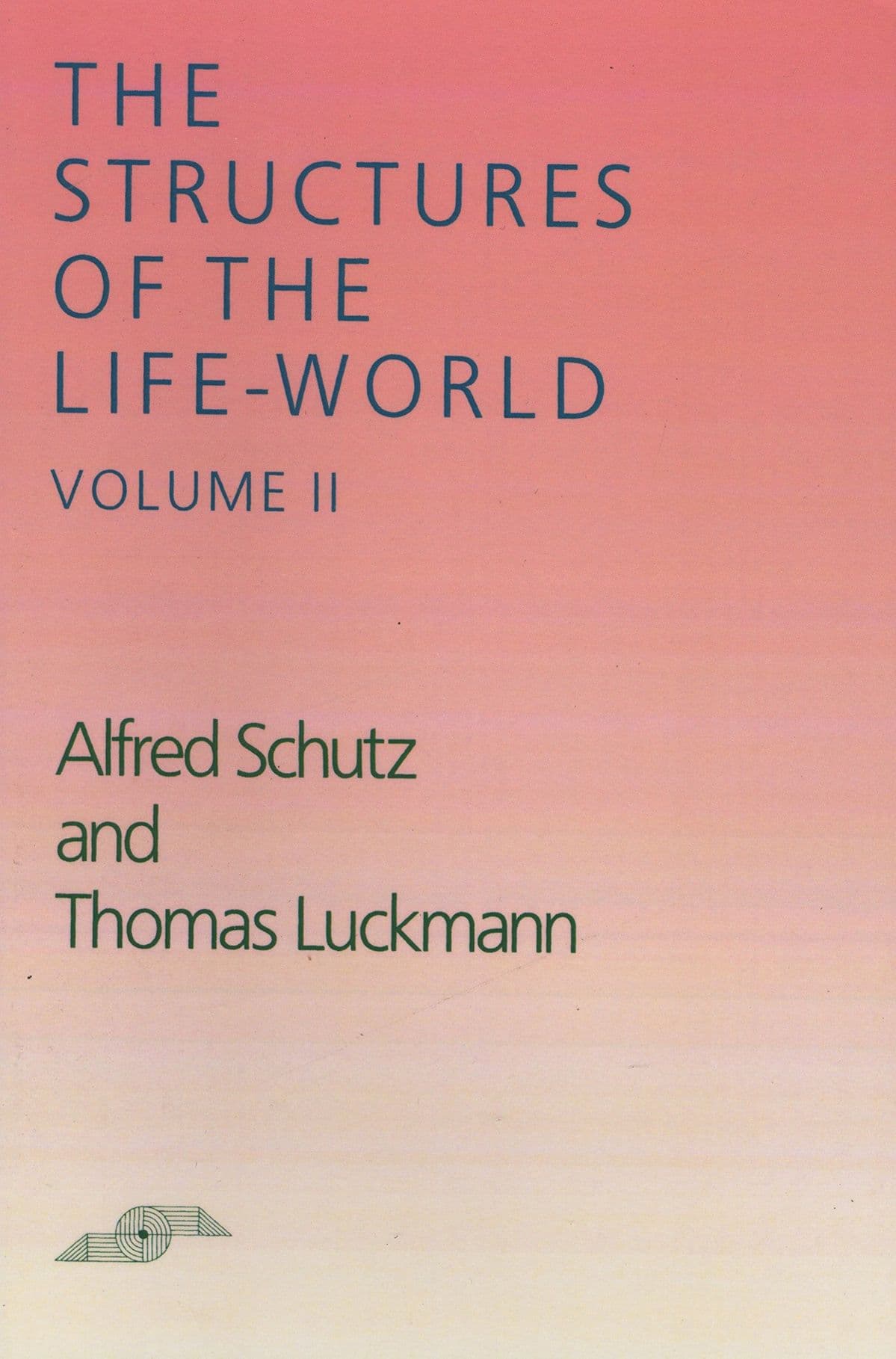
The Structures of the Life-World
Schutz's central project, left unfinished at his death and completed by his student Thomas Luckmann, is a systematic description of the everyday life-world as the unquestioned ground of all social experience. The book argues that the life-world is not a construct of transcendental philosophy but the paramount reality of the natural attitude, structured by the stock of knowledge at hand, typifications, and the basic We-relationship. Its method is a constitutive phenomenology of the natural attitude, tracing how subjective meaning becomes objective social reality without abandoning the primacy of intersubjectivity as a given datum.
Key Insights
✦What is the central claim of The Structures of the Life-World, and what does it reject?
The central claim is that the everyday life-world is the paramount reality of the natural attitude, and that its structures can be described without recourse to transcendental constitution. Intersubjectivity is not a problem to be solved but an unquestioned datum: we are born into a world already shared with others, and the We-relationship is the foundational structure of social experience . The book rejects the Husserlian project of deriving intersubjectivity from the solitary transcendental ego. Schutz had already argued that transcendental phenomenology fails to constitute genuine intersubjectivity, and this work pursues instead a constitutive phenomenology of the natural attitude, analyzing how subjective meaning becomes objective social reality through typification and the stock of knowledge .
✦What is the editorial history of the book, given that Schutz died before completing it?
The book is a posthumous, unfinished work. Schutz had been working on a systematic presentation of his life-world analysis when he died in 1959, having completed only one book during his lifetime, The Phenomenology of the Social World (1932) . His student Thomas Luckmann took up the manuscripts, continued and edited them, and the work was published in two volumes. The first English installment appeared in 1973 from Northwestern University Press, translated by Richard M. Zaner and H. Tristram Engelhardt, Jr. . The German edition, Die Strukturen der Lebenswelt, followed in 1979 and 1982 . The English translation thus preceded the German publication of the edited manuscript, a reversal of the usual order that reflects the work's complicated textual history.
✦How does the book relate to The Phenomenology of the Social World?
The Structures of the Life-World extends the programme of Schutz's 1932 book but with a broader scope. The earlier work focused on the constitution of social meaning in consciousness and on the foundations of Weberian interpretive sociology. The later work, shaped by Luckmann's editorial hand, aims at a comprehensive description of the life-world as a whole: its dimensions, its stratification into provinces of reality, and its structures of relevance and typification . A contemporary reviewer described the book as the lifelong project of a great thinker, bringing together themes that had been scattered across his Collected Papers and manuscripts into a single systematic presentation . It is the culmination rather than a revision of Schutz's phenomenological sociology.
✦How was the English edition received by reviewers?
Contemporary reviews acknowledged the book's significance while noting the difficulties of its posthumous, unfinished character. Hwa Yol Jung, reviewing in the American Political Science Review, described it as 'the first installment of the originally unfinished manuscripts of Alfred Schutz completed by his student, Thomas Luckmann,' and characterized it as a 'magnum opus' that took many years of labor from both authors . The review recognized Schutz's project as 'an archaeology of social reality or the everyday life-world as the intersubjective world,' and emphasized the importance of his conceptualization of social reality for the human sciences . The book was not a popular success but was received as a major contribution to phenomenological sociology and to the foundations of interpretive social theory.
✦What role did Thomas Luckmann play in shaping the final text?
Luckmann's role was substantial. He was Schutz's student and collaborator, and after Schutz's death he took the unfinished manuscripts and completed them for publication. The exact extent of Luckmann's contribution is not easily separable from Schutz's, since the work was assembled from manuscripts in varying states of completion. The BnF catalogue describes the work as 'an unfinished essay written in German by Alfred Schutz, continued and edited in two volumes posthumously by Thomas Luckmann' . Luckmann's own intellectual trajectory, including his later collaboration with Peter Berger on The Social Construction of Reality, was shaped by this engagement with Schutz's life-world analysis, which helped make Schutz's phenomenology influential in Anglophone sociology .
✦What is a common misconception about the book's relationship to Husserl?
A frequent misconception is that the book represents a straightforward application of Husserlian transcendental phenomenology to sociology. In fact, the book's method is deliberately a 'constitutive phenomenology of the natural attitude,' not a transcendental one. Schutz accepted Husserl's analyses of consciousness and intentionality but rejected the transcendental reduction as a foundation for social theory, arguing that intersubjectivity is a given of the natural attitude rather than something constituted by a solitary ego . The Structures of the Life-World thus draws on Husserlian method while departing from Husserlian metaphysics. The life-world it describes is the everyday world we inhabit before any philosophical reflection, not a constituted product of transcendental consciousness.
Wealthy Psyche is an intellectual archive. We do not host, distribute, or sell book copies — physical or digital. We provide structured knowledge to help you think better, faster.