


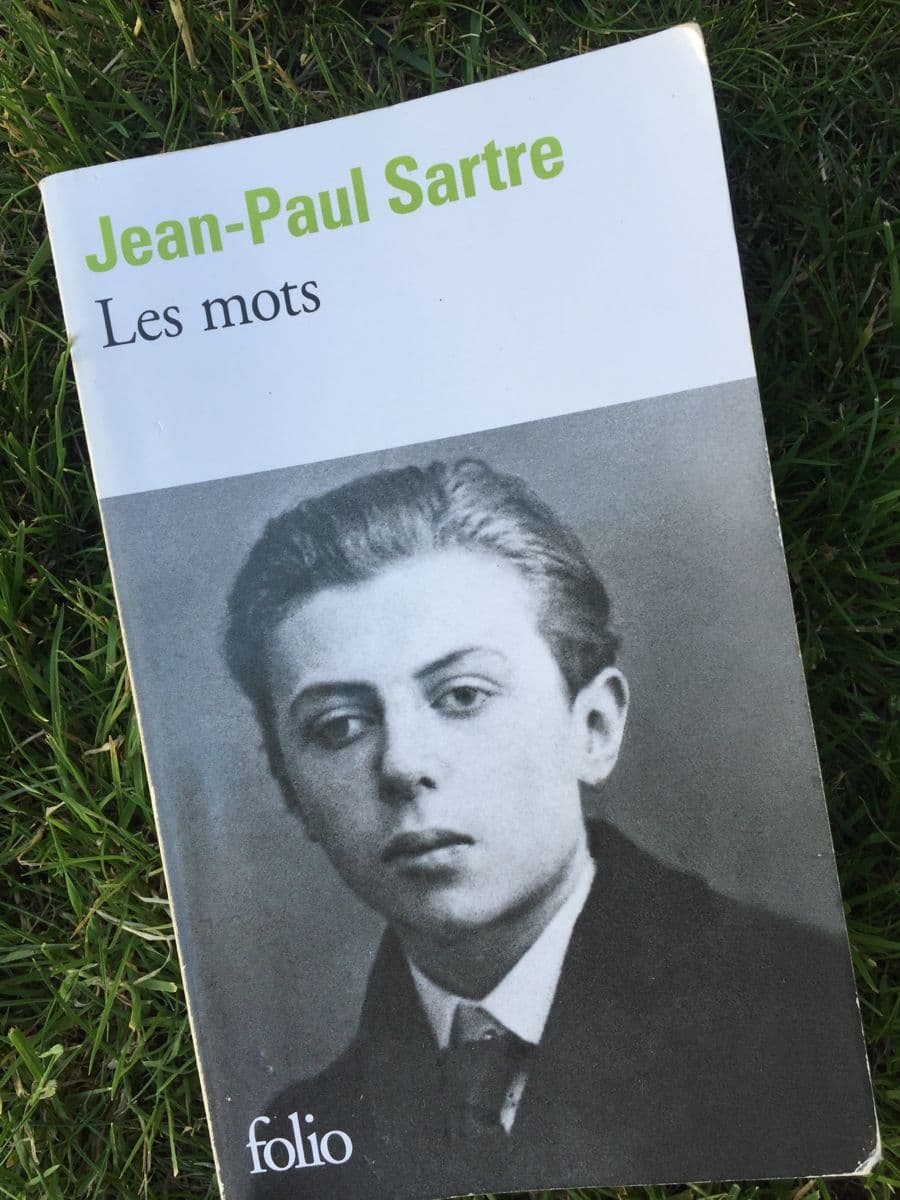
The Words (Les Mots)
Sartre's 1964 autobiography of his first ten years is not a nostalgic memoir but an act of demolition. Its central mechanism is the retrospective unmasking of a 'vocation' that the child Poulou was trained to believe was his destiny: surrounded by a bourgeois family that treated him as a genius, he learned to perform the role of a future writer before he had anything to write. Sartre's adult narrator returns to dismantle this 'family comedy,' showing that his literary calling was an illusion imposed by a class-bound milieu, and that the only honest response is to write against the very literature that formed him.
Key Insights
✦What is the central argument of The Words, and what does it reject?
The book's central argument is that Sartre's childhood sense of literary vocation was not a discovery of his true self but an illusion manufactured by his family and class. Reared by grandparents who treated him as a prodigy and a future genius, the young Poulou learned to perform the role of a writer before he had any genuine impulse to write. The adult narrator returns to expose this 'family comedy' and the bad faith it instilled . What the book rejects is the Romantic conception of the writer as a chosen vessel with a sacred calling. Sartre does not replace this with a triumphant account of finding his true voice; he insists that even his later commitment to literature was entangled with the illusions of his upbringing, and that authentic writing requires constant vigilance against the seductions of self-image.
✦Why did Sartre, who had long dismissed autobiography as narcissistic, write one himself?
Sartre's suspicion of autobiography was rooted in his philosophy: he regarded the retrospective narrative of a life as a site of 'retrospective illusion' and bad faith, in which the narrator invents a coherent self that never existed . The Words is his attempt to write an autobiography against autobiography—to use the form while dismantling its central pretension. Marie Schmidhauser's study describes the book as an 'auto-deconstruction' of his literary vocation, mobilizing his theory of freedom against the very narrative impulse that would naturalize his past . The book is therefore not an exception to Sartre's suspicion but its most rigorous application: he writes about himself in order to demonstrate that the self one thinks one knows is a fabrication.
✦How has the book's status as a literary masterpiece been received, and what does its style accomplish?
The Words was an immediate critical and commercial success in France when Gallimard published it in April 1964, despite Sartre's contemporaneous political controversies. The press response was unanimous in its admiration, with Alain Bosquet calling it a 'masterpiece' in an open letter that also registered a note of reproach . The New York Times review described the prose as 'taut, nervous, vibrant,' mixing elaborate metaphor with a simplicity that survives translation . The style is integral to the argument: the book's elegance and wit are not ornaments but evidence of the very literary skill Sartre is interrogating. If the prose were clumsy, the critique of literary vocation would be merely resentful; because it is brilliant, the critique becomes an act of self-overcoming rather than self-exculpation.
✦What is the significance of Sartre's claim that the death of his father gave him his freedom?
The claim is paradoxical and deliberately so. Sartre's father died when he was fifteen months old, and the adult narrator interprets this absence as a liberation: without a father to impose a superego, to demand obedience or model masculinity, the child was free to construct himself without the weight of paternal authority. The book's opening pages present this absence not as a deprivation but as a condition of possibility for the 'family comedy' that followed, in which the grandfather assumed the role of indulgent patron rather than disciplinarian . The argument is characteristically Sartrean: what appears as a lack is refigured as a freedom, and the freedom is then shown to have been squandered on an illusion. The father's death enabled a freedom that the child did not know how to use.
✦How does The Words relate to Sartre's earlier philosophical work, particularly Being and Nothingness?
The book is saturated with the vocabulary and conceptual structure of Sartre's philosophy, but it applies them in a register that Being and Nothingness could not sustain. The theory of freedom developed in the earlier work—that consciousness is condemned to be free, that we are responsible for the meanings we confer on our situations—is here tested against the specific situation of a child who had no choice about the meanings imposed on him . The adult narrator's freedom consists in his ability to take up those imposed meanings and skew them in a different direction, as Whitmire argues in a study of the book's 'performative' dimension . The Words does not repudiate Being and Nothingness; it demonstrates what the abstract theory looks like when applied to a life that was already formed before the philosopher could reflect on it.
✦What is the most common misreading of The Words as an autobiography?
The most persistent misreading takes the book at face value as a confession of disillusionment, in which Sartre admits that his literary vocation was worthless and that he has spent his life pursuing an illusion. But the book's final pages complicate this: Sartre does not abandon writing, he recommits to it on different terms. As one French study observes, the 'adieu to literature' is pronounced 'in beautiful writing,' and the book's meticulous construction and rhetorical sophistication contradict any simple renunciation . The misreading treats the book as a document of despair when it is better understood as a demonstration of how one can take responsibility for a past one did not choose. The writing of The Words is itself the proof that the vocation was not entirely an illusion, even if its original form was.
✦How do the two English translations of The Words differ, and which should readers choose?
The Words appeared in English in 1964 in two distinct translations: Irene Clephane's British version, published by Hamish Hamilton, and Bernard Frechtman's American version, published by George Braziller . Frechtman was Sartre's principal English translator and his version has generally been regarded as the standard American edition, while Clephane's has circulated in British and Commonwealth editions, including Penguin's twentieth-century classics series . The translations differ in tone and idiom, with Frechtman's often praised for its fidelity to Sartre's philosophical vocabulary and Clephane's for its fluency. Readers should be aware that the book's effects depend on the tension between the narrator's corrosive irony and the child's earnestness, and that a translation which smooths either register can obscure the book's central performance.
Wealthy Psyche is an intellectual archive. We do not host, distribute, or sell book copies — physical or digital. We provide structured knowledge to help you think better, faster.