


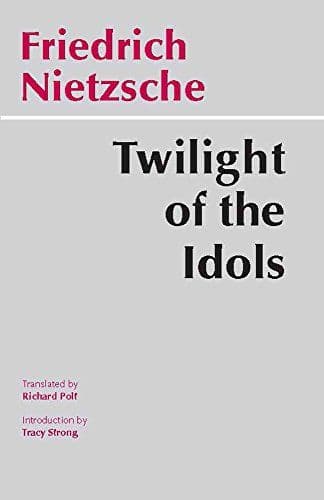
Twilight of the Idols
Written in a week in 1888 and published after Nietzsche's collapse, this book is his self-described 'handbook' of philosophy—a distillation of his mature thought executed with aphoristic economy and wit. Its central method is the sounding out of 'idols': the concepts, values, and institutions that Western culture has treated as eternal but that Nietzsche shows to be hollow, historically contingent, or life-denying. The famous chapter 'How the "Real World" Finally Became a Fable' compresses the history of metaphysics into six stages, ending not with a triumphant atheism but with the abolition of the distinction between true and apparent worlds altogether.
Key Insights
✦What is the central method of Twilight of the Idols, and what does the title's metaphor of 'sounding out' idols mean?
Nietzsche's method in this book is diagnostic rather than systematic. The title's image—philosophizing with a hammer—is often misread as a call to smash, but Nietzsche describes the hammer as a tool for sounding out: striking an idol to hear whether it rings hollow or solid . The 'idols' are the eternal verities of Western culture: the soul, God, reason, morality, the 'real world' of metaphysics. Nietzsche's procedure is to tap each one, expose its historical and psychological origins, and demonstrate that what appeared eternal is in fact contingent, what appeared solid is empty. The book's brevity and wit are integral to this method: the aphorism isolates a single idol and delivers a decisive blow without the scaffolding of a treatise.
✦How has the book's reputation changed, and why was it once dismissed as a symptom of decline?
It was once common to treat Twilight as evidence of Nietzsche's mental deterioration in 1888, a 'noisy résumé' of opinions he had expressed before. The Cambridge edition's introduction notes that this view is now generally rejected, and that Twilight represents 'a pinnacle of aphoristic economy and wit, an example of Nietzsche's mature style at its very best' . Thomas Brobjer's 2024 study goes further, positioning the book as a rich and stimulating work that contains and summarizes much of Nietzsche's late philosophy, especially the unfinished Revaluation of All Values . Duncan Large's 1998 translation presented Twilight as an independent work rather than a mere supplement, mirroring increased scholarly interest in its distinctive achievement .
✦What is the significance of the chapter 'How the "Real World" Finally Became a Fable'?
This six-stage chapter is the book's most concentrated philosophical statement, compressing the history of metaphysics into a single page. Nietzsche traces the idea of a 'true world' from Plato through Christianity to Kant, showing how each stage made the concept more refined and less accessible, until it became a mere postulate with no relation to life. The sixth stage does not celebrate the triumph of the 'apparent' world over the 'true' one; it announces that with the abolition of the true world, the apparent world has also been abolished. The distinction itself collapses, and what remains is neither metaphysics nor its negation but a world without the need for such antitheses. The chapter's compression is the point: it demonstrates how a vast philosophical tradition can be dismantled in a few paragraphs.
✦How does Twilight of the Idols relate to The Antichrist and Ecce Homo, the other works of Nietzsche's final year?
The three books of 1888 form a constellation rather than a sequence. The Antichrist is the negative, prosecutorial half of the projected Revaluation of All Values, written with a ferocity that the Cambridge editors contrast with Twilight's 'graceful, light, and even effervescent' intensity . Ecce Homo is the autobiographical companion, in which Nietzsche recounts how he became what he is. Twilight occupies a distinct position: it is the 'handbook,' the concise summary of the philosophy that the other two books presuppose or dramatize. Brobjer argues that Twilight contains and summarizes much of Nietzsche's late philosophy, and that its construction was deeply influenced by the Revaluation project, a theme he says has been ignored by almost all previous commentators .
✦What is the most common misreading of the book's title and approach?
The most persistent misreading takes 'philosophizing with a hammer' as evidence that Twilight is a work of destruction, a gleeful smashing of cherished values. But the hammer is a diagnostic instrument, not a weapon. Nietzsche strikes the idols to hear what they sound like—whether they are hollow or solid—and the book's tone is often playful rather than merely polemical. A related error treats the book as a mere summary of positions Nietzsche had argued elsewhere, as if its value lay only in convenience. The style is inseparable from the argument: the aphoristic compression is itself a demonstration of the intellectual economy Nietzsche associated with health and strength, in contrast to the laborious system-building he regarded as a symptom of weakness.
✦What translation issues affect English editions of Twilight of the Idols, and which should readers choose?
The book has a complex English translation history. Thomas Common produced the first English version in 1896, followed by A. Ludovici in the Oscar Levy edition of 1909–11, Walter Kaufmann in 1954, and R. J. Hollingdale in 1968 . Duncan Large's 1998 Oxford edition was a significant intervention: the reviewer in the Journal of Nietzsche Studies praised Large for creating 'a little more space than other translators' and for a clarity important for both philosophical students and lay readers, while noting that his edition presents Twilight as an independent work and draws on the Colli-Montinari Studienausgabe for its notes . The Cambridge edition, translated by Judith Norman and edited by Aaron Ridley, is widely used in academic contexts. Readers should be aware that the book's wit and concision are central to its effect, and that translations which smooth or expand Nietzsche's prose can obscure the very quality that makes Twilight distinctive.
Wealthy Psyche is an intellectual archive. We do not host, distribute, or sell book copies — physical or digital. We provide structured knowledge to help you think better, faster.