


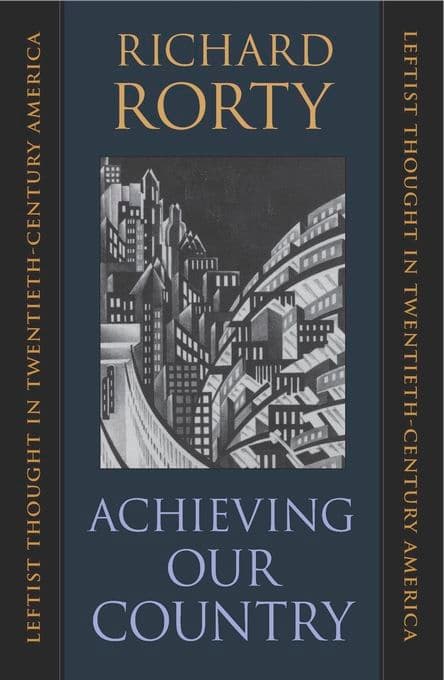
Achieving Our Country: Leftist Thought in Twentieth-Century America
Rorty's central thesis is that the American Left abandoned the reformist, patriotic tradition of Whitman and Dewey for a cultural Left absorbed in academic 'High Theory' and the politics of stigma, and that this retreat ceded the public sphere to the Right. The book's distinctive mechanism is a historical diagnosis of the split between the Old Left and the New Left after the Vietnam War, arguing that the antiwar movement's paradoxical victory produced a generation of theorists who critique America from a distance rather than participating in the civic work of shaping its future. Rorty calls for a revival of national pride as a spur to social democratic reform.
Key Insights
✦What is Rorty's distinction between the 'reformist left' and the 'cultural left'?
Rorty's central polemic contrasts two lefts. The reformist left, exemplified by labor organizers, New Deal legislators, and civil rights campaigners, fought for economic security and legal equality through practical political engagement. The cultural left, which rose to dominance in the academy after the 1960s, focuses on stigma, identity, and 'deep and hidden psychosexual motivations' rather than money and greed . Rorty does not deny the reality of cultural injuries; he argues that the cultural left's theorizing about America from a distance has made it politically ineffective, leaving the public sphere to the Right. The book's call is for the cultural left to rejoin the reformist tradition, not to abandon its concerns but to subordinate them to a shared project of social democratic renewal.
✦Why did the book become a viral sensation after the 2016 election?
Three days after the 2016 presidential election, a law professor tweeted three paragraphs from Achieving Our Country describing a predicted populist backlash. Rorty wrote that 'something will crack,' that the nonsuburban electorate would look for a strongman to vote for, and that gains made by black and brown Americans and homosexuals would be wiped out . The passage seemed to anticipate Trump's victory with unnerving precision. The book's Amazon ranking soared, it went out of stock, and Harvard University Press reprinted it for the first time since 2010 . The viral moment transformed a relatively neglected political tract into a widely read prophecy, though the book's argument is broader than its most quoted paragraphs.
✦How was the book received when it was first published in 1998?
The initial reception was mixed and politically charged. The New York Times critic Christopher Lehmann-Haupt called it 'philosophically rigorous' but objected to Rorty's strongman warning as 'a form of intellectual bullying' . Conservative commentators reacted with hostility: George Will wrote that the book 'radiates contempt for the country,' while David Brooks accused Rorty of being a 'pseudo-deviant' who posed as a critic of academic radicals while really congratulating them . On the left, Alan Wolfe in The Chronicle of Higher Education found the 'cultural Left' versus 'reformist Left' distinction useful, while Harold Meyerson in Dissent praised Rorty's insight into the academic left's 'essentially nonpolitical' worldview . The split reception foreshadowed the book's later life as a Rorschach test for debates about left strategy.
✦What does Rorty mean by calling for national pride, and is this a form of nationalism?
Rorty's national pride is not ethnic or chauvinist nationalism but a civic emotion: pride in a country's capacity for self-improvement and in the reform movements that have made it more just. He draws on Whitman and Dewey to argue that hope for America is a precondition of effective political action; without it, critique becomes a form of withdrawal. He is careful to distinguish this from the 'knowingness' of academic leftists who treat American hypocrisy as grounds for despair. The proposal is closer to a 'civic religion' of shared social hope than to flag-waving patriotism . Critics on the right still heard condescension in Rorty's tone, and critics on the left heard an accommodation to Cold War liberalism, but the argument itself is about the motivational conditions of reform, not about American exceptionalism.
✦How does Achieving Our Country relate to Rorty's earlier Philosophy and the Mirror of Nature?
The relationship is often described as a puzzle. Philosophy and the Mirror of Nature (1979) dismantled foundationalist epistemology and any context-transcendent standpoint from which to justify political claims. Achieving Our Country (1998), written nearly two decades later, urges a robustly normative social democratic politics. Dissent magazine posed the question directly: is Rorty's 'weak' antifoundationalist pragmatism adequate to the social democratic goals he came to embrace ? Rorty's answer, implicit in the book, is that anti-foundationalism liberates political hope from the need for philosophical guarantees. Dewey's pragmatism had shown that philosophy and progressivism were compatible; Rorty's wager was that his own anti-representationalism could serve the same function. Whether the wager succeeds remains contested, but Achieving Our Country is the most sustained attempt to show what Rorty's philosophy looks like when turned toward political practice.
✦What role do Whitman and Dewey play in the book's argument?
Whitman and Dewey serve as the twin icons of Rorty's reformist tradition. Whitman supplies the poetic imagination of American democracy as an unfinished project, a nation that can be 'achieved' rather than merely celebrated or condemned. Dewey supplies the philosophical framework: pragmatism as a theory of inquiry and education oriented toward social reconstruction, and the conviction that democratic life requires continuous renewal through communication and participation. Rorty places them together in the book's opening chapter as representatives of a national pride that is forward-looking rather than nostalgic. Notably, Rorty's own family had personal ties to Dewey, who was a friend of his parents; this biographical connection gives the invocation of Dewey a particular intimacy, though the argument stands on its own .
Wealthy Psyche is an intellectual archive. We do not host, distribute, or sell book copies — physical or digital. We provide structured knowledge to help you think better, faster.