


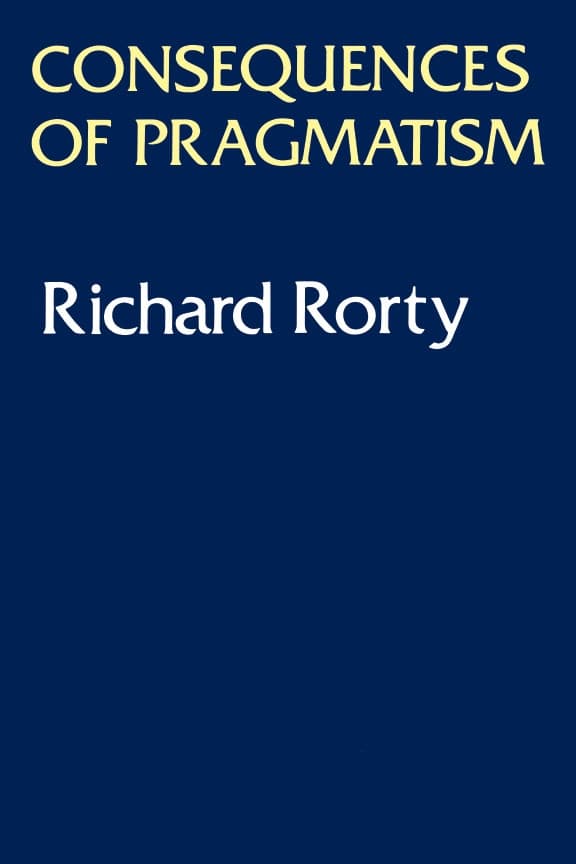
Consequences of Pragmatism: Essays, 1972-1980
Rorty's central thesis across these essays is that the American pragmatist tradition—especially Dewey—offers a way past the dead ends of modern philosophy: mind-body dualism, the foundations of knowledge, and the fact/value distinction are not perennial problems but artifacts of a representationalist picture we can abandon. The volume's distinctive mechanism is Rorty's strategy of 'overcoming the tradition' by connecting Dewey's naturalism to contemporary European developments in Heidegger, Derrida, and Gadamer, producing a revivified pragmatism that treats philosophy as a kind of writing rather than a foundational science. The title names the wager: that pragmatism's consequences are liberating rather than destructive.
Key Insights
✦What does Rorty mean by 'the consequences of pragmatism,' and why does the title matter?
The title names a wager rather than a doctrine. Rorty argues that pragmatism—particularly Dewey's version—has consequences that many philosophers fear: the dissolution of epistemology as a foundational discipline, the collapse of the fact/value distinction, and the end of philosophy's self-image as a tribunal of pure reason. The essays collected here, written between 1972 and 1980, work out those consequences across a range of topics: Dewey's metaphysics, professionalized philosophy, fictional discourse, nineteenth-century idealism, and the state of philosophy in America. The Los Angeles Times Book Review described the volume's argument as showing that 'what we consider perennial problems—mind and body, consciousness and objects, the foundations of knowledge, the fact/value distinction—are merely the dead-ends this picture leads us into' .
✦How does the essay 'Philosophy as a Kind of Writing' encapsulate Rorty's alternative to systematic philosophy?
This essay is the volume's most direct statement of Rorty's metaphilosophical alternative. Rorty argues that philosophy should be seen as a literary genre, closer to literary criticism than to science, whose task is the interpretation of interpretations rather than the discovery of truths about reality. As one Religious Studies Review endorsement put it, philosophy for Rorty is 'a form of writing, a literary genre, closer to literary criticism than anything else' . The essay's significance lies in its refusal to treat this as a demotion: if philosophy is writing, then its value lies in the new descriptions it makes possible, not in its correspondence to a non-linguistic world. This position directly anticipates the argument of Contingency, Irony, and Solidarity seven years later.
✦What role does Dewey play in this collection, and how does Rorty's reading of him differ from standard pragmatist interpretations?
Dewey is the volume's central hero, but Rorty's Dewey is not the educational reformer or the democratic theorist—he is the anti-metaphysical Dewey who dissolves traditional problems rather than solving them. The essay 'Dewey's Metaphysics' argues that Dewey's naturalism offers a way past the subject-object dualism that still traps analytic philosophy, and that Dewey's neglect by professional philosophers is a symptom of their captivity to the representationalist picture. This reading was controversial because it recruited Dewey for Rorty's own anti-foundationalist project rather than treating him as a systematic philosopher in his own right. The volume's stated aim is to connect 'the positive (and neglected) contributions of the American pragmatic philosophers to contemporary European developments,' making Dewey a precursor of Heidegger and Derrida rather than a figure in the analytic canon .
✦How does the volume engage with the analytic-continental divide, and what is Rorty's strategy?
Rorty treats the divide as a professional boundary rather than a philosophical one. The essays bring Dewey, Heidegger, Derrida, Gadamer, and Wittgenstein into the same conversation, arguing that they share a common enemy—the representationalist picture of knowledge—even though they speak different vocabularies. The essay 'Nineteenth-Century Idealism and Twentieth-Century Textualism' traces a lineage from German idealism to French deconstruction, while 'Keeping Philosophy Pure' attacks the professionalization that keeps these traditions apart. Rorty's strategy is neither synthesis nor reconciliation but redescription: he shows that analytic and continental philosophers are engaged in the same activity—coping with the world through new vocabularies—and that their mutual contempt is a failure of imagination rather than a philosophical disagreement.
✦How was the book received, and what does its reception reveal about Rorty's standing in 1982?
The reception was strong and polarized. The Review of Metaphysics called Rorty 'far and away the most provocative philosophical writer working in North America today' and insisted the book 'must be read by both those who believe that they agree and those who believe that they disagree with Richard Rorty' . The Los Angeles Times Book Review praised it as 'the best general introduction in print' to the history of modern philosophy . At the same time, the book's anti-foundationalism provoked the same charges of relativism and irresponsibility that would follow Rorty throughout his career. The volume's reception established him as a public intellectual as well as a technical philosopher, a status confirmed by the later, more accessible works like Contingency, Irony, and Solidarity.
✦What is the relationship between this collection and Philosophy and the Mirror of Nature, published three years earlier?
Consequences of Pragmatism is the application and extension of the 1979 book's diagnosis. Philosophy and the Mirror of Nature dismantled the epistemological project of grounding knowledge in accurate representations; the 1982 essays ask what follows for the practice of philosophy once that project is abandoned. The essays on Dewey, professionalized philosophy, and philosophy as writing show what Rorty thinks philosophy should become: not a foundational discipline but a form of cultural criticism that redescribes our vocabularies and opens new possibilities for action. The collection thus supplies the constructive half of the project that the earlier book had stated only negatively, and it does so in a more accessible register, which helps explain its wide readership beyond professional philosophy.
Wealthy Psyche is an intellectual archive. We do not host, distribute, or sell book copies — physical or digital. We provide structured knowledge to help you think better, faster.