


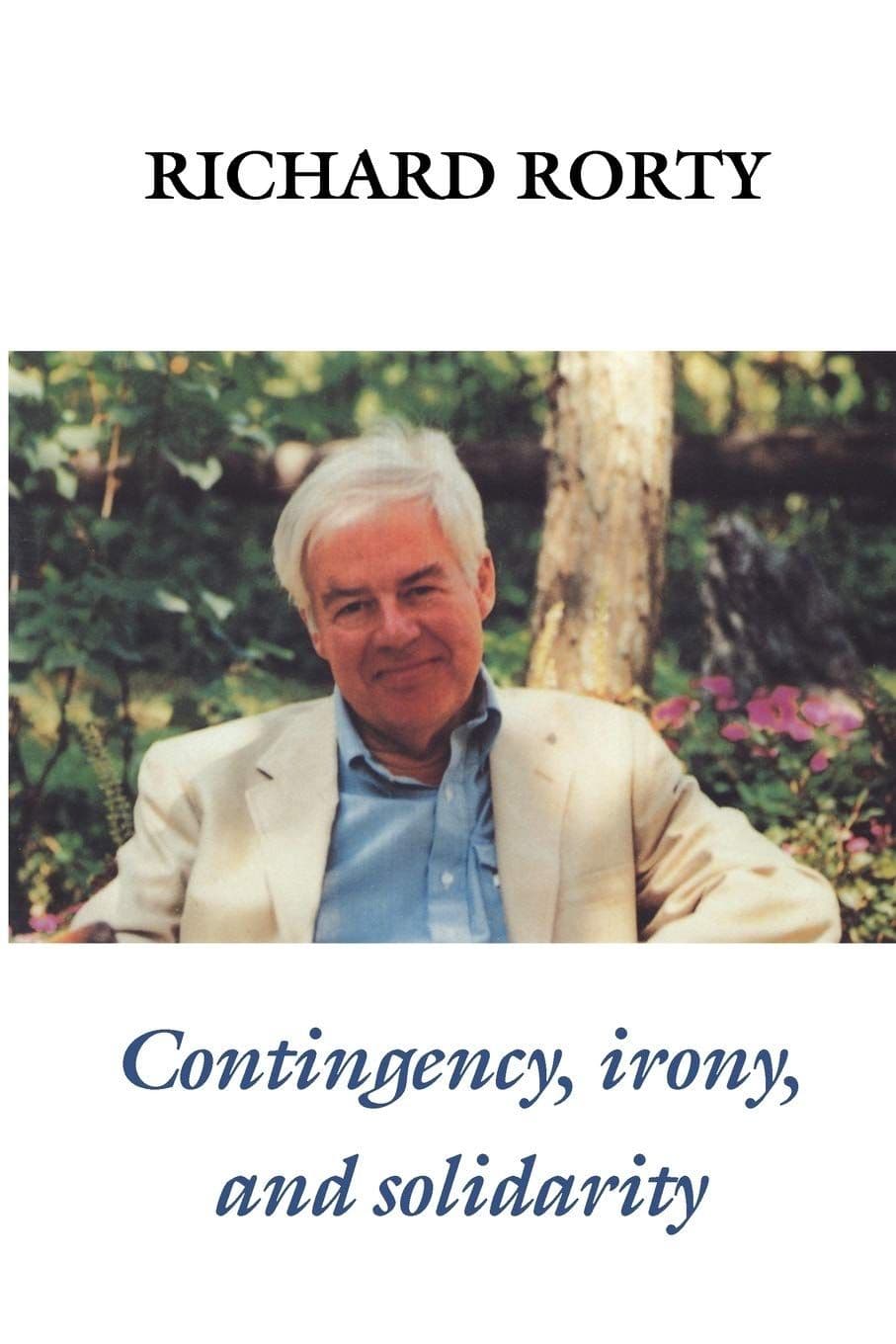
Contingency, Irony, and Solidarity
Rorty's central thesis is that the vocabulary of liberal society—truth, human nature, universal morality—is contingent and has no foundation beyond the historical accidents that produced it. The book's distinctive mechanism is the figure of the 'liberal ironist': someone who accepts the contingency of her own final vocabulary while remaining committed to reducing cruelty. Rorty argues that private self-creation through ironic redescription and public solidarity through literature must be kept separate, since the vocabulary of the ironist is useless for politics, and it is novels rather than philosophy that cultivate the imaginative identification with suffering that solidarity requires.
Key Insights
✦What is a 'final vocabulary,' and why is it central to Rorty's argument?
A final vocabulary is the set of words a person uses to justify her actions, beliefs, and life—words so fundamental that if their worth is doubted, she has no noncircular argumentative recourse. Rorty distinguishes thin terms like 'true' and 'good' from the thicker, more parochial terms like 'Christ,' 'England,' or 'the Revolution' that do most of the actual work . The concept is central because it makes contingency visible: our deepest commitments are historical artifacts, not deliverances of reason. The ironist is defined by her continuing doubt about her own final vocabulary, combined with the realization that argument within that vocabulary cannot resolve the doubt. This is what enables Rorty to separate private irony from public hope without collapsing one into the other.
✦Why does Rorty insist that irony must remain private, and what does he think happens if it enters public life?
Rorty's claim is that the ironist's redescriptive vocabulary—her private project of self-creation through new ways of speaking—has no public utility. If offered as a political program, it would either be useless (because it does not tell us what to do) or cruel (because it would humiliate those whose final vocabularies are being redescribed). The liberal ironist therefore keeps her irony private and her liberalism public, working to reduce cruelty without demanding that others adopt her ironic attitude toward their own commitments. Critics have charged that this separation is unstable, since ironists like Foucault and Derrida did in fact inspire political movements . Rorty's response is that such movements borrowed the public rhetoric of liberalism while the theorists' irony remained a private resource.
✦What role does literature play in this book, and why does Rorty privilege novelists over philosophers?
Rorty argues that solidarity is not discovered by philosophy but constructed by imaginative identification with particular suffering. Novelists like Nabokov and Orwell, he contends, succeed in awakening us to the humiliation and cruelty embedded in specific social practices and attitudes . Nabokov's attention to the barber of Kasbeam reveals cruelty in aesthetic self-absorption, while Orwell shows how political language can obscure the concrete details of suffering. Philosophy, by contrast, seeks general principles that Rorty thinks are both unavailable and unnecessary. The book's structure reflects this priority: the final third is devoted to literary analysis rather than argument, treating novels as the primary instruments by which liberal societies expand the circle of those whose suffering matters.
✦How does the book's argument relate to Rorty's earlier Philosophy and the Mirror of Nature?
Contingency, Irony, and Solidarity extends the anti-representationalism of Philosophy and the Mirror of Nature into the domains of ethics and politics. The earlier book dismantled the epistemological project of grounding knowledge in accurate representations; the later book asks what follows for liberalism once that project is abandoned. Rorty's answer is that liberalism does not need the foundations it has traditionally sought. The vocabulary of rights, human dignity, and moral obligation can be retained as a useful cultural inheritance without being justified by reference to a universal human nature. The book thus supplies the political payoff that the 1979 critique had only implied, showing how a post-foundationalist culture might still be a liberal one.
✦How was the book received, and what criticisms were most persistent?
The reception was wide and polarizing. Cambridge University Press's own review materials quote The Philadelphia Inquirer calling it a book that 'will induce intellectual tingles in the philosopher and layman alike,' and Library Journal describing Rorty as 'a major political theorist' . The most persistent criticism came from the left: that Rorty's private-public split effectively depoliticizes theory while insulating his own political commitments from scrutiny. One critic argues that Rorty rejects 'all public critiques and alternatives' while claiming to be a liberal, resulting in a 'doctrinaire intransigence' . The book's defense of liberal institutions as beyond question—'Nothing is more important than the preservation of these liberal institutions'—struck critics as a refusal to extend the ironic attitude to his own political faith.
✦What does Rorty mean by saying that language is contingent, and how does this differ from claiming that truth is relative?
The contingency of language means that the vocabularies we use to describe the world—including the vocabulary of 'truth,' 'objectivity,' and 'rationality'—are products of historical accident rather than discoveries about the nature of language or reality. Rorty draws on Nietzsche, Freud, and Wittgenstein to argue that no vocabulary is closer to reality than any other; each is a tool for coping with particular purposes . This is not relativism in the sense that any belief is as good as any other. Rorty insists on the difference between the claim that our descriptions are historically contingent and the claim that they are arbitrary or interchangeable. The liberal ironist still prefers liberal descriptions to illiberal ones, but she does so without claiming that the universe endorses her preference.
Wealthy Psyche is an intellectual archive. We do not host, distribute, or sell book copies — physical or digital. We provide structured knowledge to help you think better, faster.