


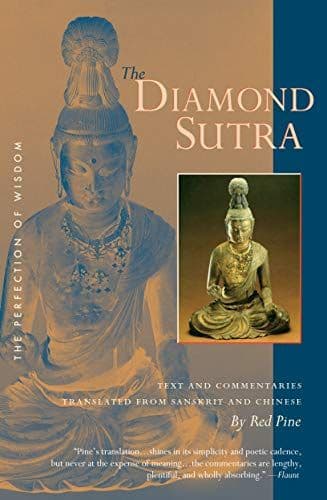
Diamond Sutra (attributed tradition)
The Diamond Sutra is a concise Prajñāpāramitā scripture structured as a dialogue between the Buddha and Subhūti, and its distinctive mechanism is the relentless use of a paradoxical formula—'A is not A, therefore it is A'—to dismantle every category the mind grasps, including the Buddha's own teaching. Unlike the Heart Sutra's compressed negation, the Diamond Sutra enacts its pedagogy through repetition, applying the formula to merit, beings, the Buddha's physical form, and the Dharma itself. Its central claim is that the bodhisattva must give without dwelling on anything, and that true perception of the Buddha is perceiving the Dharma, not the physical body.
Key Insights
✦What is the Diamond Sutra's central pedagogical mechanism, and how does it differ from other Prajñāpāramitā texts?
The Diamond Sutra's signature mechanism is a paradoxical formula that recurs throughout the text: 'A is not A, therefore it is A.' The Buddha applies this to sentient beings, merit, the Dharma, and even enlightenment itself . This is not a logical error but a deliberate pedagogical device designed to short-circuit the mind's habit of reifying concepts. Where the Heart Sutra compresses emptiness into a single negation of all categories, the Diamond Sutra enacts the dismantling through repetition, training the listener to release each category as it arises. The text's title signals this function: its teachings are like a diamond that cuts through all dualistic thought, releasing the practitioner from attachment to objects .
✦What does the Diamond Sutra teach about the bodhisattva's practice of giving?
The sutra's most sustained practical instruction concerns dāna (giving). The bodhisattva must give 'without dwelling' on anything—without attachment to forms, sounds, smells, tastes, touch, or mental objects . The reasoning is that merit accumulated through attached giving is measurable and limited, whereas giving without dwelling produces merit as immeasurable as space itself . This teaching is not merely ethical advice but an application of the text's core insight: if all phenomena are empty of inherent existence, then the giver, the gift, and the recipient lack fixed identities, and giving that recognizes this is 'non-dwelling' giving. The Diamond Sutra thus translates the abstract doctrine of emptiness into a concrete practice of generosity.
✦Why does the Diamond Sutra say that seeing the Buddha's physical form is not seeing the Buddha?
One of the text's most famous passages addresses the Buddha's thirty-two major marks, the physical characteristics that tradition holds distinguish a Buddha from ordinary beings. The sutra argues that if the Buddha could be perceived through these marks, then a universal monarch—who possesses the same marks—would also be a Buddha . Therefore, 'he who sees the Buddha in his physical form does not really see the Buddha' . True perception of the Buddha is perception of the Dharma, the transcendental dimension of Buddhahood that is neither coming nor going, neither here nor there. This teaching was decisive for Zen, which used it to justify its emphasis on direct insight over devotion to the Buddha's person or relics.
✦What is the textual history of the Diamond Sutra, and is it an Indian composition?
The Diamond Sutra was composed in India, with the fourth century CE being a commonly cited date . It is one of the shorter Prajñāpāramitā sutras, part of a literature that developed between the first century BCE and fifth century CE . The text was translated into Chinese multiple times, most influentially by Kumārajīva in 402 CE; this translation became the standard version in East Asia and the basis for most English renderings. A printed copy of Kumārajīva's Chinese version, discovered at Dunhuang and dated to 868 CE, is the oldest existing printed book in the world . The Sanskrit original also survives, though the Chinese and Tibetan translations are the primary witnesses for most of its transmission history.
✦How did the Diamond Sutra become foundational to Zen Buddhism?
The Diamond Sutra's role in Zen is inseparable from the legend of Hui-neng (638–713), the Sixth Patriarch, who is said to have attained enlightenment upon hearing a recitation of the sutra as a poor, illiterate woodcutter . Whether or not this account is historically accurate, it established the sutra as the textual touchstone of the Zen tradition's origin story. The text's teaching that the Buddha is not to be perceived through physical form, and its insistence that even the scriptures are 'empty,' resonated with Zen's characteristic emphases: 'A special transmission outside the scriptures; no dependence upon words and letters' . The Diamond Sutra provided canonical warrant for Zen's anti-scriptural rhetoric while remaining itself a scripture, a paradox the tradition embraced.
✦What are the major English translations of the Diamond Sutra, and how do they differ?
Max Müller's 1894 translation in the Sacred Books of the East was the first scholarly English rendering, made directly from the Sanskrit . Edward Conze's 1958 translation, revised in 1973, became the standard scholarly version for decades and remains widely cited. Red Pine's 2001 translation includes extensive commentary drawn from Chinese and Tibetan sources, offering a more accessible entry point. Thich Nhat Hanh's The Diamond That Cuts Through Illusion presents the sutra with a practice-oriented commentary . A significant scholarly intervention is Paul Harrison's argument that Kumārajīva's Chinese translation may have rendered a key term in a way that produced the 'A is not A' formula, and that an equally valid alternative rendering would not have generated this paradoxical structure . Readers should be aware that the text's most famous feature may be partly an artifact of translation.
Wealthy Psyche is an intellectual archive. We do not host, distribute, or sell book copies — physical or digital. We provide structured knowledge to help you think better, faster.