


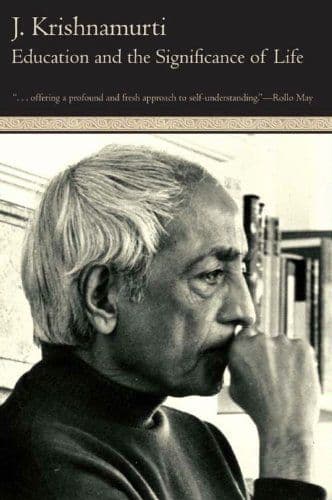
Education and the Significance of Life

Krishnamurti's central argument is that the true purpose of education is not the acquisition of knowledge or the cultivation of conformity, but the awakening of intelligence—the capacity to perceive what is without the distortion of fear, authority, and conditioning. The book argues that the educator must first understand himself, since 'what he is, that he imparts,' and that only a transformation in the individual can bring about a different society. Right education cultivates self-knowledge and right relationship, not technical efficiency or competitive ambition.
Key Insights
✦What is the central claim of Education and the Significance of Life, and what does it reject?
Krishnamurti argues that the purpose of education is not to produce efficient workers, conformists, or achievers, but to awaken intelligence—the capacity to perceive what is without the distortion of fear, authority, and conditioning. The book rejects the assumption that education is primarily about the acquisition of knowledge, the development of technique, or preparation for a career. It also rejects discipline, conformity, and the authority of the teacher as means to this end, since these only suppress fear rather than eradicate it . Right education, for Krishnamurti, must help the individual understand his own psychological process and cultivate right relationship with others and with society.
✦Why does Krishnamurti insist that 'the real problem in education is the educator'?
Krishnamurti's claim is that the educator cannot help a student to be free if he is himself bound by conditioning, authority, and fear. As one chapter puts it, 'the right kind of education begins with the educator, who must understand himself and be free from established patterns of thought; for what he is, that he imparts' . If the teacher is constrained, his students will become what he is, and education will become a source of further confusion. This is not a call for better teacher training or technique, but for a radical self-examination on the part of the educator. The teacher's own state of mind is the foundation of any genuine education, and without that foundation, reforms of curriculum or method are merely superficial.
✦How does the book treat the relationship between education and fear?
Fear is one of the book's central themes. Krishnamurti argues that fear is instilled in children from an early age, both at home and at school, and that it warps their whole outlook on life . Discipline and conformity may suppress fear, but they do not eradicate it; they only drive it underground. The right kind of education must take fear into consideration and help the child become free of it, because 'to be without fear is the beginning of wisdom.' This freedom is not achieved through punishment or reward, but through an atmosphere of mutual respect and affection between teacher and student, in which the child feels secure enough to understand his own fears without being judged or coerced.
✦What is the publication history of the book, and how does its editorial form shape its argument?
The book was first published in 1953 by Harper & Brothers in New York, and a British edition followed from Victor Gollancz in 1955 . It is not a single continuous treatise but a compilation of Krishnamurti's talks and writings on education, edited into chapters addressing topics such as 'The Function of Education,' 'The School,' and 'Parents and Teachers.' This origin explains the book's direct, conversational tone and its occasional repetitiveness. The chapters are not a systematic philosophy of education but a series of probes into the same fundamental question from different angles. Readers should approach it as an inquiry to be entered into, rather than a textbook to be mastered.
✦How does the book relate to Krishnamurti's broader critique of authority and organized religion?
The book's critique of educational authority is continuous with Krishnamurti's broader rejection of all authority—religious, political, and psychological. He argues that organized religion, with its dogmas, rituals, and doctrines of reward and punishment, instils fear and perpetuates antagonism between people . True religious education, by contrast, is not the transmission of belief but the encouragement of self-knowledge and an understanding of one's relationship to people, things, and nature. This theme connects the book to Krishnamurti's other works, such as Freedom from the Known, where he argues that freedom cannot be found through the following of any authority, whether external or internalized as tradition.
✦What is a common misreading of the book's critique of knowledge?
A common misreading takes Krishnamurti's critique of knowledge as a rejection of learning and intellectual development altogether. This is not his position. He does not deny the practical necessity of knowledge for daily life and technical work. What he questions is the assumption that the accumulation of knowledge can solve psychological problems or bring about intelligence. Knowledge is of the past, and it cannot perceive what is new. The book's argument is that education must cultivate both the practical skills needed for living and the intelligence that comes from self-knowledge—and that the latter has been almost entirely neglected by modern education, which is preoccupied with the former.
Wealthy Psyche is an intellectual archive. We do not host, distribute, or sell book copies — physical or digital. We provide structured knowledge to help you think better, faster.