


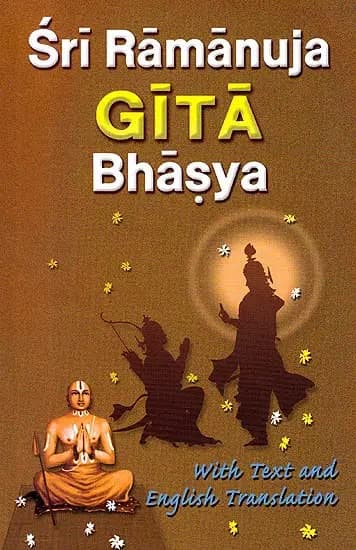
Gita Bhashya

The Gita Bhashya is Ramanuja's verse-by-verse commentary on the Bhagavad Gita, and its distinctive contribution is the integration of the Gita into Vedanta as a scripture of devotional theism rather than mere action or monistic knowledge. Ramanuja reads the Gita through Visishtadvaita: Krishna is the supreme Brahman, the individual selves are real and distinct though dependent modes of God, and the path to liberation culminates in bhakti-yoga, which is prepared for by karma-yoga and jnana-yoga. The commentary is notably less polemical than his Sri Bhashya, entering debate with Advaita and Bhaskara mainly at two specific verses (2.12 and 13.2), while otherwise elaborating the text's meaning in light of Sri Vaishnava theology.
Key Insights
✦What is the central theological claim of Ramanuja's Gita Bhashya?
The commentary's governing claim is that the Bhagavad Gita teaches Visishtadvaita: Brahman is Narayana (Vishnu), possessed of countless auspicious attributes, and the individual selves (jivas) and material world (jagat) are real, distinct entities related to God as body to soul, or as modes to substance . Liberation is not the dissolution of individuality into an undifferentiated absolute but the attainment of God through bhakti-yoga, which is itself prepared for by the disciplined performance of karma-yoga and the cultivation of jnana-yoga . Ramanuja reads the Gita as the scriptural foundation for devotional theism, not as a text about action alone or about monistic realization.
✦How does Ramanuja's commentary differ from Shankara's on key verses?
The divergence is sharpest on verses concerning the self and God's relation to devotees. At Gita 4.11, Shankara reads the correlatives yatha-tatha as signifying God's measured apportionment of rewards according to each devotee's actions, with no implication of intimacy . Ramanuja, by contrast, derives from the same syntax a sense of equality, mutuality, and closeness: God responds to devotees in the very manner they approach Him, revealing Himself in forms accessible to their desire . At Gita 2.12, where Krishna affirms the multiplicity of selves, Ramanuja enters into explicit polemic against Advaita's doctrine of avidya (ignorance) as an explanation for apparent multiplicity, arguing that no such adjunct is needed because the selves are genuinely many and distinct from God .
✦How polemical is the Gita Bhashya compared to Ramanuja's other works?
The Gita Bhashya is notably less polemical than the Sri Bhashya. As Swami Adidevananda's translation introduction notes, the commentary as a whole is not polemical but is primarily an elaboration of the verses' meanings in light of Visishtadvaita teachings . Ramanuja enters into explicit debate with rival schools at only two points: his interpretation of Gita 2.12, where he refutes Bhaskara's upadhi theory and the Advaitin's avidya theory, and his interpretation of Gita 13.2, where he addresses the distinction between ksetra and ksetrajna . This restraint suggests the Gita Bhashya was intended as a constructive theological exposition rather than a sustained philosophical assault on opponents.
✦What is the relationship between the Gita Bhashya and Yamuna's Gitararthasangraha?
Ramanuja's debt to his predecessor Yamuna is substantial and explicitly acknowledged. Van Buitenen's study demonstrates that practically all the salient features of the Gita Bhashya are already contained in Yamuna's concise thirty-two verse summary, the Gitararthasangraha . Ramanuja dedicates his commentary to Yamuna with the remark that he owes everything to his illustrious predecessor, quotes some of Yamuna's verses, and adopts Yamuna's tripartition of the eighteen chapters into three groups of six . That said, Van Buitenen argues that Ramanuja was also an original thinker who rearranged and reinterpreted inherited material with his own systematic and devotional genius, so the commentary is neither a mere reproduction nor a wholesale departure .
✦How reliable is Swami Adidevananda's English translation of the Gita Bhashya?
Adidevananda's translation, published posthumously by Sri Ramakrishna Math, is described as the only English translation that includes the original Sanskrit text alongside the rendering, making it useful for readers who want to check the translation against the source . Adidevananda was a member of the Ramakrishna Order who retained his Sri Vaishnava heritage, and he also translated other Sri Vaishnava texts, which lends his work familiarity with the tradition's vocabulary . However, the translation is a product of its devotional context rather than a critical scholarly edition. Readers seeking philological precision or engagement with textual variants should consult it alongside Van Buitenen's partial translation and study, which takes a more historical-critical approach .
✦What is the most common misreading of the Gita Bhashya's doctrine of bhakti?
A persistent misreading treats Ramanuja's bhakti as a purely emotional or spontaneous devotion that bypasses disciplined practice. In the Gita Bhashya, bhakti is the culmination of a graduated path: karma-yoga (disinterested action) and jnana-yoga (knowledge of the self's nature) are not superseded but are the necessary preparations for bhakti-yoga, which is itself a sustained discipline of loving contemplation . Ramanuja does not oppose action and devotion; he integrates them, arguing that the active life dedicated to God characterizes the aspirants described in Gita 7.16, including the jnani who has wisdom . Reading the commentary as a rejection of works or knowledge in favor of pure feeling inverts its carefully constructed hierarchy of spiritual disciplines.
Wealthy Psyche is an intellectual archive. We do not host, distribute, or sell book copies — physical or digital. We provide structured knowledge to help you think better, faster.