


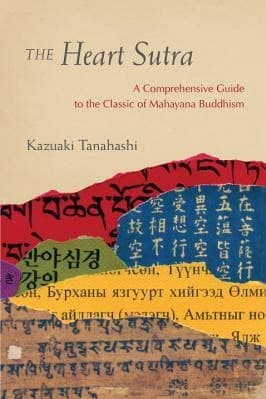
Heart Sutra (attributed tradition)
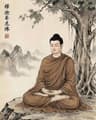
The Heart Sutra is the most concise of the Prajñāpāramitā scriptures, and its distinctive mechanism is the compression of the Perfection of Wisdom teaching into a single, radical formula: form is emptiness, emptiness is form. Attributed by tradition to the Buddha (or, in the text's own frame, to Avalokiteśvara speaking under the Buddha's power), the sutra dismantles the five aggregates and the entire Abhidharma framework of categories, declaring that in emptiness there is no suffering, no path, no wisdom, and no attainment. Its most contested feature is its origin: scholars have argued that the Chinese version may precede the Sanskrit.
Key Insights
✦What is the Heart Sutra's central claim, and how does it differ from other Prajñāpāramitā texts?
The Heart Sutra's governing claim is that all phenomena—the five aggregates, the senses, the chain of dependent origination, the Four Noble Truths themselves—are empty of inherent existence. What distinguishes it is compression and radicality: where the larger Prajñāpāramitā sutras elaborate emptiness across hundreds of pages, the Heart Sutra states it in 260 Chinese characters, using the formula 'form is emptiness, emptiness is form' as its hinge . The text then pushes further than many other sutras by negating the very categories of Buddhist soteriology: there is no suffering, no cessation, no path, no wisdom, and no attainment. This negation is not nihilism but a therapeutic dismantling of all conceptual clinging, including attachment to Buddhist doctrine itself.
✦Is the Heart Sutra an Indian or a Chinese composition?
This is one of the most consequential debates in Buddhist studies. The traditional account holds that Xuanzang translated it from Sanskrit in 649 CE . However, Jan Nattier argued in 1992 that the short Heart Sutra was likely composed in China, abstracted from Kumārajīva's translation of the larger Prajñāpāramitā, and only later back-translated into Sanskrit . The evidence includes the fact that the Sanskrit Heart Sutra's brevity resembles Kumārajīva's Chinese style rather than extant Sanskrit Prajñāpāramitā texts, and that no Sanskrit manuscript predates the Chinese version . If Nattier is correct, the Heart Sutra is not an Indian scripture that traveled east but a Chinese creation that traveled west.
✦What is the difference between the short and long versions of the Heart Sutra?
The Heart Sutra circulates in two forms. The short version, the one most familiar in East Asia and attributed to Xuanzang's 649 translation, consists of the core dialogue between Avalokiteśvara and Śāriputra followed by the mantra, totaling roughly 260 Chinese characters . The long version adds an introductory section describing the setting (the Buddha at Vulture Peak, in concentration) and a concluding section in which the Buddha emerges from meditation and praises Avalokiteśvara. The long version is commonly used in Tibetan and Mongolian tantric practices . Both versions share the same central content, but the long form situates the teaching within a narrative frame that the short form omits, making the short version more evidently a distillation.
✦Why is Avalokiteśvara, rather than the Buddha or Śāriputra, the expositor of the Heart Sutra?
This is a distinctive feature of the text. In most Prajñāpāramitā sutras, the Buddha or Subhūti expounds emptiness. In the Heart Sutra, the speaker is the bodhisattva Avalokiteśvara, who answers Śāriputra's question about how to train in the Perfection of Wisdom . Scholars have noted that this choice foregrounds compassion alongside wisdom: Avalokiteśvara is the bodhisattva of compassion, and his exposition of emptiness is framed as an act of care for Śāriputra and all beings. The Buddha's role is confined to the frame: he enters concentration, empowers Avalokiteśvara to speak, and then approves the teaching. This structure emphasizes that emptiness is not a doctrine to be believed but a realization to be embodied by a bodhisattva.
✦How has the Heart Sutra been used in practice, beyond its doctrinal content?
The Heart Sutra has functioned as far more than a philosophical text. In East Asia and Tibet, it is recited as a protective charm or dhāraṇī, used to ward off calamities, at deathbed rites, and in memorial services for the dead . Donald Lopez's study of its Indian and Tibetan commentaries documents its use as a mantra, an exorcism text, and a tantric meditation guide . The mantra at the end—gate gate pāragate pārasaṃgate bodhi svāhā—is itself treated as efficacious, not merely illustrative. This practical dimension is essential for understanding the sutra's immense popularity: it is short enough to memorize, potent enough to recite, and profound enough to meditate upon, making it accessible to laypeople and monastics alike.
✦Which English translation of the Heart Sutra should a serious reader use?
Red Pine's 2004 translation, published by Shoemaker & Hoard, is widely regarded as a standard English edition. It draws on multiple Sanskrit and Chinese versions, incorporates the insights of dozens of ancient commentators, and provides a word-by-word explication alongside the translation . Donald Lopez's The Heart Sutra Explained (1988) is indispensable for scholarly study: it translates the sutra alongside Indian and Tibetan commentaries, providing the exegetical context that modern readers lack . Edward Conze's translations remain historically important, and Thich Nhat Hanh's commentaries offer a practice-oriented reading. No translation is neutral; Red Pine's work is shaped by Chinese commentarial tradition, while Lopez foregrounds Indian and Tibetan scholasticism.
Wealthy Psyche is an intellectual archive. We do not host, distribute, or sell book copies — physical or digital. We provide structured knowledge to help you think better, faster.