


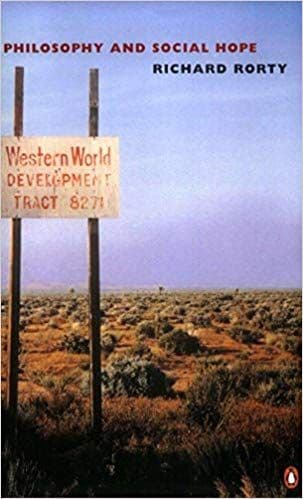
Philosophy and Social Hope
Rorty's central thesis across this collection is that pragmatism offers 'hope in place of knowledge': since truth is not correspondence to reality, social progress depends not on philosophical foundations but on the imaginative construction of a more just and inclusive future. The volume's distinctive mechanism is its autobiographical framing—'Trotsky and the Wild Orchids' opens the book by tracing Rorty's own path from a sheltered, orchid-loving child to a leftist pragmatist—and its division into sections on pragmatism, its applications, politics, and contemporary America, showing how anti-representationalism translates into concrete cultural and political critique.
Key Insights
✦What does Rorty mean by 'hope in place of knowledge,' and why is this the book's organizing idea?
The phrase names Rorty's pragmatist alternative to the epistemological project: instead of seeking foundations for belief that would guarantee its correspondence to reality, we should cultivate hope for a better future and work toward it through political and cultural practice. The book's section headings make the structure explicit—Part II is titled 'Hope in Place of Knowledge: A Version of Pragmatism,' and it contains essays on truth without correspondence, a world without substances or essences, and ethics without principles . The claim is not that knowledge is worthless but that the philosophical search for a foundation for knowledge has been a distraction from the practical task of reducing suffering and increasing equality. Hope, for Rorty, is the appropriate attitude for a species that creates its own future rather than discovering a pre-given one.
✦Why does the collection open with an autobiographical essay, and what does it reveal about Rorty's intellectual trajectory?
'Trotsky and the Wild Orchids' is the only autobiographical piece in the volume, and its placement is deliberate. Rorty recounts his childhood in a leftist family—his parents were Trotskyists—and his early attempt to find something 'beyond the world' in the study of wild orchids, a pursuit he later recognized as an apolitical longing for the absolute. The essay traces his turn from this private quest for transcendence to a public commitment to social justice, and it frames the entire collection as the work of a thinker who chose politics over metaphysics. The title itself captures the tension: Trotsky represents the political, orchids the aesthetic and the absolute, and Rorty's mature pragmatism is an attempt to reconcile them without subordinating either to the other.
✦How does this collection relate to Rorty's earlier, more technical philosophical work?
Philosophy and Social Hope is explicitly aimed at a wider audience. Penguin describes it as bringing together writings 'aimed at a wider audience, many published in book form for the first time,' and Rorty uses the collection to give 'a stimulating summary of his central philosophical beliefs and how they relate to his political hopes' . The essays presuppose rather than argue for the anti-representationalism of Philosophy and the Mirror of Nature; readers looking for the technical case against correspondence truth will find it elsewhere. What the collection offers instead is the political and cultural payoff of that position—essays on education, religion, law, Heidegger's Nazism, Derrida on Marx, and the state of the American left. A Princeton University commentator noted that Rorty's political views here are 'as banal as they come—nothing other than unreconstructed McGovernism,' while also observing that he offers 'no defense of them whatsoever' .
✦What is Rorty's argument about religion in this collection, and why did it provoke controversy?
Rorty's position, developed in 'Religious Faith, Intellectual Responsibility and Romance' and 'Religion as Conversation-stopper,' is that religion should be privatized in the Jeffersonian sense: it can be a source of personal meaning and even of inspiration for social justice, but it must not function as a public reason that terminates conversation. He admires a 'fuzzy' Christianity that emphasizes love and hope over creedal doctrine, citing Martin Luther King Jr. and liberation theology as positive examples. The controversy arises because Rorty offers no principled way to distinguish good religion from bad. He admits as much: he cannot produce a principle that would allow him to cite Psalm 72 in favor of health insurance while excluding Leviticus 18:22 from public debate. Critics on both religious and secular sides have seized on this admission as evidence that Rorty's privatized religion is arbitrary or incoherent.
✦How was the book received, and what does its reception reveal about Rorty's position in the intellectual landscape?
The reception was respectful but tinged with the familiar ambivalence that followed Rorty throughout his career. A Princeton University review described his political views as 'unreconstructed McGovernism' and noted that he offered 'no defense of them whatsoever' . The same review acknowledged that Rorty had been 'accused of many things over the years—from relativism and irresponsibility to opportunism and complacency—by critics on the right and far left' . Reader reviews on platforms like ThriftBooks, by contrast, praise the book as an excellent introduction to pragmatism. The split reflects Rorty's peculiar position: admired as a prose stylist and cultural critic, distrusted as a philosopher who had abandoned the discipline's central questions while retaining its prestige.
✦What does Rorty mean by 'the unpatriotic academy,' and how does this essay connect to his broader political project?
'The Unpatriotic Academy' is one of the volume's most directly political essays, and it anticipates the argument Rorty would develop at greater length in Achieving Our Country a year earlier. His charge is that the American academic left has abandoned national pride as a political resource, treating patriotism as inherently suspect and thereby ceding it to the right. Rorty argues that reform requires a sense of shared national identity and hope—that one cannot mobilize people to improve a country they have been taught to despise. The essay drew criticism from both sides: conservatives heard condescension, while leftists heard a demand for flag-waving conformity. But Rorty's point is pragmatic rather than nationalist: if the left wants to achieve concrete reforms, it needs the motivational resources that national sentiment can provide, and refusing to use them is a strategic error rather than a moral virtue.
Wealthy Psyche is an intellectual archive. We do not host, distribute, or sell book copies — physical or digital. We provide structured knowledge to help you think better, faster.