


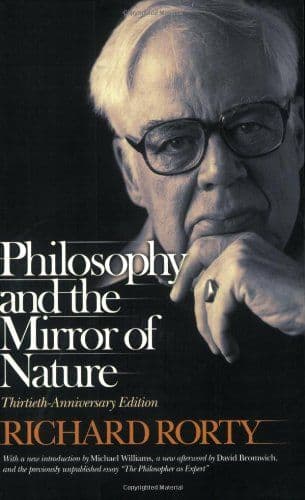
Philosophy and the Mirror of Nature
Rorty's central thesis is that the modern philosophical tradition from Descartes through Kant to analytic epistemology is built on a single, dispensable image: the mind as a mirror of nature, and knowledge as the accuracy of its representations. The book's distinctive mechanism is a genealogical dismantling of the 'theory of knowledge' as a foundational discipline, arguing that once the notion of privileged representations is abandoned, epistemology loses its subject-matter and philosophy's role as a tribunal of pure reason dissolves. What remains is 'edifying' conversation rather than systematic justification.
Key Insights
✦What is the 'mirror of nature' metaphor, and why does Rorty think it must be abandoned?
The metaphor names a picture that has dominated philosophy since the seventeenth century: the mind is a mirror that reflects reality, knowledge consists in accurate representations within that mirror, and philosophy's job is to inspect, repair, and polish the glass. Rorty's argument is that this picture generates the 'theory of knowledge' as a foundational discipline charged with validating our representations against an independent world. Once we see that there is no way to step outside our language and practices to compare them with a non-linguistic reality, the tribunal has no jurisdiction. Abandoning the mirror does not mean abandoning truth; it means ceasing to treat truth as a matter of correspondence to be certified by epistemology.
✦What does Rorty mean by 'edifying' philosophy, and who are its exemplars?
Edifying philosophy is the alternative to systematic, foundationalist philosophy. Where the systematic philosopher builds a permanent framework for assessing claims, the edifying philosopher keeps the conversation going, shattering conventional idols and refusing to let inquiry settle into a final vocabulary. Rorty names Dewey, the later Wittgenstein, and the later Heidegger as the three great edifying philosophers of the twentieth century, precisely because each in different ways undermines the representationalist project from within. The term 'edification' is deliberately modest: it means Bildung, the formation of the self through conversation, rather than the construction of a theory that will put philosophy on the secure path of a science.
✦How did the book's reception split between analytic and continental philosophy?
The reception was remarkable for its cross-disciplinary reach and its polarizing effect. Contemporary commentary noted that the book received more attention than any other philosophy book that year, with reviewers uncertain whether Rorty had 'decreed the end of analytic philosophy' or was 'turning Continental' . His favorable treatment of Heidegger, Gadamer, Derrida, and Foucault—figures largely ignored by analytically trained philosophers—established him as 'philosophy's chief gadfly in the United States' and stimulated interest in European thought among younger analytic philosophers . Within analytic philosophy, reactions ranged from Richard Bernstein's sympathetic engagement to Alvin Goldman's critical review, with both sharing a puzzlement about Rorty's apparent indifference to truth and rationality .
✦What is the significance of the 2009 thirtieth-anniversary edition?
Princeton University Press marked the book's thirtieth anniversary with an edition that includes a new introduction by Michael Williams, a new afterword by David Bromwich, and a previously unpublished essay by Rorty titled 'The Philosopher as Expert' . Williams's introduction supplies a précis of the work and an articulation of its significance, while Bromwich's afterword addresses the book's cultural and literary dimensions. The inclusion of 'The Philosopher as Expert' is particularly valuable for scholars, since it extends Rorty's critique of philosophy's professional self-image into a domain—expertise—that the original book had only gestured toward.
✦How does Rorty's anti-representationalism relate to Dewey's pragmatism?
Rorty explicitly draws on Dewey as one of his three edifying heroes, and the continuity is substantive. Dewey's critique of the 'spectator theory of knowledge'—the idea that knowing is a relation between a subject and an independent object—anticipates Rorty's attack on the mirror metaphor by decades. Both reject the notion that knowledge is a copy or correspondence and insist that inquiry is a form of practice rather than a passive reflection of reality. Where Rorty goes further is in his insistence that the entire vocabulary of 'experience' and 'inquiry' can be replaced by the vocabulary of language and conversation, a move that some pragmatists regard as a departure from Dewey rather than an extension of him.
✦Did the book actually succeed in 'ending' epistemology, as some reviewers claimed?
The claim that Rorty 'decreed the end of analytic philosophy' was journalistic hyperbole, but the book did permanently alter the terms of debate. Epistemology as a foundational discipline charged with validating knowledge-claims against reality lost much of its prestige; the naturalized epistemology that Quine had proposed and that Rorty discussed in his chapter on 'Epistemology and Empirical Psychology' became the dominant alternative. Few philosophers today would defend the 'theory of knowledge' in the form Rorty attacked. At the same time, the book did not end philosophy of mind, philosophy of language, or metaphysics—it redirected them. The lasting effect was less a termination than a redistribution of philosophical labor away from foundational justification and toward practices, norms, and conversation.
Wealthy Psyche is an intellectual archive. We do not host, distribute, or sell book copies — physical or digital. We provide structured knowledge to help you think better, faster.