


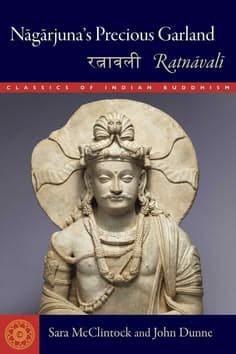
Ratnāvalī (Precious Garland)

The Ratnāvalī is Nāgārjuna's epistolary treatise addressed to a king, and its distinctive contribution lies in integrating Madhyamaka emptiness with a systematic ethics of lay and royal conduct. Where the Mūlamadhyamakakārikā dismantles metaphysical categories, the Ratnāvalī applies the same anti-essentialist analysis to statecraft, merit accumulation, and the bodhisattva path. Its five chapters map a graduated curriculum—from the 'Dharma of ascendance' for a good rebirth to the 'Dharma of the highest good' for liberation—making it Nāgārjuna's most socially embedded and ethically concrete work.
Key Insights
✦What is the Ratnāvalī's central argumentative framework, and how does it differ from Nāgārjuna's other works?
The Ratnāvalī's framework is a graduated soteriology for a lay audience, specifically a king. Its five chapters progress from the 'Dharma of ascendance'—ethical conduct yielding better rebirths—to the 'Dharma of the highest good,' which is liberation through the realization of emptiness . This distinguishes it sharply from the Mūlamadhyamakakārikā's relentless dialectical refutation of svabhāva. Where the MMK addresses philosophical opponents, the Ratnāvalī addresses a ruler who must govern, accumulate merit, and integrate worldly responsibility with spiritual aspiration. The text does not dilute Madhyamaka; it applies its anti-essentialism to concrete domains—statecraft, punishment, generosity, and the bodhisattva's perfections—making it Nāgārjuna's most ethically substantive work .
✦To whom was the Ratnāvalī addressed, and what does this reveal about its purpose?
The text is addressed to King Gautamīputra of Āndhra, a Satavahana ruler who was Nāgārjuna's friend and patron . This royal address shapes the work's entire rhetorical strategy. Nāgārjuna does not merely instruct a monk or debate a philosopher; he counsels a head of state on how to wield power without violating Buddhist ethics. The fourth chapter, devoted explicitly to 'the conduct of a king,' discusses punishment, taxation, and governance from a standpoint of compassion rather than hatred . This epistolary form makes the Ratnāvalī a rare document of early Mahāyāna political thought, showing how Madhyamaka principles could be translated into practical guidance for someone embedded in the coercive institutions of state.
✦What is the textual situation of the Ratnāvalī, and why does it matter for interpretation?
The Ratnāvalī survives complete only in Tibetan and Chinese translations; the Sanskrit original is partially preserved . Michael Hahn's 1982 edition collected the available Sanskrit verses alongside the Tibetan and Paramārtha's Chinese translation, providing the textual basis for modern scholarship . The eleventh-century Indian commentator Ajitamitra wrote the only known Indian commentary, the Ratnāvalīṭikā, which McClintock and Dunne's 2024 translation prioritizes alongside the Sanskrit . This textual mediation matters because any English rendering must navigate gaps where Sanskrit is lost, relying on Tibetan or Chinese witnesses whose readings may diverge. The Ratnāvalī one reads in English is a reconstruction from multiple textual traditions, not a direct transmission from a single Sanskrit manuscript.
✦How does the Ratnāvalī defend the Mahāyāna as authentic Buddha-word?
The Ratnāvalī contains one of the earliest defenses of the Mahāyāna sūtras as buddhavacana—the genuine word of the Buddha . This is significant because Mahāyāna sūtras were composed centuries after the historical Buddha and were not accepted as canonical by all Buddhist schools. Nāgārjuna argues that rejecting the Mahāyāna on the grounds of its late appearance is incoherent, since the same logic would undermine the authority of the śrāvaka teachings as well. This defense is embedded within the Ratnāvalī's broader project of presenting the bodhisattva path as the culmination of Buddhist practice, not a deviation from it. The text thus functions not only as ethical advice but as a polemical intervention in early Mahāyāna self-articulation.
✦What is the most common misreading of the Ratnāvalī's ethical teaching?
A persistent misreading treats the Ratnāvalī as a work of conventional morality that stands apart from Nāgārjuna's radical emptiness doctrine—as though the ethics were for laypeople and the philosophy for monastics. In fact, the text integrates the two: the bodhisattva's compassionate action is presented as the natural expression of realizing emptiness, not a concession to those incapable of metaphysics. Nāgārjuna argues that because all beings suffer and all phenomena are dependently originated, the bodhisattva's commitment to universal liberation follows from the correct understanding of reality . The Ratnāvalī's ethics are not a preliminary to emptiness but its application; separating them distorts both the text's structure and its philosophical coherence.
✦How does McClintock and Dunne's 2024 translation differ from earlier English renderings?
The 2024 Wisdom Publications translation by Sara McClintock and John Dunne is the first complete English rendering of the Ratnāvalī to take the surviving Sanskrit verses and Ajitamitra's Indian commentary as its primary authorities . Earlier English versions, notably John Dunne and Sara McClintock's own 1997 commemorative edition for the Dalai Lama's teachings, were translated from the Tibetan . Other renderings, such as Hopkins's and Lindtner's, worked from different textual bases and interpretive assumptions. The 2024 edition provides working editions of the Sanskrit and Tibetan verses translated, making it a significant scholarly advance. For readers seeking the most philologically grounded English access, it supersedes earlier translations, though the 1997 edition remains useful for its accessibility and Tibetan-based perspective.
Wealthy Psyche is an intellectual archive. We do not host, distribute, or sell book copies — physical or digital. We provide structured knowledge to help you think better, faster.