


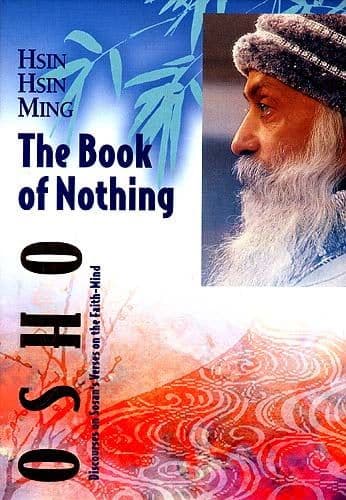
The Book of Nothing
The Book of Nothing is a transcription of Osho's discourses on Sosan's Hsin Hsin Ming (Verses on the Faith-Mind), and its central mechanism is the dismantling of the mind's dualistic choosing. Osho treats Sosan's poem not as a text to be interpreted but as a transmission of no-mind, arguing that the 'Great Way' is not difficult because it requires no effort—only the cessation of preference. The book's distinctive claim is that nothingness is not a void to be feared but the abundance of presence that remains when the chattering mind stops projecting.
Key Insights
✦What is Osho's central interpretive move in The Book of Nothing?
Osho's governing move is to treat Sosan's Hsin Hsin Ming not as a philosophical poem to be explained but as a transmission of no-mind that the commentary must enact rather than describe. His consistent emphasis falls on the cessation of choosing: the 'Great Way' is not difficult because it demands no effort, only the dropping of preference and the mind's compulsive projection of duality. In his reading, nothingness is not a void to be feared but the abundance of presence that remains when the chattering mind stops. This is why the book resists systematic exposition—Osho repeatedly turns the listener back from the text toward the act of listening itself, arguing that understanding the words is not the point.
✦What are the textual origins and publication history of this book?
The discourses were delivered in October 1974 at Buddha Hall in Poona, comprising ten talks on Sosan's Hsin Hsin Ming . The first English edition was published by Rajneesh Foundation International in 1983 . The book is also known under the title Hsin Hsin Ming: The Book of Nothing, and editions have appeared from Tao Publishing (1996) and other imprints . This places the discourses in Osho's early Poona period, and the 1983 publication date means the book was compiled and edited by his community rather than written by Osho himself. As with all his discourse literature, the text is a transcription of oral performance, mediated by editors.
✦How does Osho characterize the relationship between Zen, Buddhism, and Taoism in this book?
Osho presents Zen as a crossbreeding of Buddha's thought and Lao Tzu's thought, describing it as 'the greatest meeting that ever took place' and arguing that Zen is neither purely Buddhist nor purely Taoist but carries both within it . This framing allows him to treat Sosan, the Third Zen Patriarch, as standing near the original source when Zen was emerging. Osho contrasts the seriousness of Indian religion with Lao Tzu's non-seriousness, suggesting that the meeting of these two temperaments produced something more beautiful than either alone. This interpretive genealogy is characteristic of Osho's universalizing approach: he reads Sosan through a lens that blends traditions rather than confining him to a single lineage.
✦What is the most common misreading of The Book of Nothing?
A persistent misreading treats the title literally—as though the book were about nihilism or the absence of meaning. Osho's actual argument is nearly the opposite: nothingness, in his reading of Sosan, is not a void but the ground of presence, the state in which the mind's projections cease and reality is encountered directly. He insists that the state of 'nothing' is 'not void or emptiness, but rather an overflowing abundance of presence and being' . Readers who approach the book expecting a denial of life or a celebration of blankness will find Osho arguing that the chattering mind is the real emptiness, while the cessation of that chatter is the only fullness worth seeking.
✦How has the book been received by readers, and what criticisms exist?
Reader reception has been strongly devotional. Amazon India records over 400 ratings, with reviewers calling it a book that 'saved Buddhism & Tao' and recommending it as the one book to read in a lifetime if only one could be chosen . One reviewer recounted Osho's own claim that if all the world's scriptures were destroyed and only two books could be saved, one would be Sosan's Hsin Hsin Ming . Critical voices focus on production quality rather than content: a Kindle edition was described as 'horrible' with words beginning at the end of the page, and a French reviewer complained of a high price for a twelve-page edition . No peer-reviewed scholarly assessment of the book appears to exist.
✦How does The Book of Nothing relate to Osho's other discourse series on Zen?
It belongs to the same genre as Zen: The Path of Paradox and Osho's other commentaries on Zen masters, but its focus is distinctive. Where Zen: The Path of Paradox treats paradox as a pedagogical shock, The Book of Nothing centers on Sosan's poem as a sustained articulation of non-dualism and the faith-mind. Osho treats Sosan with unusual reverence, reportedly saying that the Hsin Hsin Ming contains 'all that is' and that each word is golden . This makes the book something of a companion to his more free-form Zen discourses—a concentrated engagement with a single foundational text rather than a series of occasional talks. Readers seeking Osho's most sustained treatment of no-mind will find it here.
Wealthy Psyche is an intellectual archive. We do not host, distribute, or sell book copies — physical or digital. We provide structured knowledge to help you think better, faster.