


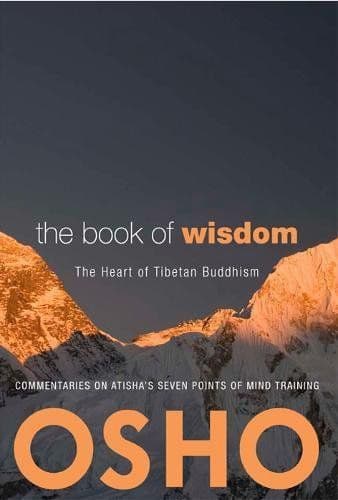
The Book of Wisdom

The Book of Wisdom is a collection of Osho's discourses nominally structured around Atisha's Seven Points of Mind Training, but its central mechanism is Osho's own interpretive substitution: he replaces Atisha's Tibetan lojong framework with a single, repeated instruction to become aware of whatever arises—anger, greed, lust—without judgment. The text operates through question-and-answer sessions in which Osho deconstructs listeners' problems using this awareness doctrine, treating the Tibetan source less as a doctrinal authority than as a launching point for his characteristic blend of Vedantic non-dualism, Zen provocation, and anti-institutional critique.
Key Insights
✦What is Osho's central interpretive move in The Book of Wisdom?
Osho's move is substitution rather than exegesis. He takes Atisha's Seven Points of Mind Training as a nominal framework, but his consistent answer to every question is the same: become aware of whatever is arising—anger, greed, lust—without judgment, because awareness cuts the root of unawareness . This is not Atisha's Tibetan lojong method, which involves formal slogans, tonglen practice, and bodhicitta cultivation. Osho strips the text of its Indo-Tibetan Buddhist scaffolding and replaces it with a generalized witnessing awareness drawn from his own synthesis of Vedanta and Zen. The book's title signals a wisdom text, but its content is Osho's teaching presented through the occasion of Atisha's slogans.
✦What are the textual origins and publication history of The Book of Wisdom?
The discourses were delivered in Rajneeshpuram, Oregon, and first published by Rajneesh Foundation International in 1983, with a second volume following in September 1984 . The 1984 volume was edited by Swami Krishna Prabhu and issued in a first edition of 10,000 copies . Later editions substantially reframed the material: Element Books published it in 2000 under the subtitle 'The Heart of Tibetan Buddhism,' and Osho Media International issued a revised edition in 2009 . This rebranding as 'Tibetan Buddhism' is an editorial decision made after Osho's death, not his own framing, and it has shaped how the book is marketed and received.
✦How does The Book of Wisdom differ from a conventional commentary on Atisha's lojong?
A conventional lojong commentary—such as those by Chögyam Trungpa, Dilgo Khyentse, or Norman Fischer—works through each slogan systematically, explaining its Tibetan context, its place in the mind-training sequence, and its practical application within a Buddhist framework. Osho's book does not do this. A reviewer on Google Shopping noted that the 'Commentaries on Atisha's Seven Points' tag is misleading because the book lacks an index, making it difficult to locate teachings on specific slogans . Library Journal's review was blunter: the title is misleading, the text has more to do with Osho's own point of view than Tibetan Buddhism, and it includes overt criticisms of religious traditions alongside off-color jokes . The book is Osho's discourse series occasioned by Atisha, not a guide to Atisha's practice.
✦How was the book received by professional reviewers?
The most substantial professional review, from Library Journal (reproduced by AbeBooks), was negative. Reviewer D. Mark Woodhouse of Elmira College wrote that the title seems designed to cash in on interest in Tibetan Buddhism, that Osho's perspective is 'at times, a very eccentric perspective,' and concluded 'Not recommended' . This assessment reflects the gap between the book's marketing as Tibetan Buddhist commentary and its actual content as Osho's idiosyncratic teaching. Reader reviews, by contrast, are often enthusiastic, with some describing it as a transformative satsang experience . This divergence between professional and devotional reception is characteristic of Osho's published discourse literature and should be weighed by any reader approaching the text.
✦What is the most common misconception about The Book of Wisdom?
The most persistent misconception is that the book is a reliable introduction to Atisha's Seven Points of Mind Training or to Tibetan Buddhism more broadly. The subtitle added by later publishers—'The Heart of Tibetan Buddhism'—reinforces this error. In fact, Osho's framework is not Tibetan Buddhist; he repeatedly criticizes religious traditions and their followers, and his core instruction of bare awareness owes more to his own synthesis than to Atisha's lojong system. Reading the book to learn about Atisha will frustrate; reading it to encounter Osho's teaching style as applied to a Buddhist occasion will not. The book is a record of Osho's performances, not a window onto the Tibetan tradition.
✦How does The Book of Wisdom relate to Osho's other discourse series on religious texts?
The Book of Wisdom belongs to the same genre as The Mustard Seed (on the Gospel of Thomas) and Osho's discourses on Zen masters, the Upanishads, and Gibran. In each, Osho takes a traditional text as an occasion for extemporaneous teaching, using its sayings to launch wide-ranging commentaries on awareness, ego, love, and fear. The pattern is consistent: Osho does not subordinate himself to the text's authority but uses it as a springboard for his own message. The Book of Wisdom's place in this series is distinctive only in its source material—an 11th-century Tibetan lojong text—which creates a sharper tension between the nominal Buddhist framework and Osho's Vedantic-Zen-inflected teaching than is found in some of his other series.
Wealthy Psyche is an intellectual archive. We do not host, distribute, or sell book copies — physical or digital. We provide structured knowledge to help you think better, faster.