


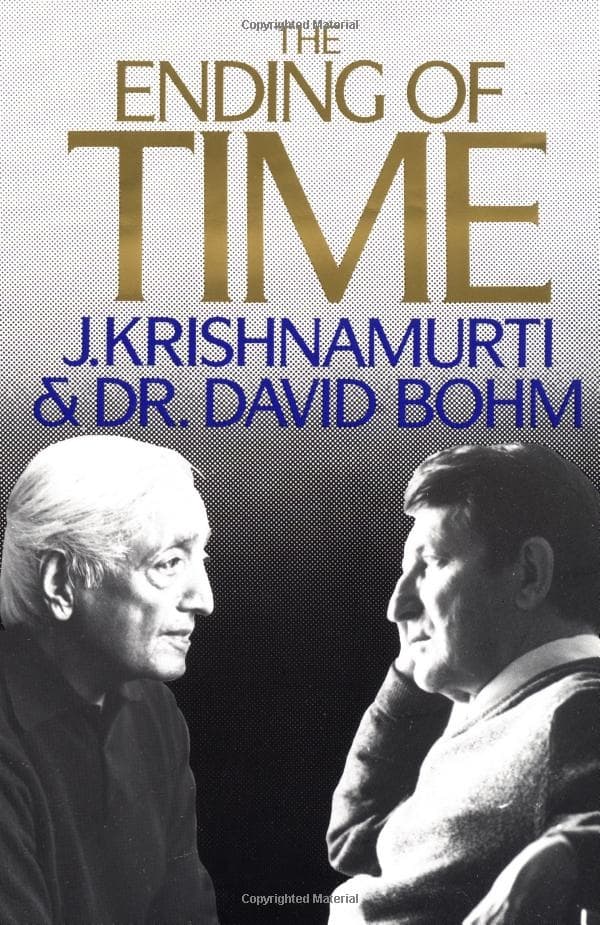
The Ending of Time

Krishnamurti and Bohm's central argument is that humanity has taken a wrong turn because thought—the accumulated residue of past experience—has usurped a function it cannot perform, attempting to solve psychological problems that are themselves generated by thought's fragmentary operation. The dialogues probe whether insight, a non-temporal perception beyond the machinations of the 'known,' can bring about a mutation of the brain cells and end the ego-centred activity that produces conflict. The book is an inquiry into whether psychological time can end.
Key Insights
✦What is the central claim of The Ending of Time, and what does it reject?
The central claim is that humanity has taken a wrong turn: thought, which is essentially the response of memory and the past, has been given supreme importance in domains where it cannot function adequately—specifically, in the psychological realm. Thought can solve technical problems, but it cannot solve the problems of the psyche, because thought itself is the source of fragmentation, division, and conflict . The book rejects the assumption that more thinking, analysis, or psychological knowledge can resolve human suffering. Instead, it asks whether insight—a perception that is not the product of thought or time—can bring about a radical mutation of the brain cells and end the ego-centred activity that perpetuates conflict .
✦What is 'psychological time,' and why is its ending central to the dialogues?
Psychological time is the internal, illusory movement of the self toward a future goal—becoming better, achieving enlightenment, escaping fear, or attaining security. It is the habitually created illusion of a self in perpetual struggle for improvement, motivated by desire, hope, and fear . Krishnamurti and Bohm argue that this psychological becoming is the root of conflict, because it divides the present 'what is' from an imagined 'what should be.' The ending of time is not the end of chronological time but the cessation of this psychological becoming. When the mind sees the futility of the movement of becoming, without any effort to stop it, that seeing itself is the ending of psychological time.
✦How did the collaboration between Krishnamurti and Bohm shape the book, and what was their relationship?
The book is drawn from a series of dialogues that took place in America and England between April and September 1980 . Krishnamurti and Bohm had a close collaboration spanning more than two decades, participating in 144 recorded dialogues and many unrecorded conversations . Bohm's background as a theoretical physicist, with his work on the implicate order and quantum foundations, provided a rigorous counterpoint to Krishnamurti's psychological and spiritual inquiry. Their mutual interest was the whole of human consciousness, its nature, and the sources of illusion and conflict. The dialogues are exploratory rather than doctrinal, with both men thinking aloud together rather than defending fixed positions .
✦How was the book edited, and what are its textual limitations?
The book is a transcript of live dialogues, edited but retaining the conversational texture of the spoken word. A revised and updated edition published in 2014 includes a new introduction and an added conversation on 'The Future of Humanity' . The textual form is a limitation as well as a strength: as one reader noted, reading a transcript of a live dialogue can yield 'the worst of both media'—lacking both the polish of written prose and the tonal nuance of audio recording . The dialogues wander, circle back, and occasionally leave questions unresolved. This is not a systematic treatise but a record of two minds inquiring together, and it should be read with that expectation.
✦How does the book relate to Krishnamurti's earlier works like Freedom from the Known?
The Ending of Time extends the central concern of Freedom from the Known (1969) into a dialogue with a physicist. In the earlier book, Krishnamurti argued that psychological freedom requires seeing the mind's entrapment in the 'known'—the accumulated residue of past conditioning. The Ending of Time deepens this inquiry by asking whether thought itself, as the movement of the known, can be transcended, and whether insight can produce a physical mutation of the brain. The presence of Bohm sharpens the inquiry, bringing a scientific rigor and a vocabulary drawn from physics to questions that Krishnamurti had previously addressed in more solitary talks. The book is thus a continuation and a deepening, not a departure.
✦What is a common misreading of the book's rejection of thought?
A common misreading takes the critique of thought as an anti-intellectual counsel to abandon thinking altogether. This is not the position. Krishnamurti and Bohm distinguish between thought's proper domain—the practical, technical, and functional—and its improper usurpation of the psychological realm. Thought is necessary for daily life; the problem is that it has been given 'supreme importance' in matters of the psyche, where it generates division and conflict . The book does not advocate the cessation of all thought but asks whether a different faculty—insight, attention, or choiceless awareness—can operate alongside thought without being contaminated by its fragmentary movement. The misreading flattens a subtle inquiry into a crude anti-rationalism.
Wealthy Psyche is an intellectual archive. We do not host, distribute, or sell book copies — physical or digital. We provide structured knowledge to help you think better, faster.