


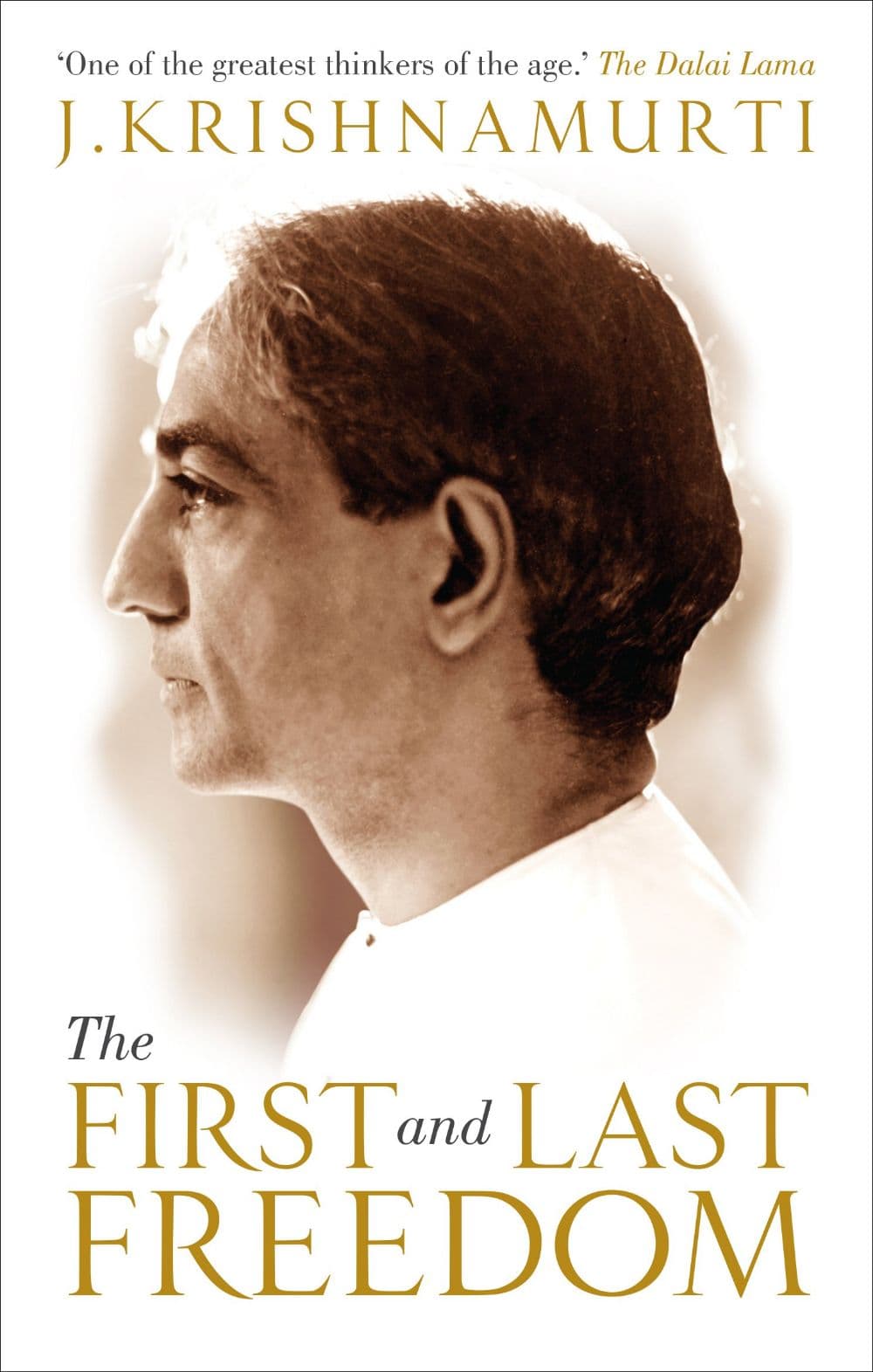
The First and Last Freedom

Krishnamurti's central argument is that freedom is not a goal to be achieved through methods, disciplines, or belief systems, but the immediate seeing of what is—without the observer who judges, selects, or seeks to change it. The book argues that all conditioning, whether religious, social, or psychological, breeds conflict and separation, and that choiceless awareness alone dissolves the thinker-thought division. Freedom is both first and last: it is the beginning of inquiry and the end of all becoming.
Key Insights
✦What is the central claim of The First and Last Freedom, and what does it reject?
Krishnamurti argues that freedom is not a future achievement to be reached through methods, disciplines, or belief systems. It is the immediate, choiceless awareness of what is—the mind's direct perception of its own conditioning without the interference of an observer who judges or seeks to change. The book rejects all organized approaches to liberation, including religious dogma, psychological techniques, and the authority of teachers. As the title suggests, freedom is both the first and the last: it is the beginning of genuine inquiry and the end of all psychological becoming. Huxley's foreword frames the book as an invitation to solve the human problem 'for and by himself,' not through collective solutions or systems .
✦What is the relationship between the thinker and the thought, and why does Krishnamurti insist they are one?
Krishnamurti argues that the division between the thinker and the thought is an illusion that perpetuates conflict. The thinker is the accumulated residue of past experience, memories, and conditioning—a center of self-interest that separates itself from what it observes. As long as this division exists, the mind is caught in the dualistic struggle of the observer trying to change the observed, which is the root of all inner conflict. When the mind sees this division clearly, without any effort to bridge it, the thinker and the thought are one. In that state, there is no becoming, no desire for change, and no 'I' that seeks to control experience. This insight is central to the book's account of freedom .
✦How does the book differ from Think on These Things, Krishnamurti's other widely read work?
Think on These Things (1964) originated in talks addressed specifically to students and teachers in India, and its chapters often begin with questions posed by young people about education, fear, and ambition. The First and Last Freedom (1954) is a broader compilation drawn from Krishnamurti's talks and writings, and it includes a substantial section of 'Questions and Answers' that addresses topics ranging from suffering and fear to the nature of thought and the unconscious. While both books share the same core insights—choiceless awareness, the thinker-thought division, the rejection of authority—The First and Last Freedom is more comprehensive and was the work that first brought Krishnamurti to a wide commercial readership, partly through Huxley's foreword .
✦How was the book received, and what role did Aldous Huxley's foreword play?
The book was an immediate commercial success, going into its sixth impression by the end of 1954, and Huxley's foreword was widely credited with setting the tone for serious reception . A Krishnamurti biographer wrote that the foreword 'set the mood to take the work very seriously' . Reviews were mixed but generally respectful: Kirkus Reviews called it a 'clear and intriguing presentation,' while The Times of India dismissed it as 'all theoria without praxis' . Jean Burden, writing in Prairie Schooner in 1959, noted that as a compilation from talks, the book 'suffered, as most compilations do, from repetitiveness and lack of structure,' though she acknowledged its impact in drawing attention to Krishnamurti .
✦What is a common misreading of the book's rejection of methods and disciplines?
A common misreading takes Krishnamurti's rejection of methods as a counsel of passivity or quietism—as if he were saying that one should simply accept one's conditioning and make no effort. This misses the intensity of the attention he describes. Choiceless awareness is not indifference; it is a state of 'passive, alert observation' in which the mind watches its own movements without the interference of condemnation or justification . Krishnamurti insists that this observation requires no method, but it does require a sustained and arduous honesty with oneself. The rejection of method is not a rejection of rigor; it is a rejection of the assumption that a technique can produce the insight that alone brings freedom.
✦What is the publication history of the book, and how has its availability changed?
The book was first published in May 1954 by Harper & Brothers in the United States and by Gollancz in the United Kingdom, with a foreword by Aldous Huxley . It was Krishnamurti's second book with a mainstream commercial publisher in the US, and it proved to be a 'compelling entry' into commercial publishing . The book has been reissued many times, including a 1975 HarperOne paperback, a 2010 HarperCollins e-book, and a 2013 Penguin Rider edition . As of 2022, there had been 95 editions in several formats across eight languages, and the work is also available as a freely readable electronic document through J. Krishnamurti Online, the official online repository .
Wealthy Psyche is an intellectual archive. We do not host, distribute, or sell book copies — physical or digital. We provide structured knowledge to help you think better, faster.