


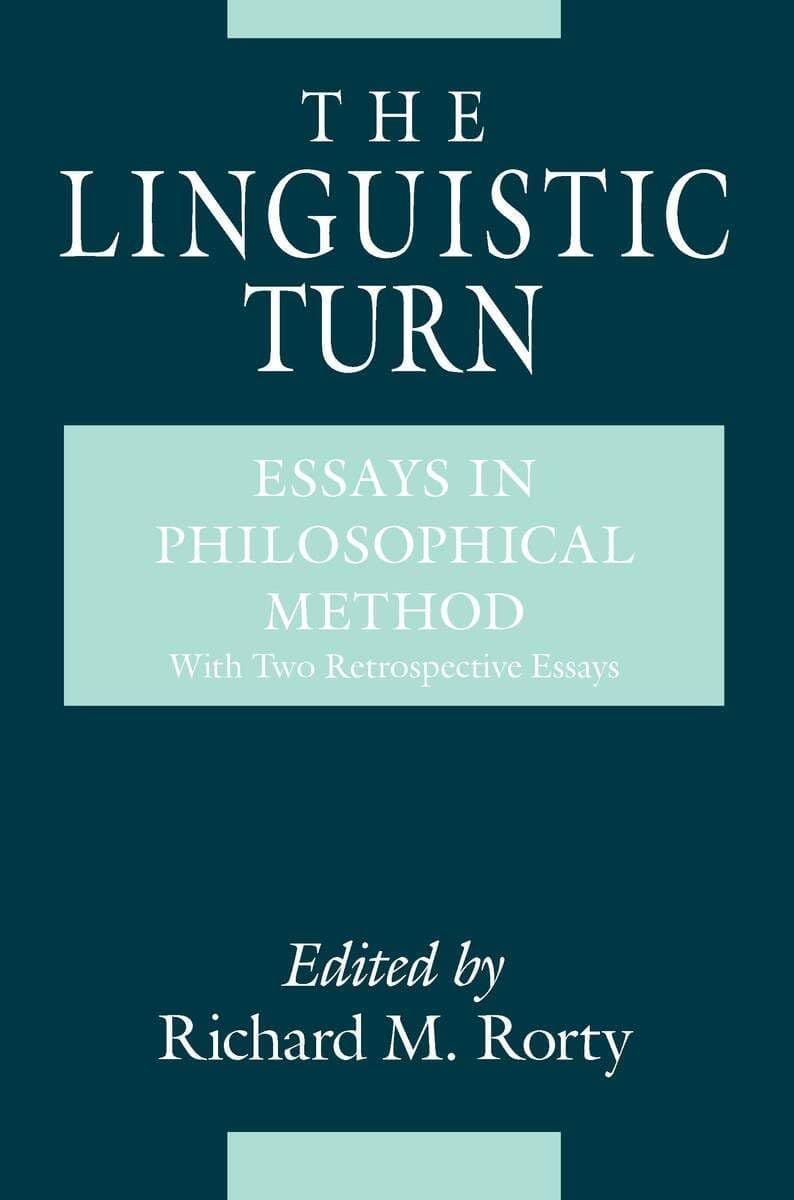
The Linguistic Turn: Recent Essays in Philosophical Method
Rorty's editorial thesis, argued in his lengthy introduction, is that the 'linguistic turn' is not a single doctrine but a methodological revolution: philosophical problems are to be solved or dissolved either by reforming language or by understanding more about the language we already use. The anthology's distinctive mechanism is its division into ideal-language philosophy (Carnap, Bergmann) and ordinary-language philosophy (Ryle, Austin, Strawson), followed by recapitulations that expose the metaphilosophical assumptions each side shares. Rorty frames the volume as materials for reflection on whether this revolution succeeds—not as a partisan manifesto for it.
Key Insights
✦What does Rorty mean by 'the linguistic turn,' and why does he refuse to define it as a single thesis?
Rorty introduces the phrase in his 1967 introduction to name 'the most recent philosophical revolution, that of linguistic philosophy'—the view that philosophical problems may be solved or dissolved either by reforming language or by understanding more about the language we presently use . He deliberately avoids treating this as one doctrine, because the anthology's contents reveal that ideal-language philosophers (Carnap, Bergmann) and ordinary-language philosophers (Ryle, Austin, Strawson) justify their methods with incompatible substantive theses. Some appeal to the verification principle, others to ordinary language as correct language, and others simply ask to be judged by their fruits. Rorty's refusal to define the turn is itself a metaphilosophical move: it keeps open the question of whether the revolution succeeds.
✦How is the anthology structured, and what does the structure reveal about Rorty's argument?
The volume falls into four parts. Part I collects 'classic statements' of the thesis that philosophical questions are questions of language, from Schlick and Carnap to Ryle, Wisdom, and Malcolm. Part II addresses metaphilosophical problems of ideal-language philosophy, including exchanges between Copi and Bergmann and essays by Black and Chisholm. Part III turns to ordinary-language philosophy, with pieces by Chisholm, Passmore, Hare, Geach, and assessments of J. L. Austin by Urmson, Hampshire, and Cavell. Part IV collects recapitulations and future prospects, including Strawson's 'Analysis, Science, and Metaphysics' and the Royaumont colloquium discussion. The structure is dialectical: Rorty presents the thesis, its internal divisions, and then the recapitulations that expose unresolved tensions.
✦Why did Rorty add retrospective essays in the 1992 edition, and what do they reveal about his own trajectory?
The 1992 edition adds two essays, 'Ten Years After' and 'Twenty-Five Years After,' in which Rorty traces how the book was shaped by its moment and where philosophy has gone since . These retrospectives are valuable because they show Rorty reassessing the linguistic turn from the vantage of his later anti-representationalism. Colin Koopman argues that the linguistic turn should be read as a methodological suggestion—'when analyzing x, try looking at how we talk about x'—rather than as the substantive thesis that language is all there is . On this reading, Rorty's later work extends the methodological insight of the 1967 volume while abandoning the metaphysical baggage that some of its contributors carried.
✦How was the anthology received, and what does its reception tell us about the linguistic turn's trajectory?
The volume was praised for its editorial judgment. A Review of Metaphysics endorsement, quoted on the publisher's page, called it a collection that 'reflects imagination, command, and comprehensiveness,' and reader commentary singles out Rorty's introduction as 'a masterpiece of critical philosophy' that synthesizes decades of debate . At the same time, the linguistic turn itself came under sustained attack from within analytic philosophy and from Rorty's own later work. By the late 1970s, as one German scholarly introduction notes, the linguistic turn was widely considered 'overcome,' even though the question of whether it had been overcome kept being asked . The anthology thus documents a revolution at its height and supplies the materials for its subsequent critique.
✦What is the relationship between this anthology and Rorty's Philosophy and the Mirror of Nature?
The Linguistic Turn is Rorty's first major editorial statement of the metaphilosophical position that Philosophy and the Mirror of Nature would later dismantle from within. In 1967, Rorty presented linguistic philosophy as a revolution with two competing wings and an unresolved question about whether philosophical problems really are problems of language. By 1979, he had concluded that the representationalist framework underlying both wings was the real obstacle. Koopman argues that the linguistic turn informs Rorty's later critiques of foundationalism, but also that Rorty never fully succeeded in explicating normativity without foundations . The anthology is therefore both a precursor and a document of the position Rorty would eventually abandon.
✦What does Rorty's selection of contributors reveal about his philosophical allegiances at the time?
The roster is heavily analytic, with Carnap, Bergmann, Ryle, Austin, Strawson, Black, and Chisholm dominating. There is no Dewey, no Heidegger, no Wittgenstein essay included—though Wittgenstein's influence saturates the ordinary-language section. This selection reflects Rorty's formation as an analytic philosopher at Princeton and his immersion in the debates of the 1950s and 1960s. The inclusion of Quine's 'Semantic Ascent' from Word and Object signals the importance Rorty placed on Quine's critique of the analytic-synthetic distinction, which would become a cornerstone of his later pragmatism. The absence of explicitly pragmatist sources is telling: in 1967, Rorty was still presenting the linguistic turn as an analytic revolution, not yet claiming Dewey as an ancestor.
Wealthy Psyche is an intellectual archive. We do not host, distribute, or sell book copies — physical or digital. We provide structured knowledge to help you think better, faster.