


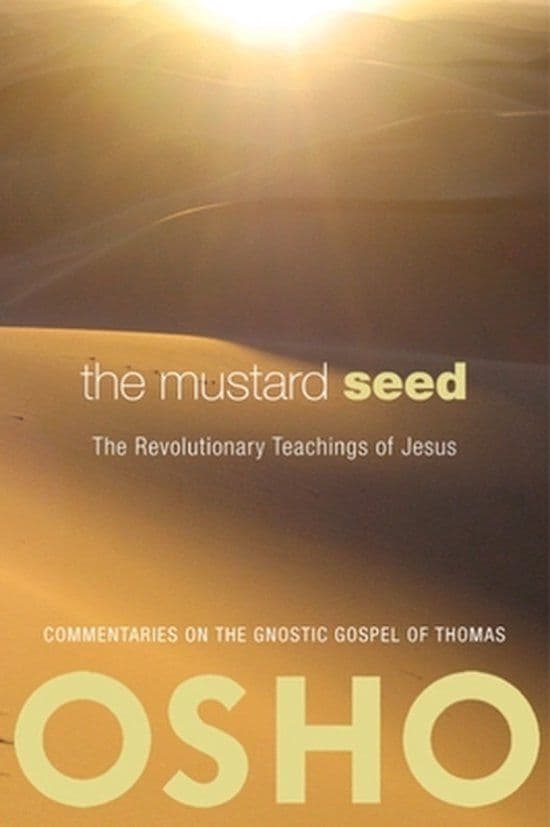
The Mustard Seed

The Mustard Seed is Osho's discourse series on the Gospel of Thomas, and its central move is to treat each logion as a seed for extemporaneous commentary rather than a text to be exegeted historically. Osho's method is associative and provocative: he reads Thomas's sayings through Vedantic non-dualism, Zen paradox, and a persistent anti-institutional critique, arguing that Jesus's kingdom is an inner state accessible only by dissolving the ego, not by belief or ritual. The book's distinctive contribution is less a thesis about Thomas than a demonstration of Osho's late-1970s teaching style.
Key Insights
✦What is Osho's central interpretive move in The Mustard Seed?
Osho treats each saying from the Gospel of Thomas not as a historical artifact or a theological proposition but as a 'seed'—an occasion for associative, extemporaneous commentary. His method is to read Thomas's logia through a lens that blends Vedantic non-dualism, Zen paradox, and a persistent critique of institutional religion. The book's governing claim is that Jesus's kingdom is an inner state, not an external event, and that it becomes accessible only when the ego dissolves. This is why Osho spends little time on the Gospel of Thomas's historical context or Gnostic theology and instead uses its sayings to launch wide-ranging discourses on love, fear, death, and the mechanics of self-transcendence .
✦When and where were these discourses originally delivered and published?
The talks that became The Mustard Seed were delivered in Poona (now Pune) in 1974, between August 21 and September 10, according to a Romanian bibliographic source . The first English edition was published by Rajneesh Foundation in Poona in 1975, a 508-page volume compiled by Swami Amrit Pathik and edited by Swami Satya Deva . This places the book in Osho's early Poona period, before the move to Oregon, when his discourse style was already established but the institutional apparatus of Rajneeshpuram had not yet taken shape. Later editions from Osho Media International (2010) and various international publishers substantially revised the presentation and subtitle .
✦How does Osho's reading of Jesus relate to his broader philosophical framework?
Osho consistently presents Jesus as a mystic in the Vedantic mold rather than a Jewish prophet or Christian savior. In one passage from the book, he argues that Jesus's sayings align more closely with the Upanishads than with the Old Testament, claiming that Jesus was 'a pure Hindu' in his metaphysical orientation even while living as a Jew . This is not a historical argument but a rhetorical strategy: by de-Judaizing and de-Christianizing Jesus, Osho frees the Thomas sayings for use as universal spiritual wisdom. The move mirrors his broader approach to religious traditions—treating them as repositories of mystical insight that must be extracted from their dogmatic and institutional encrustations.
✦How has the book been received, and what happened with its Christian publisher?
The Mustard Seed found an unexpected initial audience among Christian readers. Osho later recounted that Sheldon Press, a Christian publishing house in London, published the book along with eight others, and that it was 'accepted all over the Christian world as something unique' . However, Sheldon withdrew all of Osho's books after a talk in which he made provocative claims about Jesus's physical appearance. According to Osho's account, the publisher sold the remaining stock to a recycler, but his followers tracked down the books and returned them to circulation . This episode illustrates the book's ambiguous position: it attracted Christian interest while remaining fundamentally incompatible with Christian orthodoxy.
✦What is the most common misreading of The Mustard Seed?
A frequent misreading treats the book as a work of biblical scholarship or as a reliable guide to the Gospel of Thomas's original meaning. Osho himself was explicit that his interest was not historical or philological. In a later discourse, he stated that when he spoke on Jesus, 'it had nothing to do with Jesus'—he was 'playing with words' . This does not make the discourses worthless, but it does mean that readers seeking to understand the Gospel of Thomas as a second-century Gnostic text should look elsewhere. The Mustard Seed is a record of Osho's performative teaching, not an exegetical commentary, and judging it by the standards of biblical criticism mistakes its genre.
✦What are the textual issues with the various editions of The Mustard Seed?
The book's editions vary significantly in title, length, and framing. The 1975 Rajneesh Foundation edition was subtitled 'Discourses on the Sayings of Jesus Taken from the Gospel According to Thomas' and ran 508 pages . The 2010 Osho Media International edition is subtitled 'The Revolutionary Teachings of Jesus,' runs 432 pages, and presents the material in a more streamlined format aimed at contemporary readers . Dutch and other European translations sometimes split the work into multiple volumes . No scholarly critical edition exists, and the relationship between the spoken originals, the 1975 compilation, and later editorial revisions has not been documented in peer-reviewed literature.
Wealthy Psyche is an intellectual archive. We do not host, distribute, or sell book copies — physical or digital. We provide structured knowledge to help you think better, faster.