


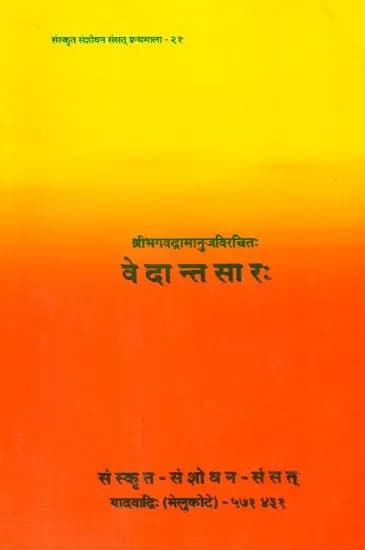
Vedanta Sara

The Vedanta Sara is Ramanuja's most concise commentary on the Brahma Sutras, and its distinctive function is introductory rather than polemical. Where the Sri Bhashya argues at length against Advaita and the Vedanta Dipa presupposes some philosophical training, the Vedanta Sara presents the kernel meaning of each sutra in one or two lines, explicitly avoiding dialectical confrontation. Tradition holds it was Ramanuja's first Brahma Sutra commentary, written for beginners who lack the time or preparation for the full Sri Bhashya. Its central claim is that the Upanishads, systematically read, teach Brahman as the sole cause and ground of a real, differentiated world.
Key Insights
✦What is the Vedanta Sara's distinctive function among Ramanuja's three Brahma Sutra commentaries?
Ramanuja wrote three commentaries on the Brahma Sutras, and the Vedanta Sara is the most elementary. Publishers and traditional accounts describe it as intended for beginners: it presents the purport and kernel concepts of each sutra in just one or two lines, making it useful to those who lack the time to study the longer Sri Bhashya . The Hindu notes that of the three, 'the Vedanta Sara is for the beginners and the Vedanta Deepa is for students in the advanced level' . Unlike the Vedanta Dipa, which has an elaborate introduction critically reviewing Advaita, the Vedanta Sara deliberately avoids dialectics and focuses solely on bringing out the essence of the Upanishads .
✦Is the Vedanta Sara traditionally regarded as Ramanuja's first Brahma Sutra commentary?
Yes, this is the traditional account. Exotic India Art and Motilal Banarsidass both state that 'it is said that Vedantasara was his first commentary on Brahmasutras' . The reasoning offered is that its initial circulation may have provoked arguments and counter-arguments from opponents and followers during Ramanuja's own lifetime, prompting him to write a more elaborate defense that culminated in the Sri Bhashya. This chronological priority, if accepted, would make the Vedanta Sara a window into Ramanuja's earliest sustained engagement with the Brahma Sutras, before the full polemical apparatus of his mature system was assembled.
✦What is the relationship between the Vedanta Sara and the Sri Bhashya?
The relationship is one of simplification and accessibility rather than independent development. Wikipedia summarizes the scholarly consensus that Ramanuja wrote the Vedanta Dipa and Vedanta Sara 'to aid in the overall understanding of the Sri Bhashya' . Exotic India Art elaborates: the Sri Bhashya is the elaborate commentary, the Vedanta Dipa is an abridged form of it following the systematic five-part presentation, and the Vedanta Sara presents the essence in a more compressed format . The Vedanta Sara does not introduce new doctrines; it condenses the same Visishtadvaita reading of the sutras—Brahman as the efficient and material cause, the reality of distinct selves—into a form accessible to readers without specialist training.
✦What English translations of the Vedanta Sara exist?
English access has a longer history than for most of Ramanuja's minor works. The earliest translation appears to be J. R. Ballantyne's 1898 rendering, published by the Christian Literature Society for India, held in the French Institute of Pondicherry library . The standard modern edition is the Adyar Library publication, edited by Pandit V. Krishnamacharya with English translation by M. B. Narasimha Ayyangar, first published in 1953 and reprinted in 1979 . This edition includes the Sanskrit text with English translation and remains the most widely cited English version. No critical scholarly edition with full philological apparatus appears to be in wide circulation.
✦What is the most common misreading of the Vedanta Sara?
A persistent misreading treats the Vedanta Sara as a lesser or derivative work because it lacks the Sri Bhashya's argumentative depth and polemical rigor. This misunderstands its deliberate design. The text explicitly sets out to present the essence of Vedanta without entering into dialectics . Its brevity is not a failure of rigor but a pedagogical choice: it is meant to give beginners and busy readers the core conclusions of Visishtadvaita without requiring them to master Nyaya, Mimamsa, and the full commentarial apparatus. Reading it as a failed Sri Bhashya misses its function as Ramanuja's most accessible introduction to his Brahma Sutra interpretation, valuable precisely for what it omits.
Wealthy Psyche is an intellectual archive. We do not host, distribute, or sell book copies — physical or digital. We provide structured knowledge to help you think better, faster.