


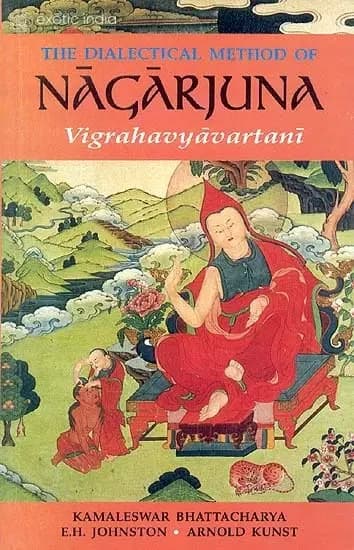
Vigrahavyāvartanī (Refutation of Objections)

The Vigrahavyāvartanī is Nāgārjuna's defensive reply to critics of his own emptiness doctrine, and its distinctive contribution is the 'no-thesis' (pratijñā) position: Nāgārjuna claims he asserts nothing, so the objection that his own words must be empty or self-refuting misses the mark. Written in a question-and-answer style, the text extends Madhyamaka analysis into epistemology and philosophy of language—areas the Mūlamadhyamakakārikā leaves largely untouched—asking how epistemic instruments can be established if all things lack intrinsic nature.
Key Insights
✦What is the 'no-thesis' position, and why is it central to the Vigrahavyāvartanī?
The no-thesis position is Nāgārjuna's response to the charge that his own emptiness doctrine is self-refuting. Critics argue: if all things are empty, then Nāgārjuna's statements are also empty, and therefore cannot refute anything. Nāgārjuna replies that he advances no thesis (pratijñā)—no positive proposition about the nature of reality—and that his words function only as therapeutic negations, dismantling the opponent's reification without substituting a new metaphysical claim. Jan Westerhoff's commentary identifies the no-thesis view as one of the text's ten major thematic units . This move is philosophically controversial: it raises the question of whether a text can coherently refute without asserting, and whether the no-thesis position is itself a thesis in disguise.
✦How does the Vigrahavyāvartanī differ from the Mūlamadhyamakakārikā in subject matter?
The MMK is primarily a metaphysical and dialectical treatise, dismantling categories like causation, motion, and the self. The Vigrahavyāvartanī shifts focus to epistemology and philosophy of language—topics Nāgārjuna addresses nowhere else with comparable depth . It asks how epistemic instruments (pramāṇas) can be established if nothing possesses intrinsic nature, whether words refer to real objects, and how negation functions in a world without svabhāva. Westerhoff notes that the text's question-and-answer format makes it more accessible than the MMK's compressed verses, while its arguments about knowledge and language anticipate problems that later Buddhist epistemologists would develop in different directions.
✦What is the textual history of the Vigrahavyāvartanī, and how does it affect English translations?
The Sanskrit text survives and has been critically edited by E. H. Johnston and Arnold Kunst, with their edition reprinted in Kamaleswar Bhattacharya's 1978 translation . However, Jan Westerhoff's 2010 translation is based on a more recent edition by Yonezawa (2008), which incorporates manuscript material discovered after earlier translations were produced . This means Bhattacharya's rendering, while historically important, reflects an older textual basis. Westerhoff also addresses the scholarly debate over the text's authenticity, discussing arguments that it may not have been composed by Nāgārjuna . The existence of multiple Sanskrit editions and an unresolved authenticity question make the Vigrahavyāvartanī a text where translation choices and textual scholarship are inseparable.
✦How does the Vigrahavyāvartanī argue against the self-establishment of epistemic instruments?
The text examines whether epistemic instruments—perception, inference, testimony—can validate themselves or require other instruments to establish them. If an instrument must be established by another instrument, this leads to infinite regress; if it establishes itself, the text asks how self-validation differs from circularity. Nāgārjuna deploys analogies including fire (which burns itself and other things) and the father-son relation to probe these problems. Westerhoff's commentary organizes these arguments under the heading 'Establishing the epistemic instruments' and 'The epistemic instruments as self-established' . The conclusion is not that knowledge is impossible, but that epistemic instruments, like all phenomena, lack intrinsic nature and function only conventionally.
✦What is the most common misconception about the Vigrahavyāvartanī's purpose?
A frequent misreading treats the text as a positive exposition of Nāgārjuna's own philosophical system—as though it were a Madhyamaka summa answering all objections with settled doctrine. In fact, the Vigrahavyāvartanī is defensive and dialectical: it responds to specific criticisms without constructing an alternative metaphysics. Nāgārjuna does not argue that emptiness is the ultimate truth in a substantial sense; he argues that the charge of self-refutation fails because he advances no thesis. Reading the text as a systematic treatise rather than a targeted rejoinder misses its rhetorical situation and overstates its doctrinal positivity. The no-thesis position, whether or not one finds it convincing, signals that the text's aim is therapeutic rather than constructive.
✦Which English translation of the Vigrahavyāvartanī is preferable for serious study?
Jan Westerhoff's 2010 The Dispeller of Disputes (Oxford University Press) is the most current and philosophically engaged English edition, incorporating the Yonezawa Sanskrit edition and providing extensive commentary that connects Nāgārjuna's arguments to contemporary epistemology and philosophy of language . Kamaleswar Bhattacharya's 1978 The Dialectical Method of Nāgārjuna (Motilal Banarsidass) remains valuable for its Sanskrit text and earlier scholarly apparatus, and it was the standard English rendering for decades . For readers seeking philosophical analysis alongside translation, Westerhoff is the clear choice. For those interested in the history of scholarship or needing the Johnston-Kunst Sanskrit edition, Bhattacharya remains useful, though its textual basis is older.
Wealthy Psyche is an intellectual archive. We do not host, distribute, or sell book copies — physical or digital. We provide structured knowledge to help you think better, faster.