



Yuktiṣaṣṭikā (Sixty Verses on Reasoning)
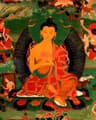
The Yuktiṣaṣṭikā is a compact Madhyamaka treatise in which Nāgārjuna frames reasoning as soteriological therapy rather than metaphysical construction. Its distinctive contribution is the sustained treatment of the two truths—absolute (paramārtha-satya) and conventional (saṃvṛti-satya)—through the lens of dependent origination, arguing that the world's likeness to a mirage or a banana tree's corelessness is not a denial of experience but the condition of liberation. Unlike the Mūlamadhyamakakārikā's exhaustive dialectic, this text addresses the practitioner's cognitive transformation directly.
Key Insights
✦What is the Yuktiṣaṣṭikā's distinctive contribution to Madhyamaka thought?
The text's governing concern is the relationship between the two truths—absolute (paramārtha-satya) and conventional (saṃvṛti-satya)—articulated through dependent origination . Where the Mūlamadhyamakakārikā systematically dismantles categories, the Yuktiṣaṣṭikā addresses the practitioner's cognitive predicament: how clinging to views, even the view of emptiness, obstructs liberation. The text's similes—the banana tree with no core, the city of gandharvas, the mirage—serve not as metaphysical assertions but as therapeutic correctives. The goal is not to establish a new doctrine but to induce the cognitive shift in which phenomena are seen as dependently arisen and therefore neither real nor unreal, neither existent nor nonexistent.
✦Does a Sanskrit original of the Yuktiṣaṣṭikā survive?
Yes, the Sanskrit text survives and has been critically edited by B. Kumar, whose edition was published in The Tibet Journal in 1993 . This is significant because it distinguishes the Yuktiṣaṣṭikā from several other Nāgārjuna works—such as the Śūnyatāsaptati and Vaidalyaprakaraṇa—that survive only in Tibetan translation. However, the Sanskrit textual situation is not straightforward: scholarly discussion has noted discrepancies between the Sanskrit verses and the canonical Tibetan translation, and Śāntarakṣita and Ratnākaraśānti quote verse 21 in a form that differs from the Tibetan canonical reading . Modern translators thus navigate between Sanskrit and Tibetan witnesses that do not always agree.
✦How does Candrakīrti's commentary shape the interpretation of the Yuktiṣaṣṭikā?
Candrakīrti's Yuktiṣaṣṭikāvṛtti is the principal Indian commentary on the text and has exerted enormous influence on its reception, particularly in Tibetan scholastic traditions. Joseph Loizzo's 2007 translation, republished in a second edition in 2024, presents Nāgārjuna's verses alongside Candrakīrti's commentary, making the commentarial mediation explicit . Loizzo's introduction draws comparisons between Candrakīrti's reasoning and Wittgenstein's later philosophy, framing the text's arguments as therapeutic rather than foundationalist . This interpretive frame is not neutral: it presents the Yuktiṣaṣṭikā through a Candrakīrti-inflected, Prāsaṅgika lens, and readers should be aware that other commentators, such as the Yogācāra-influenced Ratnākaraśānti, read the same verses in markedly different ways .
✦How have later Buddhist thinkers used the Yuktiṣaṣṭikā for their own philosophical projects?
The text became a site of interpretive contestation. Śāntarakṣita and Kamalaśīla quoted verses 21 and 34 to support a Yogācāra-Madhyamaka synthesis, while Ratnākaraśānti read the same verses through a Yogācāra theory of the three natures, in effect 'Cittamātrising' Nāgārjuna to show that he taught the Madhyamaka of the three natures . Atiśa, by contrast, interpreted verse 34 in terms of dependently arisen mere appearances that are conjunctions of form and emptiness, a reading that Ratnākaraśānti criticized as pseudo-Madhyamaka . This history of interpretation demonstrates that the Yuktiṣaṣṭikā's compressed verses do not dictate a single doctrinal position; their brevity and allusiveness allowed later thinkers to recruit Nāgārjuna for competing philosophical programs.
✦What is the most common misreading of the Yuktiṣaṣṭikā's similes?
A persistent misreading treats the text's similes—the banana tree, the mirage, the city of gandharvas—as straightforward metaphysical assertions that phenomena do not exist. In the Yuktiṣaṣṭikā's argument, these images function differently: they illustrate that phenomena lack a core or essence, not that they are absent. The banana tree, when stripped of its layers, reveals no substantial heartwood, but the tree was there to be stripped. The mirage is a real perceptual event that is falsely cognized as water. The text's soteriological aim is to correct the false cognition, not to deny the conventional reality of the dependently arisen process. Reading the similes as nihilistic declarations inverts the text's therapeutic purpose and misses its careful negotiation between existence and nonexistence.
✦How does Loizzo's translation compare with earlier English renderings?
Loizzo's translation, first published in 2007 and reissued in a second edition in 2024, is distinctive for presenting the Yuktiṣaṣṭikā together with Candrakīrti's commentary and for its substantial introductory study . Earlier translations, such as those in Fernando Tola and Carmen Dragonetti's volume containing the Yuktiṣaṣṭikākārikā alongside the Śūnyatāsaptati and Catustava, offered more compact renderings without the full commentarial apparatus . Loizzo worked from the Tibetan translation rather than the Sanskrit, as the title page states explicitly . This choice means his rendering reflects the Tibetan canonical tradition and Candrakīrti's commentarial reading, rather than the Sanskrit text as reconstructed by Kumar. Readers seeking philological precision on the Sanskrit should consult Kumar's edition alongside Loizzo.
Wealthy Psyche is an intellectual archive. We do not host, distribute, or sell book copies — physical or digital. We provide structured knowledge to help you think better, faster.