


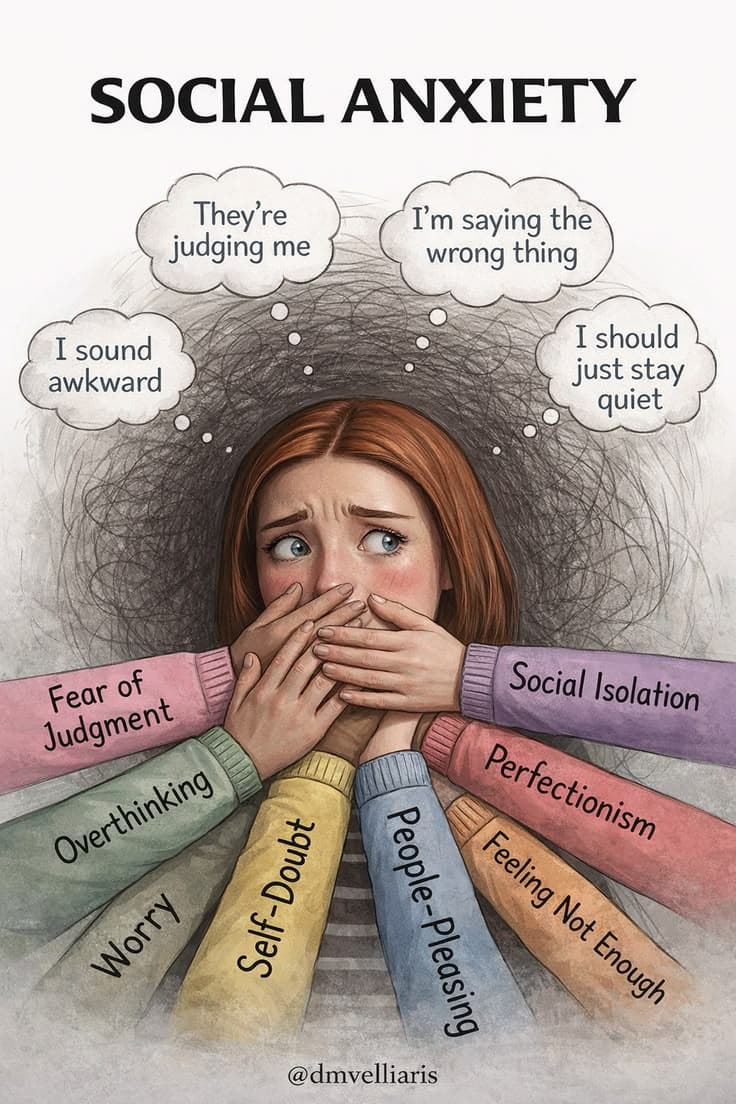
Anxiety arrives without an invitation, floods the body with heat or cold, and whispers of a catastrophe that feels both imminent and unknowable. The modern impulse, reflected in countless quick-fix solutions, is to treat anxiety as a malfunction—an error in neural circuitry, a chemical imbalance to be corrected, a cognitive distortion to be restructured. Psychoanalysis begins elsewhere. It does not ask how to silence anxiety but instead asks: what is this dread trying to say? This shift reframes the entire problem. Anxiety, from a psychoanalytic perspective, is not a meaningless glitch but a message from a part of the psyche that has been exiled, a compromise formation between a forbidden impulse and the forces that repress it. To engage with anxiety psychoanalytically is to descend into the unconscious conflicts, infantile wishes, and repressed memories that generate its signal, and to discover that the relief sought lies not in eradication but in understanding—a process that transforms the very structure of one's being.
This article explores how psychoanalysis helps with anxiety not by offering techniques or reassurances, but by attending to the hidden logic of the symptom. We will move through Freud's foundational insights, Lacan's radical reframing, and the clinical practice that brings the unconscious into speech. Along the way, we will challenge the assumption that anxiety is an enemy to be defeated, examine the bodily terrain where anxiety manifests, and investigate why the digital age—with its relentless demands for visibility and enjoyment—has become a breeding ground for new forms of dread. The aim is not to persuade but to illuminate, to offer a way of thinking about anxiety that resonates with the complexity of lived experience rather than reducing it to a problem to be solved.
1. The Two Anxieties: Signal and Traumatic Overwhelm
Freud distinguished between two fundamental modes of anxiety that remain indispensable for understanding the psychoanalytic approach. The first, signal anxiety, is a low-voltage warning emitted by the ego when an unconscious, repressed impulse threatens to break into consciousness. Like a smoke detector sensing a fire behind a wall, signal anxiety alerts the psyche to mobilize defenses—repression, denial, avoidance—that keep the dangerous material out of awareness. This form of anxiety is not pathological; it is a necessary function of psychic life, a guardian at the gate of the forbidden. Without it, the ego would be constantly invaded by wishes and memories too threatening to integrate.
The second form, traumatic anxiety, arises when the defenses fail. It is the experience of being flooded, helpless, overwhelmed by a quantity of excitation that cannot be bound or processed. This is the panic attack, the night terror, the sensation of falling apart—states in which the psychic apparatus is no longer a container but a sieve. Traumatic anxiety echoes the original helplessness of the infant, the Hilflosigkeit that marks the human condition from birth. For Freud, all later anxiety draws upon this primal state of psychical inundation. What distinguishes psychoanalysis from other treatments is its willingness to explore both the signal and the trauma, to trace the signal back to its source rather than merely muting the alarm.
The Birthplace of Anxiety: Separation and the Loss of the Object
One of Freud's most enduring clinical observations is that the prototype of all anxiety lies in the infant's experience of separation from the mother. The sudden absence of the caregiver, the hunger that is not answered, the darkness unbroken by a familiar face—all produce a state of mounting tension that the infant cannot discharge. This experience of loss and longing becomes the template for later anxieties, from the fear of abandonment in love to the existential dread of death. Psychoanalysis helps patients trace their adult anxieties back to these early object losses, not to indulge in blame but to understand the emotional grammar they inherited. By speaking the unspeakable, the analysand gradually separates the present danger from the archaic one, loosening the grip of a terror that belongs to a time before memory.
2. The Unconscious Conflict: What Anxiety Guards
Anxiety, from a psychoanalytic vantage, is never a primary phenomenon; it is a derivative, a compromise. It signals the presence of an unconscious wish that seeks expression and the equally unconscious prohibition that forbids it. These wishes can be aggressive, sexual, dependent, or narcissistic—impulses that were once forbidden by parents or society and have since been internalized as the punitive superego. The energy of the forbidden wish, blocked from direct satisfaction, is transformed into anxiety, which then attaches itself to a more acceptable object—a phobia, an obsession, a vague sense of doom. The phobic who cannot ride an elevator is not afraid of the small metal box; they are terrified of the claustrophobic proximity of bodies and the forbidden fantasies that proximity might awaken.
Psychoanalysis helps by reversing this displacement. Through free association, the patient slowly uncovers the real source of the anxiety. This is not a cognitive exercise; the unconscious does not respond to direct questioning. It reveals itself in slips of the tongue, in the gaps and hesitations of speech, in the dreams that seem nonsensical, in the patient's relationship to the analyst herself. The work is archaeological, not educational. The analyst does not explain the patient's anxiety to them; she creates the conditions in which the patient can hear, for the first time, what they have been unconsciously saying all along.
The Return of the Repressed: When the Past Breaks Through
A repressed memory or wish is not inert; it exerts a constant pressure toward consciousness, seeking discharge. The more rigid the repression, the more intense the counterforce, and the more likely the system is to rupture in a crisis. Anxiety often intensifies precisely when a long-buried truth is on the verge of breaking through—a forgotten trauma, a disowned desire, a rage that was too dangerous to feel. Psychoanalysis views these acute episodes not as setbacks but as opportunities. The anxiety is the clue, pointing to the seam where the unconscious is pressing against the conscious. By following the anxiety rather than fleeing it, the patient can integrate what was split off, reducing the need for the symptom. The relief is not immediate but structural, a rewiring of the psychic economy rather than a temporary sedation.
3. The Analytic Speech Act: Why Talking Helps
The talking cure is often misunderstood as a simple catharsis, a venting of emotion that provides relief. Psychoanalysis, however, posits a more radical claim: speech itself restructures the psyche. When a person puts an unnamed dread into words, they do not simply describe a pre-existing state; they transform it. Unarticulated anxiety is diffuse, somatic, invasive; spoken anxiety becomes an object that can be examined, related to, and eventually placed within a narrative. Lacan radicalized this insight by arguing that the unconscious is structured like a language, and that the subject is constituted through speech addressed to an Other. Anxiety, in this view, is what happens when something cannot be symbolized, when there is no signifier to absorb the excess of the real. The analytic session is a space where the unsayable can begin to find its signifiers.
Free Association and the Surprising Voice
The fundamental rule of psychoanalysis—say whatever comes to mind, without censorship—is a technique designed to bypass the ego's editing. It allows material that would normally be dismissed as trivial, shameful, or irrelevant to enter the room. In this stream of seemingly disconnected fragments, patterns emerge that the conscious mind would never deliberately construct. The patient might begin by describing a headache, drift to a childhood memory of a schoolyard humiliation, then mention a dream about falling, and suddenly the analyst hears the shape of a repressed conflict. Anxiety, which had been floating without context, begins to anchor itself in personal history and unconscious meaning. The act of speaking in the presence of a trained listener, someone who does not judge, reassure, or interrupt the flow, is itself therapeutic—it creates a new relationship to one's own interior, one in which the scary thoughts can be hosted rather than expelled.
4. The Body and the Symptom: When Anxiety Speaks Somatic
One of the most persistent misconceptions about anxiety is that it is solely a mental state. Psychoanalysis, from its earliest days with hysteria, recognized that the body is the unconscious's primary stage. Freud's patients presented with paralysis, blindness, choking sensations, and chronic pain for which no organic cause could be found. These were not imaginary; they were conversions—psychic conflict translated into bodily idiom. Modern psychoanalysis continues to encounter this: the tension headache that appears every Sunday evening before the workweek, the stomach cramps that flare during family gatherings, the panic that arrives as chest pain indistinguishable from a heart attack. In each case, the body is speaking a truth that the conscious mind cannot acknowledge.
Rather than dismissing these symptoms as "just anxiety," psychoanalysis takes them seriously as coded communications. The work involves helping the patient translate the somatic message back into emotional language, to discover that the back pain that makes them feel weak may carry an unconscious identification with a frail parent, or that the hyperventilation before a presentation recreates an early experience of being silenced. The symptom is not an enemy but a text, and analysis is the slow, collaborative process of reading it aloud until it gives up its meaning and, with it, its power over the body.
5. Transference and the Repetition of Anxiety in the Room
Perhaps the most powerful mechanism of psychoanalytic work lies in the phenomenon Freud named transference. The patient inevitably recreates with the analyst the same emotional patterns, conflicts, and anxieties that structure their relationships outside the room. A patient who fears rejection will, at some point, become convinced the analyst is bored or disgusted. Someone who struggles with authority will find the analyst's silence infuriating and persecutory. Rather than viewing this as a complication, psychoanalysis regards the transference as the heart of the treatment. The anxiety is no longer an abstract concept discussed from a safe distance; it is alive in the room, tangible, immediate.
This allows a uniquely effective intervention. The analyst, unlike the original figures from the patient's past, does not react with punishment, seduction, or abandonment. Instead, she interprets the transference: "You are speaking to me as if I were your father, and expecting the same harsh judgment." This interpretation, delivered at the right moment, can puncture the cycle of repetition. The patient experiences the anxiety in real time, but within a relationship that does not confirm the unconscious expectation. Gradually, the old template loosens its grip. The anxiety that once automatically triggered defensive routines becomes a signal that can be observed, questioned, and eventually chosen rather than merely suffered.
"Anxiety is not a failure of the mind but a triumph of the unconscious—a protest against the burial of a truth that demands to be lived."
6. The Superego's Demand: Anxiety and the Command to Enjoy
Freud's early model of anxiety centered on the conflict between the id's drives and the ego's defenses, but his later work recognized a more sinister source: the superego, that internalized voice of moral and social authority that is never satisfied. The superego does not simply prohibit; it commands. It demands that we be happy, successful, fulfilled, loved—and punishes us with anxiety when we fall short. Lacan extended this insight to the contemporary condition, arguing that modern anxiety is fueled less by repression than by the obscene imperative to enjoy. The advertising image of the perfect body, the curated happiness of social media, the corporate culture of relentless optimization—all issue a silent command that cannot be fulfilled without generating a surplus of anxiety.
Psychoanalysis helps patients identify this sadistic voice and separate it from their own desire. The work involves recognizing that the anxiety one feels when scrolling through a feed of seemingly perfect lives is not a personal failure but a response to an impossible demand. As the analysis progresses, the patient begins to discern what they actually want, as opposed to what the Other wants them to want. This is an ethical shift, not just a therapeutic one: it moves the person from a position of anxious compliance to one of authentic, if uncertain, desire. The anxiety does not vanish, but it changes character, from a persecutory voice to a compass needle that trembles when one strays too far from one's own truth.
7. The Gaze and the Digital Age: Social Media Anxiety Through a Lacanian Lens
The anxiety of being watched, evaluated, and compared is ancient, but the architecture of social media gives it a new, relentless intensity. Lacan's concept of the gaze helps illuminate why. The gaze is not the eye looking but the feeling of being looked at from all sides, of being exposed to an Other who judges. Online, the gaze becomes multiplied and disembodied; the user is perpetually aware that their image, their words, their body, are subject to an invisible audience whose judgment can never be fully predicted or controlled. The anxiety of the unread message, the poorly received post, the profile picture that fails to capture the "real" self—all replay the mirror stage's drama of misrecognition, now with infinite mirrors.
Psychoanalysis offers not a solution to digital anxiety but a reorientation. It helps the patient understand that the anxiety is not about the smartphone or the app but about the structure of desire and recognition that the technology amplifies. The need to be seen is archaic, rooted in the infant's dependence on the maternal gaze; the terror of being mis-seen is equally primal. By working through these fundamental dynamics in the safe space of the analysis, the patient can develop a more resilient relationship to the digital gaze—not by eliminating social media but by inhabiting it with less desperation, less identification with the image, and a growing capacity to tolerate being unseen without disintegrating.
Analogue World Anxiety | Digital Mirror Anxiety |
|---|---|
Fear of social judgment in face-to-face encounters | Fear of judgment by an invisible, quantifiable audience |
Immediate feedback through voice, posture, eye contact | Asynchronous, ambiguous feedback (likes, comments, silence) |
The self as a body present among others | The self as a curated image competing with idealized images |
Mistakes witnessed by a limited group | Mistakes potentially visible to millions, archived forever |
Superego commands to conform to communal norms | Superego commands to be unique, happy, and perpetually enviable |
8. Psychoanalysis vs. Other Approaches: A Depth Comparison
Psychoanalysis is often contrasted with cognitive-behavioral therapy (CBT) and pharmacotherapy, and the distinctions illuminate the unique way it addresses anxiety. CBT focuses on identifying and restructuring maladaptive thought patterns, teaching skills to manage symptoms. Medication targets the neurochemical correlates of anxiety, dampening the physiological intensity. Psychoanalysis, by contrast, seeks neither to correct thoughts nor to alter brain chemistry, but to reveal and resolve the unconscious conflicts that generate the anxiety in the first place. The difference is temporal and structural: where CBT aims for relatively quick symptom relief, psychoanalysis pursues a deeper reorganization of the psyche, one that continues long after the sessions end.
Dimension | Psychoanalysis | CBT | Pharmacotherapy |
|---|---|---|---|
View of Anxiety | Meaningful symptom of unconscious conflict | Learned maladaptive thought pattern | Neurochemical imbalance |
Mechanism of Change | Making the unconscious conscious through speech and transference | Cognitive restructuring and behavioral experiments | Altering neurotransmitter levels |
Role of the Past | Central; symptoms rooted in infantile conflicts and history | Secondary; focus on present cognitions | Not directly addressed |
Therapeutic Relationship | Used as a tool to explore transference patterns | Collaborative, but not analyzed in depth | Primarily prescriptive and monitoring |
Duration | Long-term (years, often multiple sessions per week) | Short- to medium-term (weeks to months) | Ongoing, possibly indefinite |
Goal | Structural change, integration, authentic desire | Symptom reduction, functional coping | Symptom suppression |
None of these approaches is inherently superior; each serves different needs. However, for individuals whose anxiety feels ancient, rooted in the core of their identity, or impervious to conscious correction, psychoanalysis offers a depth of engagement that other modalities cannot. The comparison table above is not a ranking but a map of fundamentally different philosophies of the human psyche. Psychoanalysis dares to ask not just "How can I stop feeling this?" but "Who am I, that I feel this, and what does it demand of me?"
9. Resistance and the Limits of Insight: Why Knowing Isn't Enough
One of the most humbling discoveries in psychoanalysis is that intellectual understanding does not dissolve anxiety. A patient may come to see with startling clarity that their panic around intimacy stems from a fear of engulfment linked to a controlling mother, yet the panic persists. This is because the unconscious conflict is not an idea but a force, embedded in the body and repeated in relationships. The ego resists change because the symptom, however painful, also serves a function—it protects against an even greater anxiety, organizes a chaotic inner world, or maintains a crucial, though unconscious, attachment. This is the phenomenon of resistance, and working through it is the essence of analysis.
Working Through: The Slow Labor of Transformation
Working through (Durcharbeitung) is the repetitive, often tedious process by which insight is gradually integrated into the personality. It involves returning to the same material again and again, from different angles, in different contexts, until the ego stops resisting and allows the repressed impulse to be acknowledged not just intellectually but emotionally. This is why psychoanalysis takes time. Each session is a loop in a spiral that descends deeper into the unconscious, and the analyst's patience—her refusal to offer premature reassurance or quick solutions—creates the containing space within which the anxiety can be held long enough to lose its terror. The patient learns that they can survive the anxiety, and that survival, repeated hundreds of times, rewires the brain at a level no cognitive technique can reach.
10. Anxiety as an Ethical Signal: Facing the Real of Existence
Beyond the neurotic mechanisms, psychoanalysis recognizes an anxiety that is not pathological but existential. Kierkegaard, whom Lacan read closely, distinguished between fear, which has an object, and anxiety, which is the dizziness of freedom, the encounter with pure possibility. This is the anxiety that arises when one contemplates a major life choice, faces mortality, or feels the groundlessness of all values. Psychoanalysis does not pathologize such states; it insists they are necessary passages toward a more authentic existence. In Lacanian terms, anxiety is the only affect that does not lie. It signals proximity to the Real—that which resists symbolization—and therefore cannot and should not be medicated away.
The psychoanalytic attitude toward this deep anxiety is not to remove it but to help the analysand bear it without fleeing into neurotic solutions (addiction, conformity, manic activity). This is a spiritual dimension of the work, though entirely secular. The patient gradually develops the capacity to sit with the fundamental uncertainties of existence—the lack in the Other, the absence of any ultimate guarantee—and to discover that this very lack is the condition of desire and creativity. Anxiety, in this light, is not the enemy but the teacher, and psychoanalysis is not a cure but an education in listening to its lessons.
"The only anxiety that does not deceive is the one that signals that something in you knows more than you do, and is asking, with terrible urgency, to be heard."
11. The Silence of the Analyst: Creating a Space for the Unconscious
A distinctive feature of psychoanalysis, often caricatured and misunderstood, is the analyst's relative silence. This is not a technique of withholding but a radical invitation. In ordinary conversation, silence is filled with social reassurance, small talk, advice. In the analytic session, the analyst's silence and neutrality strip away these social props, exposing the patient to their own free associations and the anxiety that arises from them. This deprivation compels the unconscious to speak—first through somatic symptoms, then through memories, dreams, and eventually through words. The analyst becomes a blank screen upon which the patient projects their internal figures, and this controlled regression is the engine of change.
The Analyst as the Subject Supposed to Know
Lacan described the analyst's position as the "subject supposed to know"—the one to whom the patient attributes a hidden knowledge about their suffering. This attribution is essential to the transference; it motivates the patient to speak. But as the analysis proceeds, the analyst gradually divests herself of this assumption, returning the knowledge to the patient. The moment when the analysand realizes that the analyst does not have the answers—that the answers must come from their own unconscious—is a moment of profound anxiety, but also of liberation. The anxiety that had been projected outward returns to its source, and the patient discovers their own authority. This is the end of analysis, not a state of blissful peace but a capacity to question one's desire without looking for an external savior.
12. Beyond Cure: Psychoanalysis as a New Relationship to Anxiety
Psychoanalysis does not promise a life without anxiety. Such a promise would be a fantasy, and analysis is, above all, a process of disillusionment. Instead, it offers something more paradoxical and enduring: a changed relationship to anxiety. The patient who has undergone a deep analysis may still feel anxious before a difficult conversation, but they no longer interpret the anxiety as a sign of their own fundamental inadequacy. They may still wake at 3 a.m. with a nameless dread, but they know how to wait with it, how to listen for the dream that preceded it, how to trace its tendrils back to an old wound that needs attention. The anxiety, once a persecutor, becomes an informant.
This shift changes everything else. Relationships become less reactive because the ancient fears of abandonment or engulfment no longer hijack intimacy. Work becomes more sustainable because the superego's whip is replaced by a more gentle, curious internal voice. The very texture of daily life alters: the quiet moments are no longer filled with a gnawing restlessness but with a possibility of presence. None of this is achieved overnight, nor through insight alone, but through the slow, cumulative effect of being heard at the deepest level by another human being, and through the even slower process of internalizing that listening so that one can, finally, hear oneself.
Before Psychoanalysis | After Psychoanalytic Work |
|---|---|
Anxiety as enemy to be eliminated | Anxiety as signal to be deciphered |
Reactive, unconscious repetition of patterns | Capacity to observe and choose responses |
Identity built on idealized images and social approval | Identity rooted in authentic, if uncertain, desire |
Symptoms suffered passively, mysteriously | Symptoms understood as meaningful communications |
Superego demanding impossible perfection | Internal voice of self-compassion and realistic standards |
Dependence on external validation to quell anxiety | Inner capacity to tolerate uncertainty and lack |
Closing Reflection: The Dread That Opens
Psychoanalysis helps with anxiety not by conquering it but by walking into it, with another person as witness, and discovering that the monster in the dark speaks a language one can learn. It is a strange, demanding, and immeasurably deep process that asks more of the patient than any other therapy—more time, more honesty, more willingness to suffer—and in return it gives not a tranquil life but a real one. Anxiety, in the end, is the guardian of the truths we most need to integrate. To flee it is to remain a stranger to oneself; to approach it with curiosity and courage, supported by the analytic frame, is to reclaim parts of the self that were lost to fear. The question is not how to banish anxiety, but how to let it teach us what we have refused to know.
Frequently Asked Questions
How is psychoanalysis different from regular talk therapy for anxiety?
Unlike supportive or cognitive-behavioral therapies that often focus on present coping strategies, psychoanalysis delves into unconscious conflicts, infantile wishes, and repressed memories that underlie anxiety. It typically involves multiple sessions per week, uses free association, and heavily utilizes the transference relationship with the analyst. The goal is not just symptom reduction but a deep restructuring of the personality, so that the anxiety becomes a meaningful signal rather than a disabling intruder.
Does psychoanalysis work for panic attacks?
Yes, psychoanalysis can be effective for panic attacks, but the approach is distinct from panic management techniques. The analyst helps the patient explore the unconscious triggers and symbolic meaning of the panic attacks, which often represent a breakthrough of traumatic anxiety linked to early experiences of helplessness or forbidden impulses. By putting the unspeakable terror into words within a safe relationship, the intensity and frequency of attacks can diminish as the underlying conflict is resolved rather than merely suppressed.
How long does psychoanalytic treatment for anxiety take?
Psychoanalysis is typically a long-term endeavor, often lasting several years with three to five sessions per week. The duration reflects the depth of the work: it takes time to build the trust necessary for the unconscious to reveal itself, for transference patterns to emerge and be interpreted, and for insight to be worked through and integrated. Some forms of psychodynamic therapy, which apply psychoanalytic principles, may be shorter and less frequent. The length of treatment is always tailored to the individual’s needs and goals.
Can psychoanalysis help with anxiety if I am already on medication?
Yes, combining psychoanalysis with pharmacotherapy is common. Medication may reduce the physiological intensity of anxiety enough to allow the patient to engage in analytic work without being overwhelmed. The psychoanalyst typically does not prescribe medication but may collaborate with a psychiatrist. The analysis addresses the psychological roots of the anxiety that medication alone cannot resolve, aiming for a durable change that may eventually reduce the need for medication.
Why does psychoanalysis focus so much on childhood?
Psychoanalysis holds that the core conflicts generating adult anxiety are formed in early childhood, when the ego is immature and heavily dependent on caregivers. The patterns of attachment, separation, and prohibition established during this period become unconscious templates that shape later emotional reactions. By revisiting and reworking these early experiences in the transference, the patient can free themselves from anachronistic fears and discover new ways of relating, not by blaming parents but by understanding the psychic architecture inherited from them.