


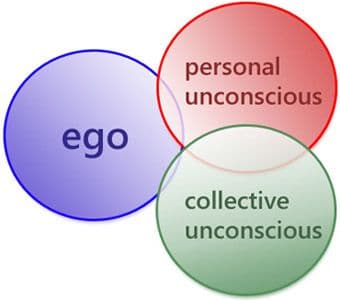
To ask what the collective unconscious is, one must first question the assumption that the mind belongs entirely to the individual. We grow accustomed to thinking of our inner lives as private property—memories stitched from personal experience, dreams woven from the day’s residues, fears shaped by a unique biography. This assumption holds an intuitive comfort: I am the author of my psyche. Yet certain experiences refuse to fit that narrative. A dream presents a figure the dreamer has never encountered, a mythic motif surfaces in a child’s drawing without cultural instruction, a sudden, shared impulse sweeps through a crowd and transforms strangers into a unified force. The collective unconscious is the name Carl Jung gave to the layer of psyche that precedes and transcends the personal—a dimension of mind that we do not create but inherit, one that speaks not in the voice of the individual but in the murmur of the entire human story.
This concept unsettles the modern sense of self. It suggests that beneath the autobiographical, there exists an ancient, universal stratum, structured by patterns Jung called archetypes. These are not images but the psychic equivalent of instincts: forms of perception, feeling, and action that shape experience before conscious thought enters the room. The collective unconscious is not a storage unit of forgotten memories but a living, dynamic ground from which consciousness arises—and into which it can fall. To explore it is to walk the edge between what we think we are and what we have always been, without knowing.
1. The Unconscious Before Jung: A Private Basement
Before Jung deepened the map, the unconscious was largely conceived as a repository of the repressed. Freud’s model gave the Western mind a powerful metaphor: a basement where unacceptable desires, traumatic memories, and forbidden wishes were locked away, occasionally escaping in slips of the tongue or disguised in dream symbols. This personal unconscious was biographical through and through—every occupant of that basement had been personally encountered, then exiled. The work of analysis was excavation: dig into childhood, unearth the buried, make the unconscious conscious, and the symptom would dissolve.
This framework held enormous explanatory power, yet it could not account for the recurring motifs that appeared across cultures, epochs, and individuals who had never been exposed to the same stories. The hero’s journey, the wise old figure, the great mother, the trickster, death and rebirth symbolism—these emerged in the dreams of modern city dwellers who had never read a myth. Jung’s radical move was to propose that the psyche has a floor beneath the personal basement, a level that belongs to no single life but to the species itself. This was not an esoteric leap; it was a clinical observation that forced a redefinition of the unconscious altogether.
Challenging the Boundary of Selfhood
If the unconscious contains material that was never personally acquired, then the boundary between self and world blurs. The very notion of the individual psyche becomes a provisional construct, a temporary edifice resting on impersonal foundations. This does not negate personal history—it contextualises it. The grief you feel at a loss may be yours, but the form of that grief, the archetypal images that arise in mourning rituals, belong to a pattern older than any language. The collective unconscious, then, is not a theory to believe in but an experience that demands a new relationship to one’s own interiority. It asks: to what extent are your most intimate thoughts truly yours?
2. Jung's Discovery: The Depths That Dream Us
Jung did not arrive at the collective unconscious through armchair speculation. His descent came through a confrontation with his own psyche, documented in the then-unpublished Red Book, and through decades of clinical work with patients whose dreams and fantasies overflowed with non-personal, mythic imagery. He noticed that certain motifs in psychotic delusions mirrored ancient mythological themes, that symbols appeared in the dreams of children that echoed alchemical texts the children could not possibly have read. These were not learned; they emerged spontaneously, as if the psyche possessed its own native language, independent of cultural transmission.
The collective unconscious, Jung wrote, is “a boundless expanse, populated with figures that are not of our own making, yet they shape the very contours of our being.” This is not a mystical realm; it is a psychological hypothesis grounded in the observable fact that the human mind repeatedly produces the same fundamental patterns. The hypothesis has a biological parallel: just as the body evolves through inherited morphological structures, so the psyche may inherit its own forms of apprehension. The archetype, in this sense, is the psychical counterpart to the instinct—a pattern of behaviour and meaning that operates without conscious direction.
From Observation to Implication
The profound implication of Jung's discovery is that consciousness does not stand alone but floats upon an immense, impersonal sea. This changes the task of psychology. No longer can we aim merely to untangle personal complexes; we must also learn to navigate the transpersonal currents that rise unbidden in moments of crisis, creativity, and collapse. A person who falls into a profound depression may be encountering not only personal loss but also the archetype of the underworld journey, a descent that cultures once ritualised. Without this lens, the experience can feel like isolated, meaningless suffering. With it, the individual discovers that their pain participates in a larger pattern—one that carries the possibility of renewal. The collective unconscious, therefore, is as much about meaning as it is about structure.
3. The Architecture of the Collective Unconscious: Archetypes as Psychic Organs
If the collective unconscious were a library, archetypes would not be the books but the shelves themselves—the structuring categories that determine what kinds of books can be placed and how they are arranged. Jung described archetypes as “typical modes of apprehension,” primordial forms that organise experience into recognisable patterns. They are not fully formed images but rather dispositions that shape perception, emotion, and action. An archetype is like a gravitational field: invisible until its effects are traced in the movement of conscious life.
Key archetypal patterns include the Persona (the mask one wears for social adaptation), the Shadow (the disowned and often projected darkness), the Anima/Animus (the contrasexual inner figure mediating the unconscious), and the Self (the organising totality that seeks wholeness). But these are not fixed entities; they are dynamic processes. The archetype of the Mother, for instance, is not a specific person but a structuring principle that can manifest as the nurturing caregiver, the devouring devourer, the source of life, or the indifferent nature that gives and takes without compassion. The same archetype can appear as a goddess in myth, an overprotective parent in biography, or a corporate culture that infantilises its employees.
Instinct and Image: The Two Poles of the Archetype
Jung insisted that the archetype has two inseparable poles: the instinctual, biological pole and the spiritual, image-forming pole. The instinctual pole connects the archetype to the body's innate patterns—fear of the dark, the impulse to bond, the urge to dominate or submit. The image pole generates symbolic representations that give these instincts meaning and shape. This means the archetype is not merely a survival mechanism; it is a bridge between matter and psyche, ensuring that even our most animal reactions come wrapped in a veil of significance. When we fall in love, we are not just flooded with hormones; we are seized by an image—the lover, the beloved, the union of opposites—that carries the weight of millennia. To reduce the experience to biology is to miss the very thing that makes it human.
4. The Archetype Is Not the Image: Distinguishing Pattern from Manifestation
A common misunderstanding collapses the archetype into its cultural clothing. The Hero is not a warrior with a sword; that is an image, a specific historical and cultural expression. The archetype itself is the underlying pattern of departure, ordeal, and return, of confronting chaos and bringing back a boon. Every culture fills this pattern with different content—the hero may be a scientist, a single mother, an activist, a mythical figure. The same archetypal structure animates a corporate turnaround story and an ancient epic. Recognising this distinction is crucial because it prevents archetypes from becoming stereotypes, frozen forms that dictate behaviour rather than invite creative unfolding.
The Danger of Literalising the Archetypal
When archetypes are taken literally, they become possessions. A man gripped by the Warrior archetype may live as if every interaction is a battle, incapable of vulnerability. A woman identified with the Mother archetype may lose herself in caretaking until there is no self left to care for. The archetype, when unconscious, rules as fate; when made conscious, it becomes a dialogue partner. The goal is not to act out the archetype but to relate to it, to feel its pull without being dragged under. This is the difference between being a hero and performing heroism—the former is a living engagement with a pattern; the latter is a hollow imitation of an image.
Aspect | Archetype | Stereotype |
|---|---|---|
Nature | Universal pattern, generative | Cultural cliché, reductive |
Expression | Open, can manifest in infinite images | Fixed, predictable image |
Relationship to consciousness | Can be dialogued with, deepened | Unreflective repetition |
Psychological effect | Vitality, meaning, tension | Rigidity, caricature, deadness |
Example | The pattern of transformation through trial | The “strong silent type” as a mask |
5. The Shadow of the Collective: When the Unconscious Possesses the Masses
The collective unconscious is not a harmonious realm of benevolent wisdom. It contains the shadows of humanity as much as its light. When archetypal energies are constellated in a group, they can overwhelm individual judgment and give rise to mass phenomena that no single person would consciously choose. The crowd that cheers for destruction, the online mob that devours a reputation, the nation that falls into collective paranoia—all are expressions of the collective shadow seizing the psyche. In such states, the archetype of the Enemy projects onto a scapegoat, the Hero archetype justifies violence, and the Self archetype becomes identified with a leader or an ideology.
Jung witnessed this firsthand in the rise of totalitarian movements in the 20th century. He saw not just political events but a psychic epidemic, an eruption of unconscious contents that had been denied and repressed by an overly rational, secular culture. The symbols and rituals of mass movements—rallies, uniforms, salutes, mythologised histories—are archetypally charged. They bypass the intellect and speak directly to the collective layer, creating a temporary pseudo-identity that relieves the individual of the burden of being a separate self. The relief is intoxicating, and the aftermath devastating.
The Collective Unconscious in Digital Mobs
This dynamic has not disappeared; it has migrated online. Social media algorithms do not create archetypal possession, but they amplify its conditions. A tweet can constellate the Trickster archetype, sparking a cascade of mockery that feels playful to each participant yet collectively destroys a person. The Hero archetype emerges in the figure of the activist who must be either wholly pure or utterly damned—no nuance permitted. The digital crowd, disembodied and anonymous, becomes an ideal vessel for archetypal forces because the usual brakes of face-to-face empathy are absent. In these moments, the collective unconscious is not a metaphor; it is a felt reality that hijacks individual consciousness with astonishing speed.
6. Dreams as Doorways: The Mythic Language of the Psyche
Dreams, for Jung, were the primary avenue through which the collective unconscious communicates with the conscious mind. But they do not speak in concepts; they speak in images, in the dramatic language of symbol and narrative that predates literacy. A dream of a flood may refer to a personal emotional overwhelm, but it also echoes the great deluge myths found in cultures across the globe. A dream of a wise old figure may draw on a personal teacher, yet the archetype of the Wise Old Man is a transpersonal presence that appears when the dreamer needs orientation beyond ego. The dream is never merely personal; it dips its roots into the ancestral soil every night.
To work with dreams from a collective unconscious perspective is to treat them as visitations, not puzzles to be decoded. The question is not “What does this symbol mean?” but “Who has come to meet me, and what do they want?” This approach changes the dreamer from a detective into a host. A person who dreams repeatedly of being chased may be avoiding a necessary confrontation with the Shadow. The imagery is not a random neural firing but an active compensation from the unconscious, seeking to restore balance to a psyche tilted too far toward conscious control.
The Dream as a Living Myth
In many traditional societies, dreams were shared and interpreted communally because they were understood to belong not only to the individual but to the tribe. The collective unconscious was not a theory but a daily reality; a significant dream could guide a hunt or avert a conflict. Modern dreamers often suffer from privatisation—their dreams feel meaningless because they have lost the communal context that made them legible. Reconnecting with the mythic dimension of dreaming is not about finding a universal dream dictionary; it is about recovering a felt sense that the psyche is larger than the ego and that its nightly visitations are acts of care, however unsettling they may appear.
7. Cultural Dreaming: Collective Unconscious in Myth, Art, and Religion
Myths are the collective dreams of humanity, just as dreams are the personal myths of individuals. Every culture’s stories, rituals, and art forms can be read as expressions of the collective unconscious attempting to make itself known. The hero’s journey, the descent into the underworld, the sacred marriage, the dying and resurrecting god—these are not inventions of clever storytellers but eruptions of archetypal patterns that demand conscious representation. When a myth resonates deeply, it is because the listener recognises, in some pre-rational part of the psyche, a story they have always known.
Religion, too, can be understood psychologically as a container for the collective unconscious. Its symbols—the cross, the mandala, the crescent moon—function as archetypal images that structure the psyche’s relationship to transcendence, suffering, and meaning. Jung was careful not to reduce religion to psychology, arguing that he was describing the psychic reality of these symbols, not their metaphysical truth. Still, his perspective reveals why the loss of living religious symbolism in secular modernity leaves a vacuum. Into that vacuum rush political ideologies, celebrity cults, and self-help systems that mimic religious forms without their depth. The collective unconscious will not remain unexpressed; if one channel is blocked, it finds another, often less conscious and more destructive.
8. The Individual's Encounter: Individuation and the Transpersonal
Individuation—the lifelong process of becoming one’s own whole self—is not a withdrawal from the collective but a conscious relationship to it. The person who individuates does not escape the collective unconscious; they learn to distinguish its voice from the voice of the ego, to hear the archetypal melodies without being swept away by them. This is the difference between being lived by the unconscious and living with it. Individuation demands that one face the personal shadow, yes, but also the collective shadow—the inherited patterns of prejudice, fear, and power that shape one’s culture. It asks for a moral differentiation that is as much about the species as about the self.
The Loneliness of the Archetypal Encounter
To truly meet the collective unconscious is to experience a profound aloneness. The images and voices that arise are not validated by the outer world; they belong to no shared consensus. A person who carries a powerful dream or a visionary experience often has no language to communicate it without sounding unmoored. This is one reason Jung insisted on the importance of a contained, ritualised engagement—through active imagination, painting, writing, or dialogue with a skilled companion. Without such containment, the archetypal encounter can lead to inflation (identification with the archetype) or to a sense of exile from ordinary life. The challenge is to hold the tension between the personal and the transpersonal, letting the collective deepen the individual rather than dissolve it.
9. The Collective Unconscious in Relationships: Anima/Animus and Projection
Nowhere does the collective unconscious reveal its shaping power more intimately than in romantic and relational life. The experience of falling in love often carries an archetypal charge that far exceeds the actual person. Jung’s concepts of anima (the inner feminine in a man) and animus (the inner masculine in a woman) describe unconscious, contrasexual complexes that project onto the other, imbuing them with god-like or goddess-like qualities. When a person says “You are my everything,” they are speaking a literal truth of the psyche: the beloved has become the carrier of the anima/animus archetype, and through them the lover accesses a sense of wholeness temporarily. The inevitable disillusionment is not the failure of love but the withdrawal of projection, demanding that the individual reclaim the archetypal content from the partner and integrate it inwardly.
Projection as a Bridge, Not a Mistake
Rather than viewing projection as a mere error, Jung saw it as the psyche’s way of making unconscious contents visible. The traits we find unbearably irritating in another, the kind of person who “always” does that thing, are often precise indicators of our own unacknowledged shadow material. The collective unconscious ensures that we encounter ourselves in the guise of others. This is especially potent in family dynamics, where children can become vessels for the unlived lives of parents—carrying the archetype of the Golden Child, the Scapegoat, or the Lost One. Becoming conscious of these patterns does not end projection altogether (that would be impossible) but allows a more fluid recognition: “I am seeing something in you that also lives in me, and something in me that I am giving to you.”
Personal Unconscious | Collective Unconscious |
|---|---|
Acquired through individual experience | Inherited, transpersonal, universal |
Content: forgotten memories, repressed traumas, personal complexes | Content: archetypes, primordial images, instinctual patterns |
Unique to the individual’s biography | Common to all humanity across time and culture |
Manifests in personal slips, forgetting, dream day residues | Manifests in myths, fairy tales, cross‑cultural symbols, collective dreams |
Analogical foundation: a private basement | Analogical foundation: the ocean beneath all basements |
Work required: recollection, integration of biography | Work required: differentiation of archetype from ego, symbolic attitude |
10. The Digital Collective Unconscious: Algorithms, Memes, and the Techno-Archetype
The internet has become an uncanny mirror of the collective unconscious. Memes behave like archetypal fragments—simple, emotionally charged, infinitely replicable patterns that bypass rational thought and seize attention. A viral meme is not just a joke; it often constellates a collective feeling, a shared anxiety, or a shadow impulse that had no other outlet. The algorithm, which curates content based on engagement, functions like an unconscious selector, amplifying what resonates with the archetypal predispositions of the crowd rather than what is true or nuanced. The digital sphere does not create the collective unconscious, but it externalises and accelerates its dynamics, making visible what previously simmered beneath the surface of culture.
Identity and the Digital Persona
Online, the Persona archetype undergoes a strange mutation. The persona—the mask one wears for social adaptation—becomes a curated profile, a brand. But because the digital persona is disembodied and persistent, it can be mistaken for the whole self. A person who receives validation for a particular online identity may become inflated by the archetype of the Hero, the Sage, or the Lover, losing touch with the messy, contradictory, offline self. The shadow, meanwhile, does not disappear; it accumulates in the unseen data, the anonymous comments, the trolling that acts out the collective’s disowned cruelty. The digital age demands a new form of psychological hygiene: the ability to hold one’s online presence as a partial, archetypally infused expression, not as a substitute for the living, indeterminate psyche.
“We do not possess the archetypes; they possess us, quietly orchestrating our desires and fears until we turn to meet them.”
11. Collective Trauma and Inherited Wounds: The Unconscious of History
The collective unconscious is not a timeless realm untouched by history. It bears the imprints of collective trauma—war, genocide, colonisation, natural catastrophe—that echo across generations. These imprints form what later Jungians have called cultural complexes, archetypally organised patterns of memory and affect that shape the identity of a group. A nation that has been invaded may carry a collective complex of victimhood and suspicion that activates centuries later in response to a minor geopolitical event. The body remembers what the conscious mind has forgotten, and the collective unconscious transmits what the official history denies.
This does not mean trauma is inherited in a simple Lamarckian sense. Rather, the archetypal patterns provide a ready-made script for traumatic experiences, and the emotional climate of a family or culture silently inducts children into these patterns. A grandchild of a war survivor may dream of flight and persecution without ever having been told the family story. The collective unconscious functions here as a psychic ecosystem in which trauma circulates, seeking expression and resolution. The work of healing cultural trauma requires not only political action but a kind of collective shadow work—a willingness to face the disowned history and its archetypal charge without collapsing into guilt or defensive pride.
12. Misconceptions and Misuses: Where Jung Is Misread
The concept of the collective unconscious has suffered from its own popularity. It is frequently reduced to a catalogue of archetypes—a kind of spiritual personality test—or co-opted by New Age narratives that promise easy access to “ancient wisdom.” Both trivialise Jung’s vision. The collective unconscious is not a benign resource to be downloaded at will; it is an amoral, dynamic force that can heal or destroy. Treating it as a collection of positive affirmations is a form of spiritual bypassing that avoids the genuine darkness and otherness of the psyche.
Another misreading is to interpret Jung’s work as a justification for cultural stereotypes. The anima/animus theory, for example, has been used to reinforce rigid gender roles, when Jung’s original intent was to describe psychic structures that exist in everyone, regardless of biological sex, and that demand integration. The archetypes of the feminine and masculine are not prescriptions but descriptions of polarities within the psyche that, when rigidified, become pathological. A nuanced reading sees them as fluid, relational, and ultimately transcended in the wholeness of the Self.
The Science Question: Is It Real?
Critics demand empirical evidence for the collective unconscious. Jung’s response would likely be that the archetype is a hypothesis that proves itself in the consulting room and in the study of cultural history, not in a laboratory that requires measurable, repeatable effects under controlled conditions. The collective unconscious is a psychological reality, not a biological organ; its evidence lies in the patterns of dreams, myths, symptoms, and transferences that consistently appear across unrelated individuals. The demand for material proof may itself be a kind of defense against the unsettling idea that we are not the masters of our own inner houses. Still, the question remains a living tension: how do we hold a concept that is neither strictly scientific nor purely metaphorical, but occupies a liminal space between the two?
Archetype | Core Dynamic | Shadow/Distortion |
|---|---|---|
Persona | Adaptation to outer world, social role | False self, rigid identification with role |
Shadow | Disowned, repressed aspects of self | Projection, destructive enactment |
Anima/Animus | Inner contrasexual bridge to unconscious | Possession, moodiness, opinion‑rigidity |
Self | Organising principle of wholeness | Inflation (god‑complex) or fragmentation |
Hero | Overcoming obstacle, transformation | Grandiosity, tyranny, destruction of others |
Mother | Nurturing, containing, life‑giving | Devouring, smothering, refusal to let go |
Closing Reflection: Living with the Collective Unconscious
To integrate the reality of the collective unconscious is to accept that we are simultaneously more and less than our individual selves. More, because our psyche participates in a vast, archaic network of meaning that links us to every human who has ever lived. Less, because our cherished autonomy is revealed as a fragile boat on an immense ocean. This is not a truth that can be grasped intellectually and filed away; it is a shift in existential posture. It invites a different kind of listening—to dreams, to slips, to emotional reactions, to the sudden pull of an image or a story, to the moods that seem to come from nowhere. This listening does not demand belief in a supernatural realm; it asks only for a suspension of the assumption that consciousness is the sole occupant of the house.
Perhaps the most honest relationship to the collective unconscious is one of respectful, wary, and open dialogue. It is not a deity to worship nor a demon to exorcise but a dimension of the human condition that will express itself regardless of our theories. The question is not whether we will be influenced by the collective unconscious—we are, constantly—but whether we will meet that influence with awareness or with blindness. In an era of mass movements, algorithmic amplification, and ecological crisis, this choice has never carried more weight. To know the collective unconscious is not to escape its pull but to claim a small, vital island of reflection from which one can respond rather than react. It is the difference between being a pawn of the invisible and becoming, however imperfectly, a conscious participant in a story that began long before we arrived and will continue long after we are gone.
“The collective unconscious is not a destination to reach but a dimension to be honoured—a depth that reminds us we are dreamt as much as we dream.”
Frequently Asked Questions
Is the collective unconscious scientifically proven?
The collective unconscious is a psychological hypothesis, not a claim that can be proven or disproven in a laboratory like a chemical reaction. Its evidence is phenomenological: the recurrence of similar dream motifs, mythological themes, and symbolic patterns across unrelated individuals and cultures. While neuroscience studies of innate cognitive structures offer partial analogies, the collective unconscious remains a clinical and cultural observation that requires a symbolic, not just a materialist, lens of inquiry. Its validity rests on its capacity to illuminate experiences that otherwise remain inexplicable, not on a reduction to brain states.
How does the collective unconscious differ from the personal unconscious?
The personal unconscious contains material that was once conscious but has been forgotten or repressed—biographical memories, personal complexes, individual traumas. The collective unconscious, by contrast, has never been conscious in the individual’s lifetime; it is a transpersonal layer of psychic inheritance, structured by archetypes that shape experience across all humans. If the personal unconscious is a private storehouse of one’s own history, the collective unconscious is the shared, archaic fundament that makes certain kinds of experience universally possible, from falling in love to dreaming of a great flood.
Can you access the collective unconscious intentionally?
Direct, deliberate access is neither advisable nor fully controllable, but you can cultivate a receptive attitude. Jung developed active imagination—a method of dialoguing with inner images while maintaining conscious awareness—as a way to engage with unconscious contents without being overwhelmed. Dream work, creative expression, and a mindful attention to synchronicities and emotional reactions can open a window, but the unconscious does not respond to demand. It responds to a respectful invitation, often arriving in its own time and in unexpected forms. The posture is not mastery but relationship.
What are some common archetypes?
Among the most frequently encountered archetypes are the Persona (the social mask), the Shadow (the hidden, often darker aspects), the Anima/Animus (the inner feminine and masculine), the Self (the centering totality), the Hero, the Mother, the Father, the Trickster, the Wise Old Man/Woman, and the Child. These are not an exhaustive catalogue; they are living patterns that can appear in infinite variations. Each person’s psyche constellates archetypes uniquely according to personal history and cultural context, making the archetypal landscape as varied as the individuals who inhabit it.
Does the collective unconscious exist in all cultures?
Yes, by definition. The collective unconscious is the universal substrate of the human psyche, which means it underlies all cultures, though its expressions are shaped by local history, environment, and tradition. The same archetypal pattern—the great flood, the dying god, the sacred marriage—appears in geographically and historically separated cultures because it emerges from a shared psychic foundation. Differences in mythological detail are the cultural flesh clothing the archetypal bone; the bone itself belongs to the species.