


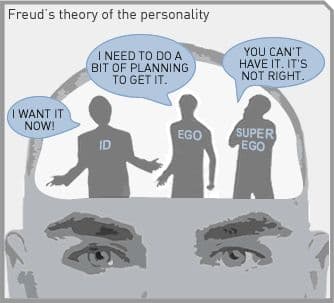
The question suggests a diagram — three neatly labeled boxes, perhaps with arrows connecting them, as though the personality were a machine whose components could be removed and examined on a workbench. Sigmund Freud’s structural model (the id, the ego, and the superego) has often been reduced to such a diagram in introductory textbooks: the id as the unruly child, the ego as the rational manager, the superego as the stern judge. This is not wrong, exactly. But it is a domestication — a way of making a radical and unsettling theory safe for multiple-choice exams.
What Freud actually proposed was less a taxonomy than a tragedy. The three parts of the personality are not parts in the way a carburetor is part of an engine. They are agencies — centers of demand, prohibition, and negotiation — locked in a permanent, necessary, and often exhausting struggle. You are not a harmonious whole. You are a parliament in which no party holds a stable majority. The id clamors for immediate satisfaction. The superego intones its moral condemnations. The ego, caught between them, tries to broker deals with reality. This is not a pathology. This is the normal condition of being a self.
To ask "what are the three parts of the personality?" is therefore to ask about the structure of inner conflict — about why you want what you want, why you forbid yourself from wanting it, and how you manage to live in the gap between desire and prohibition. The answer is not a definition. It is an invitation to recognize the civil war within.
1. The Id: It Speaks Before You Think
The id is the oldest part of the psyche — present from birth, possibly from before. It is the reservoir of instinctual drives: hunger, thirst, sexual desire, aggression, the impulse to avoid pain and seek pleasure. The id operates on the pleasure principle: it wants what it wants when it wants it, without delay, without regard for consequences, and without any capacity for moral reasoning. It does not know "no." It does not know "tomorrow." It knows only tension and the demand for release.
This sounds like a description of a tantrumming toddler, and that is not accidental. The id is the psychological representative of our biological heritage. It is the part of you that reaches for the last piece of cake even when you are on a diet, that feels a flash of rage when someone cuts you off in traffic, that experiences sexual attraction without consulting your values. You do not decide to have these impulses. They arise. They are the raw material of mental life — unshaped, unedited, and often inconvenient.
The id’s mode of thinking is the primary process: hallucinatory, imagistic, indifferent to logic and time. A hungry baby hallucinates the breast. A thirsty man in the desert hallucinates water. This is the id’s attempt to satisfy a need by producing an image of the needed object. It does not work, of course — the hallucinated breast does not provide milk — but it is the only tool the id has. The ego will later develop the secondary process (reality-based thinking, planning, delay). But the id never grows up. It remains infantile, impatient, and imagistic throughout life.
One common misconception is that the id is "evil." This is a category error. The id is not moral or immoral; it is premoral. It does not intend harm. It simply does not register harm as a category. A tiger is not evil for eating a deer. The id is not evil for wanting what it wants. The trouble begins only when id impulses conflict with reality or with the demands of the superego. That conflict is the engine of psychic life — and of psychoanalysis.
2. The Ego: The Negotiator Who Serves Three Masters
If the id is the demanding child, the ego is the anxious parent — except that the parent is also the child, and the child never stops demanding. The ego develops from the id during infancy, as the infant learns that crying does not magically produce food, but that certain actions (reaching, vocalizing in a particular way) do. The ego operates on the reality principle: it delays gratification, plans, tests reality, and makes compromises. It is the executive of the personality — the part that decides whether to act on an impulse, suppress it, or transform it.
But the ego is not the "true self" or the "rational CEO" that popular accounts sometimes suggest. The ego is itself a product of conflict. Freud described the ego as serving three harsh masters: the id, the superego, and the external world. Each makes incompatible demands. The id says, "Do it now." The superego says, "Never do that; you should be ashamed." The external world says, "You can do it, but only under these conditions, and there will be consequences." The ego’s job is to satisfy all three — an impossible task. Small wonder that the ego experiences anxiety as its constant companion: anxiety about being overwhelmed by id impulses (neurotic anxiety), about punishment from the superego (moral anxiety), and about real danger in the world (realistic anxiety).
The ego’s primary tools are defense mechanisms: unconscious strategies for managing conflict without being overwhelmed. Repression pushes threatening impulses out of awareness. Projection attributes one’s own unacceptable feelings to someone else. Rationalization supplies a logical excuse for an irrational action. These are not signs of weakness. They are the ego’s way of surviving. Without defenses, the psyche would be flooded by raw, unmanageable conflict. The problem is that defenses also distort reality and limit freedom. Psychoanalysis does not aim to eliminate defenses — that would be impossible and unwise — but to make them more flexible, so that the ego can choose when to repress and when to face what is difficult.
"The ego is not master in its own house." — Sigmund Freud
This famous sentence captures the ego’s predicament. You believe you are in charge of your decisions, your thoughts, your actions. But the ego is constantly being pushed and pulled by forces it did not choose. The id surges. The superego condemns. Reality resists. The ego’s mastery is always provisional, always contested. To recognize this is not to despair. It is to replace the fantasy of absolute control with the reality of skillful navigation.
3. The Superego: The Internalized Judge That Never Adjourns
The superego is the last of the three agencies to develop, emerging around age five or six as the child internalizes parental prohibitions and social ideals. It has two subsystems: the conscience (what you should not do, and the guilt you feel when you do it) and the ego ideal (what you should aspire to be, and the shame you feel when you fall short). The superego is not merely a moral compass. It is a ruthless internal critic — one that often bears little resemblance to the actual values of your parents or culture. It is a caricature of morality, distorted by the child’s immature understanding and by the child’s own aggressive impulses turned inward.
Where does the superego’s harshness come from? In part, from the child’s fear of losing parental love. To avoid that terrifying loss, the child incorporates the parent’s prohibitions — but adds their own punitive fury. The child who is told "Don't hit your brother" may internalize not only the rule but also a ferocious self-punishment for even thinking about hitting. The resulting superego can be more sadistic than any actual parent ever was. This is why people suffer from irrational guilt — guilt about thoughts, about feelings, about being happy, about succeeding. The superego does not care about proportionality. It cares about purity, and no one is pure.
The superego also generates the ego ideal: images of perfection that can never be attained. A woman may strive to be the perfect mother, the perfect professional, the perfect partner — and feel like a failure because she cannot be all three simultaneously. The ego ideal is not a realistic goal. It is a fantasy, a fossilized childhood wish to be loved unconditionally. And because it is unattainable, it produces a steady stream of shame and self-reproach. The superego, in other words, is a machine for making you feel bad — not because you have done anything wrong, but because you have not done enough, not been good enough, not measured up to an impossible standard.
This raises a difficult question: Is the superego entirely negative? Not entirely. The superego also provides the capacity for moral reasoning, for empathy, for loyalty, for ideals worth pursuing. Without some internalized structure of prohibition, we would be sociopaths. The problem is not the superego’s existence but its severity. A healthy superego is flexible, forgiving, capable of nuance. A harsh superego is a tyrant. Psychoanalysis often aims to reduce the superego’s cruelty — not to eliminate moral feeling, but to replace punishment with reflection, and shame with discernment.
4. The Myth of Separation: No Part Works Alone
The three-part model tempts us to think of the id, ego, and superego as distinct entities. They are not. You cannot point to a neuron and say, "This is the id." The structural model is a metaphor — a useful fiction for describing patterns of mental functioning. In reality, what we call "id" is a set of processes (primary process, drive pressure), what we call "ego" is another set (reality testing, defense, synthesis), and what we call "superego" is a third set (moral evaluation, self-criticism, ideal formation). These processes overlap, interpenetrate, and conflict.
Consider a moment of moral temptation. You see a wallet on the street. The id impulse: grab it, keep the money. The superego: you are a terrible person for even thinking that. The ego: check if anyone is watching, consider the risk, perhaps take the wallet to a police station. But these are not three voices in your head. They are aspects of a single, conflicted experience. You feel the desire, the guilt, and the calculation all at once. The model helps you distinguish them, but the lived reality is a blur.
This blur is not a flaw in the model. It is a reflection of how the mind actually works: not as a committee meeting in a boardroom, but as a dynamic field of forces. The ego is not a homunculus sitting at a control panel. It is a set of functions that emerge from the interplay of drives, defenses, and internalized relationships. The superego is not a voice from above; it is a pattern of self-evaluation that can be conscious or unconscious, rational or irrational, loving or sadistic. The id is not a beast in the cellar; it is the raw energy of life, constantly seeking expression, constantly being shaped and reshaped by experience.
The practical implication: you cannot resolve a psychic conflict by getting rid of one of the parts. You cannot eliminate the id (unless you want to stop being alive). You cannot eliminate the superego (unless you want to become amoral). You cannot eliminate the ego (unless you want to stop functioning). The only path is negotiation: helping the ego become stronger, more flexible, more capable of facing conflict without resorting to extreme defenses. This is the work of psychoanalysis — and the work of growing up, which is never finished.
5. Energy Without Morality: The Id Beyond the "It"
Freud chose the German word "das Es" (the It) to name the id — a pronoun that depersonalizes. The id is not a person inside you. It is an impersonal force, like gravity or electricity. This is an unsettling recognition. The most powerful urges in your psyche — the ones that drive you toward food, sex, safety, and dominance — are not "yours" in any simple sense. They are the products of evolutionary biology, channeled through a nervous system that did not ask your permission. You do not choose to be hungry. You are hunger.
This perspective challenges the Western ideal of the autonomous individual. If the id is impersonal, then your deepest desires are not expressions of your free will. They are visitations — visitors that arrive with their own demands. The ego can decide how to respond to the visitor, but it cannot decide whether the visitor knocks. This is both humbling and liberating. Humbling because it punctures the fantasy of self-creation. Liberating because it relieves you of the burden of having to justify every impulse. The desire to shout at your boss is not a moral failing. It is an id impulse. The question is not whether you had it, but what you do with it.
The id’s energy (what Freud called libido, though he later distinguished libido from aggressive drive) is neutral. It becomes good or bad only through the ego’s choices and the superego’s judgments. The same aggressive drive that fuels a murder also fuels competitive ambition, artistic destruction of old forms, and the assertiveness needed to leave an abusive relationship. The same sexual drive that produces inappropriate desire also produces romantic love, creative passion, and the pleasure of a beautiful sunset. The id is not the enemy. It is the raw material. The enemy — if there is one — is the rigid defense that cannot bend, the superego that cannot forgive, the ego that cannot choose.
One overlooked implication: many people experience anxiety about the intensity of their own id impulses. They mistake normal drive pressure for dangerous perversion. A parent who feels a flash of irritation at a child may conclude they are a monster. A spouse who notices attraction to someone else may believe their marriage is a fraud. Psychoanalysis offers a different reading: these impulses are normal. The question is not whether you have them, but whether you can acknowledge them without acting on them, and without punishing yourself for having them. This is the ego’s highest achievement: to hold an impulse in awareness, feel its force, and still choose a response that aligns with one’s values.
6. The Ego's Slippery Ground: What Holds the Self Together?
If the ego is always under pressure from the id and superego, what keeps it from collapsing? The answer is a set of functions that psychoanalysis calls ego strengths: the ability to tolerate frustration, to delay gratification, to test reality accurately, to synthesize conflicting demands, to maintain a coherent sense of self across time. These are not given at birth. They develop through experience — particularly through the experience of being cared for by someone who can tolerate the infant’s distress without being destroyed by it.
The psychoanalyst Heinz Hartmann distinguished between the ego as a structure and ego functions as processes. Some ego functions are conflict-free — they operate without being caught up in id-superego battles. Perception, memory, language, and motor coordination, under normal conditions, simply work. They are the ego’s reliable servants. Other ego functions are constantly embroiled in conflict: defense mechanisms, reality testing under stress, the capacity for self-observation, the sense of agency. When these falter, the ego weakens, and symptoms appear: anxiety, depression, compulsions, paranoid ideas.
A weak ego is not a moral failing. It is a developmental outcome, often the result of early trauma, neglect, or excessive superego pressure. The person with weak ego strength experiences every impulse as a crisis, every mistake as a catastrophe, every demand as overwhelming. They cannot say "not now" to the id; they cannot say "that’s enough" to the superego. Psychoanalysis strengthens the ego not by lecturing but by providing a relationship in which the ego can practice its functions without catastrophic consequences. The analyst’s calm presence, reliable frame, and non-punitive interpretations give the ego room to experiment, to fail, and to try again.
One paradox of ego strengthening: the ego must sometimes regress to progress. In the safety of the analytic relationship, the analysand may temporarily abandon mature defenses and regress to more infantile modes of relating — dependency, magical thinking, intense transference. This regression is not a setback. It is a controlled experiment. The ego allows itself to become weak so that it can be reorganized on a stronger foundation. This is why analysis can feel like getting worse before getting better. The ego is dismantling its old, brittle strategies to build new, flexible ones. That process is messy. But it is also the source of genuine change.
7. The Superego's Secret Sadism: When Morality Becomes Torture
The superego is often described as the internalized parent, but this understates its ferocity. The superego does not simply remind you of rules. It torments you for breaking them — and for thinking about breaking them, and for not knowing that you might have wanted to break them. It is a sadistic internal voice that takes pleasure in your suffering. This is not a metaphor. Freud observed that many patients experienced a need for punishment that went far beyond any realistic transgression — a moral masochism in which the psyche arranged for its own suffering.
Where does this sadism come from? Partly from the child’s own aggressive drive, which, when it cannot be expressed toward the parent, turns back on the self. The child who wants to hit the parent instead internalizes the parent and hits themself with guilt. The resulting superego is a fusion of the parent’s prohibition and the child’s fury — a hybrid monster. The parent may have been mild, but the child’s fury is not. The superego inherits that fury and directs it inward. This is why people with harsh superegos are not simply conscientious. They are cruel to themselves in ways that no external authority would endorse.
The consequences of a sadistic superego are pervasive: chronic low self-esteem, inability to accept praise, perfectionism that paralyzes, depression that worsens after success (because success violates the ego ideal’s demand for perpetual striving), and a strange attraction to failure. The person may unconsciously arrange to be rejected, to lose opportunities, to fall ill at the moment of triumph. The superego punishes success as a form of hubris.
Addressing a harsh superego is not a matter of positive thinking. You cannot talk yourself out of an internal structure that operates below awareness. What helps is the experience of being accepted by another person (the analyst) even when you fail, even when you disappoint, even when you are not perfect. The analyst does not praise or punish. The analyst simply stays — present, neutral, non-retaliatory. Over time, this steady presence weakens the superego’s terror. The analysand internalizes a less punitive voice. The ego ideal becomes more realistic. Guilt becomes proportionate. This is not self-esteem training. It is the slow, relational repair of an internal relationship.
8. Conflict as Structure, Not Pathology
A common misunderstanding of the structural model is that conflict between id, ego, and superego is a sign of illness. The healthy person, on this view, would have no conflict — a perfect harmony of desire, morality, and reality. This is a fantasy. A person without inner conflict would be either dead or a robot. Conflict is not the absence of health. It is the form that health takes in a finite, embodied, socially embedded creature.
To be alive is to want incompatible things. You want to eat the cake and be thin. You want to be close to others and protect your independence. You want to express your anger and be loved. These are not failures of integration. They are the texture of human existence. The id pushes for one thing; the superego forbids it; the ego negotiates. That is not pathology. That is Tuesday.
The question is not whether you have conflict, but how you handle it. The neurotic person handles conflict with rigid defenses: repression, denial, reaction formation, isolation of affect. The healthier person handles conflict with flexible defenses: humor, sublimation, anticipation, altruism. The neurotic person cannot tolerate ambiguity; the healthier person can hold contradictory desires without collapsing. But both have conflict. There is no exit. Psychoanalysis does not promise to resolve all conflict. It promises to help you have better conflicts — conflicts that you can bear, reflect on, and learn from, rather than conflicts that run you like a puppet.
This reframing has existential weight. The search for a conflict-free self — for a state of permanent peace, perfect integration, absolute authenticity — is not only impossible; it is a form of avoidance. The person who seeks to "get rid of their ego" or "transcend their superego" is still in the grip of those structures, now disguised as spirituality. Psychoanalysis offers no transcendence. It offers only a clearer view of the struggle, and a little more room to move within it. That is not a small gift.
9. Beyond the Individual: The Three Parts in Culture and Relationships
Freud’s model is a model of the individual psyche. But its logic extends outward. Families, organizations, and entire cultures can be analyzed in id, ego, and superego terms. A family with a tyrannical father (superego) and indulgent mother (id) produces children with characteristic ego weaknesses. A corporation that rewards impulsive risk-taking (id) while punishing ethical reflection (superego) will develop a culture of rationalized fraud — the ego serving as a mere technician, not a moral agent.
The cultural superego is particularly visible in social media. Platforms amplify superego functions: the constant surveillance of others’ judgments, the production of guilt about insufficient activism or insufficient happiness, the ego ideal of the curated life. The id, meanwhile, finds expression in the impulsive scroll, the rage tweet, the purchase made at 2 a.m. The ego — the capacity to pause, reflect, and choose — is systematically undermined. The result is a collective psychic state of heightened conflict, with the three parts locked in a feedback loop that benefits no one except the platforms’ engagement metrics.
This cultural analysis suggests that the three parts are not merely internal. They are distributed across environments. A person’s ego strength depends in part on the stability of their social world. A person’s superego harshness is shaped by the moral climate of their community. A person’s id expression is channeled by what the culture permits and forbids. Psychoanalysis, often criticized for being individualistic, actually provides a framework for understanding how the social enters the psyche — and how the psyche, in turn, reproduces the social. The three parts are not inside the skin. They are at the boundary, where inner and outer meet.
One implication: to change the self, you may need to change the environment. A harsh superego may not yield to introspection alone; it may require a community that offers forgiveness rather than punishment. A weakened ego may not be strengthened by willpower; it may require predictable structures and reliable relationships. Psychoanalysis provides one such environment. But it is not the only one. The three-part model, properly understood, is an argument for paying attention to the psychic architecture of everyday life — the id-baiting advertisements, the superego-rousing news cycles, the ego-destroying precarity of modern work.
10. Critiques and Revisions: What the Model Misses
The structural model has been criticized on many grounds. Some are empirical: there is no brain region corresponding to the id, ego, or superego. Others are feminist: Freud’s model, developed in a patriarchal culture, reflects and reinforces gender stereotypes (the id as feminine, the superego as masculine, the ego as a masculine ideal of rationality). Others are relational: the model focuses on internal conflict but downplays the actual relationships that shape the psyche. Others are cultural: the model universalizes a particular Western, bourgeois, nuclear-family structure.
These critiques are serious. They have led to revisions. Contemporary psychoanalysts often speak of ego functions rather than the ego as an entity. They emphasize the self as an experiential concept distinct from the ego as a structure. They integrate object relations theory, which focuses on internalized relationships with others, not just on id-ego-superego conflict. They recognize that the superego’s content varies dramatically across cultures, and that what looks like a harsh superego in one context may be normal moral development in another.
Yet the three-part model persists — not because it is scientifically accurate, but because it is experientially recognizable. Anyone who has tried to diet knows the feeling: the id (cake), the superego (you weak-willed failure), the ego (perhaps one small slice, and then a walk). Anyone who has been in love knows the negotiation between desire (id), fear of rejection (superego?), and the effort to act appropriately (ego). The model works as a phenomenology — a description of how inner conflict feels. That is its genius. And that is why it remains useful, even after a century of critique.
The table below summarizes key critiques and psychoanalytic responses:
CritiqueSummaryPsychoanalytic ResponseLack of neural basisNo brain region identified for id/ego/superegoModel is psychological, not neurological; describes functions, not locationsGender biasAssociates id with femininity, superego with masculinity, ego with male rationalityHistorical limitation; contemporary theorists reject these associationsNeglect of relationshipsFocuses on internal conflict, downplays actual interpersonal experienceObject relations and relational psychoanalysis add this dimensionCultural specificityModel reflects Western, bourgeois, patriarchal family structureAgreed; the forms of id/ego/superego vary, but the structural logic of conflict may be universalOverly abstractId, ego, superego are reified (treated as things)Modern usage treats them as shorthand for processes, not entities
The model is not sacred. It is a tool. Like any tool, it works for some jobs and not for others. The task is not to defend it against all criticism, but to use it where it helps — and to set it aside where it does not.
11. Living With the Three Parts: Everyday Negotiations
How does this abstract model translate into daily life? Consider a few common situations:
Procrastination: The id wants immediate relief from the anxiety of the task (escape into social media). The superego says, "You should be working; you are lazy." The ego tries to negotiate: ten minutes of work, then a break. But if the superego is too harsh, the ego may give up entirely — better to feel guilty about procrastinating than to face the superego’s judgment of the work’s quality.
Romantic jealousy: The id feels possessive rage. The superego says jealousy is ugly and insecure. The ego tries to suppress the rage, but suppression fails; the rage leaks out as passive aggression. A stronger ego might acknowledge the feeling without acting on it: "I notice I am jealous. That is unpleasant, but it does not require me to accuse my partner."
Creative work: The id provides raw material — images, impulses, chaotic ideas. The superego judges it all as not good enough. The ego must protect the creative process from the superego long enough for the raw material to be shaped. This is why many artists have rituals (walking, showering, drinking coffee) that quiet the superego and let the id speak.
Social media: The id scrolls impulsively. The superego compares your life to curated highlights and finds it wanting. The ego — if it is functioning — can set limits: a timer, a blocklist, a decision to log off. But the platforms are designed to overwhelm the ego, to keep you in a loop of id-superego oscillation without reflective pause.
In each case, the goal is not to eliminate any part but to improve their relationship. A healthier psyche is not one in which the id is tamed, the superego silenced, and the ego triumphant. It is one in which the ego can listen to the id without panic, hear the superego without shame, and make a choice that is neither impulsive nor self-punishing. The choice may still be imperfect. That is fine. Imperfection is the ego’s natural habitat.
12. The Structural Model as a Practice, Not a Belief
The most important thing to understand about the id, ego, and superego is that they are not doctrines to believe. They are heuristics — ways of paying attention to experience. You do not have to believe that there is a literal entity called the id inside your head. You only have to try asking, on a given day, "What does my id want right now? What is my superego saying? What is my ego doing with these voices?" If the question yields useful self-awareness, the model is working. If it does not, discard it.
This pragmatic attitude was Freud’s own. He revised his models repeatedly throughout his career, abandoning the topographical model (conscious/preconscious/unconscious) for the structural model, then adding the death drive, then rethinking anxiety. He was not building a dogma. He was building a set of tools for investigating the mind. The three-part model is one such tool. It is not the truth. It is a lens. Through it, certain things come into focus: the universality of inner conflict, the disguised power of the past, the way morality can become torture, the importance of negotiation over suppression.
What the lens obscures is also important: the role of culture, the centrality of relationships, the limits of intrapsychic conflict as an explanation for suffering. No single lens shows everything. The wise reader learns to switch lenses.
"The interpretation of dreams is the royal road to a knowledge of the unconscious activities of the mind." — Sigmund Freud (but the same could be said for attending to id-ego-superego conflicts in waking life)
Closing Reflection: The Civil War We Call Self
You are not one thing. You never were. The belief that you should be — that a unified, consistent, harmonious self is possible or desirable — is a product of the superego, or of culture, or of a deep wish for safety in a dangerous world. The three-part model offers a different possibility: that the self is a conversation, not a conclusion. The id speaks. The superego answers. The ego tries to translate. The conversation never ends, and that is not a failure. It is the sound of being alive.
To know the three parts is not to master them. It is to recognize that mastery is impossible, and to find, in that recognition, a strange kind of peace. You will still want what you should not want. You will still judge yourself for wanting it. You will still try to negotiate a livable compromise. That is the human condition. Psychoanalysis does not offer an escape. It offers a map of the territory — and a companion who has walked it before.
Frequently Asked Questions
What are the three parts of the personality in Freudian theory?
They are the id (instinctual drives, operates on pleasure principle), the ego (reality-based executive, operates on reality principle), and the superego (internalized moral prohibitions and ideals).
Which part of the personality is present from birth?
The id. It is the original structure, present at birth, containing all the instinctual drives. The ego and superego develop later through interaction with the environment.
What is the main function of the ego?
The ego mediates between the demands of the id, the prohibitions of the superego, and the constraints of reality. It uses defense mechanisms to manage anxiety and aims to achieve realistic, adaptive solutions.
How does the superego develop?
The superego develops around age five through the internalization of parental standards and societal rules, as well as through the resolution of the Oedipus complex. It becomes the internal voice of conscience and ego ideal.
Can the id, ego, and superego be in conflict?
Yes, conflict among the three is normal and constant. Neurotic symptoms arise when the conflict is too intense or when the ego’s defenses are too rigid. Health involves flexible conflict management, not absence of conflict.
Is Freud's structural model still used today?
Yes, but often in modified form. Contemporary psychoanalysts emphasize ego functions, self-representations, and object relations, but the id-ego-superego framework remains a useful shorthand for describing internal conflict.
How does psychoanalysis address an overly harsh superego?
Through the therapeutic relationship. The analyst’s non-punitive, reliable presence provides a new experience that gradually modifies the internal critic. Interpretation helps the patient see the superego’s irrationality without identifying with it.
What is ego strength?
Ego strength refers to the ego’s capacity to tolerate frustration, delay gratification, test reality, and manage conflict without being overwhelmed. It develops through successful negotiation of developmental challenges and supportive relationships.
Are there gender differences in the id, ego, and superego?
Freud controversially suggested that women had weaker superegos. Most contemporary psychoanalysts reject this as a cultural bias. The structural model is now understood as describing universal psychic functions that vary by individual, not by gender.
Can the three-part model be applied to groups or cultures?
Yes, metaphorically. Organizations and cultures can be analyzed in terms of impulsive (id-like) behavior, executive (ego-like) functions, and moral (superego-like) codes. This is common in applied psychoanalysis and critical theory.