


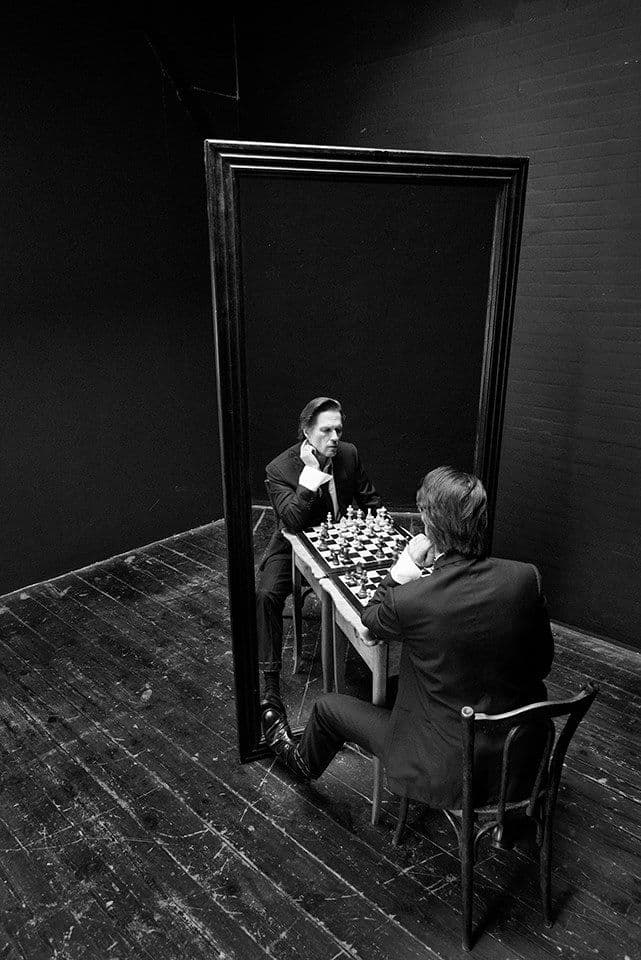
Before we ever say “I,” we are already caught in a reflection. The act of recognizing oneself in a mirror seems, at first glance, a simple developmental milestone—the toddler touching their nose, delighted at the correlation between inner sensation and outer image. Jacques Lacan, however, dismantled this innocence. For him, the mirror stage is not a quaint chapter in child psychology but the founding drama of human identity, a moment in which a fragmented, uncoordinated being assumes an image of wholeness that is both captivating and fundamentally alien. This assumption shapes the entire architecture of the ego, seeding a lifelong misrecognition that infiltrates our relationships, our ambitions, our digital personas, and our most private anxieties. To ask “What is the mirror stage?” is to probe the very genesis of the self as a fiction held together by an image, and to uncover the profound alienation at the heart of being human.
Lacan introduced the mirror stage in 1936, but its implications reverberate far beyond psychoanalytic clinics. It speaks directly to why we curate our appearance so carefully, why we compare ourselves to others with such painful intensity, and why the promise of a “true self” perpetually eludes us. The mirror stage suggests that identity is not an interior essence that unfolds naturally, but an exteriority we mistake for our innermost core. This essay will explore the mirror stage not as a doctrine to be memorized but as a lens through which to re-examine the most familiar aspects of experience: the glance at a reflection, the construction of an online profile, the pang of envy, the yearning to be seen. In each domain, we will challenge the assumption that we are whole, autonomous subjects, and instead trace how we are constituted by an image that can never be fully owned.
1. The Scene of the Mirror: The Child Before the Image
Lacan’s account begins with a concrete observation. Between the ages of six and eighteen months, a human infant, still motorically helpless and physiologically premature, encounters its own reflection in a mirror. Unlike a chimpanzee, which quickly loses interest once it grasps the image’s emptiness, the child reacts with a jubilant, fascinated assumption of the form. This is the celebrated Aha-Erlebnis, the flash of recognition: “That is me!” Yet Lacan insists this recognition is at once a misrecognition (méconnaissance). The child identifies with a Gestalt, a totalized, bounded, unified image that stands in stark contrast to the lived reality of a body still subject to uncoordinated, fragmented movements and drives. The image is a promise of mastery, an anticipatory coherence, but it is external, sited in the mirror, and thus alien.
This moment installs a fundamental split. The infant, who does not yet possess a coherent sense of self, leaps into an identification with an image that is both self and other. The jubilation hides a tragic structure: the ego is born as an armor, a rigid shell borrowed from the outside that will henceforth mask a persistent experience of fragmentation. The mirror stage, therefore, is not a simple step toward self-awareness; it is the first instance of the ego’s defensive function, a fortress built against a primal chaos that never fully disappears.
The Fragmented Body Versus the Gestalt
Lacan contrasts the image of the whole body with the “fragmented body” (corps morcelé), a phantasmatic experience of dismemberment that erupts in nightmares, anxiety attacks, and psychotic episodes. This is not a memory of an actual dismemberment but the psychic correlate of the infant’s prematurity: the body lived as disjointed urges, scattered limbs, and uncontrollable impulses. The mirror image offers salvation from this chaos by presenting a total form, but it does so at the price of installing an alien identity. The self is henceforth a mask that conceals the underlying fragmentation, and the ego becomes a desperate attempt to maintain this illusory unity. Every time we feel shattered by a failure or a rejection, the ghost of the corps morcelé stirs beneath the smooth surface of the mirror image.
2. The Imaginary Order: The Realm of Dualities and Illusions
Lacan situated the mirror stage as the founding moment of the Imaginary order, one of the three registers (along with the Symbolic and the Real) that structure human existence. The Imaginary is the domain of images, of dual relationships, of the lure of the specular. It is pre-linguistic but not pre-verbal; it is the theatre in which the ego performs its identifications, forever caught in a seesaw of seeing and being seen. In the Imaginary, the subject relates to others through the same logic that governs the mirror relation: as a rivalrous, alienating reflection that promises wholeness but delivers only endless comparison.
This is why the mirror stage explains far more than the infant’s first self-recognition. It installs a template for every subsequent identification: with a lover, a leader, a brand, a digital avatar. The Imaginary is essentially narcissistic, because the ego falls in love with its own image wherever it finds it. Yet this love is always laced with aggression, because the image is also a rival that threatens the subject’s uniqueness. To contemplate the mirror stage is to realize that the ego is not a neutral center of agency but a battleground of imaginary captures.
The Imaginary, the Symbolic, and the Real
Order | Domain | Role in the Mirror Stage | Effect on Identity |
|---|---|---|---|
Imaginary | Images, dual relationships, the ego | Founds the ego as a misrecognized gestalt | Produces a sense of wholeness that is alienated and rivalrous |
Symbolic | Language, law, the big Other | Ratifies the image with words, inserts the subject into culture | Replaces the mirror image with a linguistic “I,” introducing lack |
Real | That which resists symbolization, the traumatic | The unrepresented fragmented body behind the image | Remains as the unspeakable kernel that shatters coherence |
The mirror stage throws the child into the Imaginary, but the child’s entry into the Symbolic—learning language, accepting names, obeying rules—retroactively restructures this founding moment. The Real, meanwhile, is the ever-present residue that the image was meant to cover, the pre-mirror chaos that can never be fully assimilated. The three orders interlock, and the mirror stage can only be properly understood as a pivot between them.
3. The Ego as Alienation: The Misrecognition That Defines Us
If the mirror stage produces the ego, then the ego is, by definition, an instance of alienation. This turns many conventional psychological assumptions on their head. A strong, well-adapted ego is not a sign of mental health in Lacanian terms; it is a hardened fortress of misrecognition, a refusal to acknowledge the fundamental division of the subject. The ego is always a fiction, a narrative we tell ourselves to maintain a semblance of consistency, but it is written in the language of the Other—first the image, then the words of parents, then the codes of culture.
This alienation is not a pathology to be cured but a structural condition of being human. The very act of saying “I” constitutes a split: the speaking subject of the enunciation is never identical to the “I” that appears in the statement. The mirror stage prefigures this linguistic division by demonstrating that the first “I” was already an other. When a child says “That’s me!” they are referring to a reflection, a representation, not to an inner essence. Identity is always representation, always for another, and the mirror stage dramatizes this original alienation in visible form.
The Permanent Fiction of the Self
If the ego is a fiction, then the pursuit of an authentic self becomes deeply paradoxical. To seek the “real me” behind all masks is to chase a phantom, because there is no pre-mirror identity waiting to be uncovered—only the fragmented body and the chaotic impulses. The closest we can get to authenticity is not the stripping away of all images but a recognition that we are constituted through images, and that our task is to inhabit them with less rigidity, more irony, more awareness of their borrowed nature. This insight carries profound existential consequences: it means that our most cherished attributes—our personality, our style, our self-image—are on loan from the outside, and that the ego is more like a character in a story than a solid entity.
4. The Mirror Stage and Narcissism: Rivalry, Aggression, and the Desire of the Other
One of Lacan’s most unsettling contributions is his insistence that the mirror stage links narcissism with aggression. The jubilant assumption of the image conceals a rivalry with that very image, because the specular other is simultaneously me and not-me. It presents a completeness that I lack, and I both desire to be it and to destroy it for reminding me of my insufficiency. This is the structure of the Hegelian struggle for recognition that Lacan wove into his theory: the subject needs the other’s recognition to exist, but that recognition always comes from a place of threat.
In everyday life, this imaginary rivalry manifests in countless ways. The colleague whose success stings, the friend whose beauty unsettles, the stranger on the street whose confident stride feels like a personal accusation—all are mirror doubles, reflecting back a wholeness we desire and resent. Social media amplifies this dynamic to an excruciating pitch: the curated profiles of others function as idealized mirrors, triggering comparison, envy, and the aggressive impulse to tear down what we cannot possess. The “like” button is the contemporary form of the Other’s gaze that ratifies the image, and its absence can shatter the fragile ego like a punch to the mirror.
“The mirror image is the threshold of the visible world, but what we see there is never ourselves—only the inverted phantom we have agreed to call ‘I’.”
5. The Temporal Paradox: Anticipation, Retroaction, and the Future Perfect
The mirror stage is not merely a spatial event but a temporal one. The infant identifies with an image of future mastery—a body in control, a coordinated self—that it does not yet possess. This identification is anticipatory, a leap into a time that has not arrived. Lacan characterized it with the grammatical tense of the future perfect (futur antérieur): “I will have been.” The child acts as if the unity is already realized, thereby bringing it into being retroactively, but this unity remains permanently deferred. The self is always a promise made to the mirror, never a possession.
This temporal twist implies that identity is constituted through a fundamental retroaction. The meaning of the mirror stage is not fixed at the moment of recognition; it is rewritten when the child later enters language and the Symbolic order. The “I” that speaks is always looking back at a moment that never actually occurred as a pure presence. We are always catching up with an image that ran ahead of us, and this lag structures our entire psychic life. It explains the feeling, familiar to many, of being out of sync with one’s own life, as though one’s true self is just around the corner, waiting to be assumed in the next promotion, the next relationship, the next transformation.
6. The Gaze of the Other: From Image to Symbolic Ratification
Lacan’s mirror stage is never a solitary event. The child, after catching its reflection, typically turns toward the adult present—often the mother—as if seeking confirmation. This gesture introduces the dimension of the big Other, the symbolic order that must validate the image. The parent says, “Yes, that’s you, Charlie!” and thereby anchors the specular image in a name, a place in language, a social identity. Without this ratification, the mirror image remains a mere spectacle; with it, the subject is inserted into the network of kinship, law, and meaning.
This turning toward the Other reveals that identity is never simply self-generated. We depend on an external witness to confirm that the image in the mirror is truly ours, and this dependency never ends. Throughout life, we seek out figures who will mirror us in ways that feel accurate or desirable: therapists, partners, audiences, followers. The “mirror” is no longer just glass and silver; it is the gaze of anyone whose recognition we crave. The absence of such a gaze can lead to a terrifying sense of unreality, as though one’s very existence is in question. The mirror stage, therefore, is the prototype of all social validation, and its failure can produce profound alienation, including the depersonalization and identity diffusion seen in severe psychopathology.
The Digital Gaze and the New Mirror
On social media, the gaze of the Other has become quantified and dispersed. Every notification is a micro-ratification that momentarily stabilizes the digital mirror image. The child’s turning toward the parent becomes the adult’s endless refreshing of a feed, the anxious scanning for reactions that confirm: yes, I exist, I am seen, I am what this image shows. The mirror stage illuminates why the absence of such feedback can feel like annihilation: without the Other’s gaze, the image collapses, and the fragmented body threatens to resurface.
7. The Digital Mirror: Selfie Culture and the Multiplication of the Specular
If Lacan were alive today, he would likely recognize the smartphone screen as a technological iteration of the mirror stage—only now, the mirror is portable, omnipresent, and capable of generating infinite variations of the ideal image. The selfie is the contemporary jubilant assumption, a carefully staged gestalt that masks the chaos of actual lived experience. Filters and editing tools perfect the unified form, eliminating the inconsistencies and asymmetries that recall the corps morcelé. Yet this digital mirror introduces new complexities: instead of one reflection, there are many, each tailored to different audiences, different platforms, different versions of the self.
This multiplication can lead to a fragmentation of the ego that is paradoxically more faithful to the Lacanian subject than the coherent self-image of earlier eras. The digital self is always in flux, always being updated, always a construction—and many people experience this as exhausting rather than liberating. The mirror stage explains why: the ego was meant to be a stable fiction, a defense against chaos. When the fiction itself becomes chaotic, the underlying fragmentation is no longer veiled, and anxiety surges. The relentless curation of online identity is an attempt to shore up the mirror image against the tide of the Real, but each new profile is just another borrowed reflection.
Dimension | The Literal Mirror (Infant) | The Digital Mirror (Social Media) |
|---|---|---|
Image | Single, immediate reflection | Multiple, edited, curated avatars |
Ratification | Parental gaze and verbal confirmation | Likes, comments, follower counts |
Temporality | Anticipatory unity (future perfect) | Constant present, always updatable |
Fragmentation | Veiled by the gestalt | Exposed by the proliferation of images |
Aggression | Rivalry with the specular other | Comparison, envy, online hostility |
8. The Mirror Stage in Love: The Idealization and Collapse of the Other
Falling in love often begins with a moment of captivation not unlike the mirror stage. The beloved appears as a complete, radiant gestalt, seemingly holding the key to a wholeness the lover lacks. This is not merely attraction; it is an imaginary identification in which the lover projects their own ego-ideal onto the other. The mirror logic operates here with full force: I see in you the image of what I wish to be, and loving you becomes a way of possessing that image. This is why the early phase of romance feels so intoxicating—it replicates the jubilant assumption of the mirror, a promise of unity restored.
But the same structure inevitably breeds rivalry and disappointment. Because the beloved is also a separate subject with their own lack, they cannot permanently sustain the projected ideal. The moment the mirror cracks—when the partner reveals vulnerability, inconsistency, or desire that does not include the lover—the imaginary unity shatters, and the fragmented real beneath the image bursts forth. Breakups can feel like the death of one’s own self, and in a real psychological sense, they are: the mirror image one had built around the beloved is lost, and the ego that depended on that image collapses. Understanding this through the mirror stage does not make heartbreak painless, but it reveals that the pain is not merely about losing another person; it is about losing a specular anchor for one’s own identity.
9. The Political Mirror: Imaginary Identifications and Collective Identity
The mirror stage also illuminates the dynamics of group identity. Nationalism, fandom, political movements—all rely on imaginary identifications that bind individuals through a shared image. A flag, a leader, a slogan can function as a mirror in which the group sees its idealized unity, a gestalt that promises coherence to fragmented social atoms. The leader, in particular, serves as a specular other: the followers identify with the leader’s image and through it gain a sense of wholeness and purpose that is otherwise elusive.
As with all imaginary relations, this unity is built on rivalry and exclusion. The group’s coherence depends on an outside—an enemy, a scapegoat, a “them”—that reflects back the group’s own rejected fragmentation. The collective mirror stage thus fuels both solidarity and persecution. The aggression inherent in the mirror relation explodes in racism, xenophobia, and political violence, all driven by the need to preserve the idealized image of the group against any perceived threat. A Lacanian reading of political polarization sees it not as a clash of ideas but as a war of mirrors, each camp holding up a distorted image of the other that reflects its own repressed chaos.
10. Misconceptions and Clarifications: What the Mirror Stage Is Not
Over the decades, the mirror stage has been frequently misunderstood. It is not a literal developmental stage that every child passes through and then leaves behind, like learning to walk. Lacan himself later revised the concept to emphasize its structural, not chronological, function. The mirror stage is a permanent and recurring structure of identification, a matrix that can be reactivated whenever the subject encounters an image that promises wholeness—whether in a dream, a film, a crowd, or a new social role.
Nor is the mirror stage a theory of self-consciousness in the cognitive sense. It does not describe a neutral milestone of self-recognition; it describes a constitutive alienation. The infant does not “discover” a self that was already there; the self is produced through the identification with the image. Any account that frames the mirror stage as a step toward healthy ego development misses Lacan’s radical point that the ego is itself the symptom. Furthermore, the mirror stage is not purely about the visual; it involves the entire bodily schema and the anticipation of motor coordination, and it is immediately entangled with the auditory (the parent’s voice) and the symbolic (the name).
The Mirror Stage and the Trauma of Birth
Some have tried to link the mirror stage to Otto Rank’s trauma of birth, but Lacan’s emphasis is different. The fragmentation experienced by the infant is not a memory of the birth canal but a structural condition of prematurity and dependency. The mirror stage is not a reenactment of a primal trauma but a defensive response to a structural lack. The real trauma lies in the fact that the image one assumes can never coincide with the living, desiring being one is.
11. When the Mirror Breaks: Psychosis and the Failure of the Imaginary
If the mirror stage is foundational, its failure has devastating consequences. In psychosis, Lacan argued, the fundamental anchoring of the ego in the mirror image may be missing or profoundly disturbed. The result is a terrifying experience of the body as fragmented, disjointed, or invaded by alien forces—precisely the corps morcelé that the mirror image was meant to cover. Hallucinations of dismemberment, delusions of bodily transformation, and the feeling of being watched or controlled can all be traced to a failure of the imaginary function to provide a stable gestalt. The psychotic subject lives, in a sense, in the pre-mirror chaos, unable to maintain the fiction of a unified self.
This does not mean that psychosis is simply a regression to an infantile state. Rather, it reveals the fragility of the mirror operation and the immense work required to sustain a coherent ego. Even in neurosis, moments of extreme anxiety, depersonalization, or existential dread can momentarily dissolve the mirror image, making the world feel unreal and the body strange. The mirror stage thus serves as a diagnostic lens, not for labeling but for appreciating the depth of the human need for an image, and the terror that accompanies its loss.
12. Living with the Broken Mirror: Implications for Analysis and Self-Understanding
If the ego is an alienated fiction, the goal of psychoanalysis cannot be to strengthen it, as ego psychology proposed. Lacanian analysis aims instead to help the analysand traverse the fundamental fantasy and acknowledge the division of the subject. This does not mean destroying the ego—impossible and dangerous—but loosening its grip, reducing the subject’s investment in the mirror image as the truth of their being. The end of analysis is not happiness or adaptation, but a kind of acceptance of lack, a capacity to bear the fact that one is not whole and never will be, without resorting to desperate identifications.
In everyday life, this translates into a more ironic relationship to one’s self-image. One can still enjoy the mirror—put on a suit, take a selfie, present a persona—without mistaking the performance for one’s essence. The digital mirror can become a playground rather than a prison. Love can move beyond idealization toward a recognition of the other’s otherness, their own lack and mystery. The political gaze can be met with skepticism toward any leader or movement that promises to fill the void. The mirror stage, once understood, offers not a solution but a loosening of the spell, a way to inhabit the image without being wholly possessed by it.
“We are never more ourselves than when we recognize that the self is an other, and that the mirror we hold up to the world is, finally, a gift from those who came before us, waiting to be returned with difference.”
Closing Reflection: The Image in the Age of Infinite Mirrors
Lacan’s mirror stage is not a historical curio; it is a diagnosis of the human condition that becomes more acute the more mirrors we create. From the still pool of Narcissus to the screen in our pocket, the lure of the image has only intensified. We live in a hall of mirrors, each surface offering a slightly different version of ourselves, and the question is no longer how to achieve a stable identity, but how to navigate the fragmentation without losing the capacity for meaning. The mirror stage reminds us that fragmentation was always there, beneath every image we ever assumed. Our task is not to flee it but to recognize it as the ground from which all identity arises—and to learn, perhaps, to extend the same recognition to others, whose images, like ours, are fragile attempts to hold back an ocean with a reflection. The mirror does not lie; it tells the truth of our desire, but it does so by showing us what we are not. The wisdom of the mirror stage is to know that the image is both a shelter and a cage, and that the only freedom lies in seeing it for what it is.
Frequently Asked Questions
Is the mirror stage an actual developmental stage that all children go through?
Lacan initially presented the mirror stage as a chronological phase between six and eighteen months, but he later emphasized its structural significance rather than its temporal fixity. It is less a milestone that is passed and more a fundamental dynamic of identification that repeats throughout life. Not every child encounters a literal mirror, but every child encounters a specular logic—through the face of the caregiver, through images, and through social recognition. The mirror stage is therefore better understood as a universal structural moment than as a universally observable behavior.
How does the mirror stage differ from the Freudian concept of narcissism?
Freud’s primary narcissism refers to an early state in which the infant takes itself as a love object, a libidinal investment in the ego. Lacan reworks this through the mirror stage by showing that the ego itself is formed through an identification with an external image, so narcissism is always already a relation to an other. For Lacan, narcissism is not an auto-erotic phase but an imaginary capture in which the subject falls in love with an alienating reflection. The mirror stage thus gives narcissism a structural and spatial foundation, tying it directly to the visual and the specular.
Can the mirror stage be observed empirically in infant research?
Some developmental psychologists have challenged Lacan’s claim about the infant’s jubilant reaction, arguing that self-recognition is a gradual process measurable by the rouge test (recognizing a mark on one’s nose in a mirror). However, Lacanian psychoanalysis is not primarily concerned with empirical developmental milestones but with the logical structure of subject formation. The mirror stage is a theoretical construction that illuminates the alienation inherent in the ego; it does not depend on a specific age or observable behavior for its validity, though its description resonates with many observations of infant behavior.
What is the “fragmented body” and why is it important?
The fragmented body (corps morcelé) is the phantasmatic experience of the body in pieces—disjointed limbs, disconnected organs—that underlies the imaginary unity of the mirror image. It represents the infant’s primordial state of motor helplessness and drive chaos before the assumption of the gestalt. This fragmented body never disappears; it remains as a constant threat beneath the ego’s cohesion, erupting in dreams of dismemberment, psychotic episodes, and anxiety states. Its importance lies in exposing the defensive and fragile nature of the ego’s identity: the whole self is a cover for a disquieting disunity.
How does the mirror stage relate to social media and digital identity?
The mirror stage provides a powerful framework for understanding digital identity formation. Social media platforms function as a new kind of mirror, offering curated images that invite the user to assume an idealized, alienating gestalt. The feedback from others—likes, shares, comments—serves as the symbolic ratification that stabilizes the image. However, the proliferation of images and the constant comparison with others can intensify the aggressivity and fragmentation inherent in the imaginary, leading to anxiety, envy, and a sense of unreality. The digital mirror replicates the foundational misrecognition of the self, but with new technological intensity.