


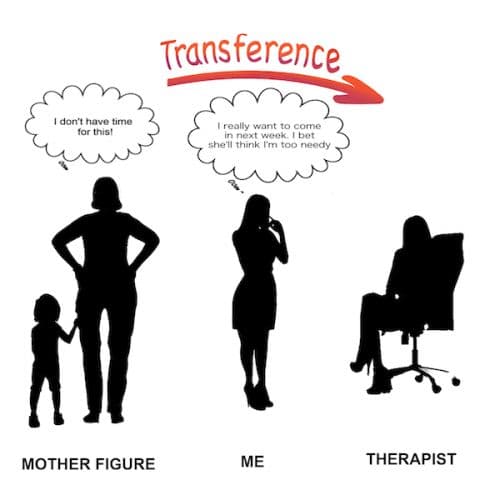
You walk into the therapist's office. The room is neutral, the chair comfortable, the person across from you has a calm, professional demeanor. You have never met before. And yet, within minutes, something stirs. She reminds you of your mother — the way she tilts her head, the slight impatience in her voice. Or he feels distant, like your father, and you find yourself performing, trying to earn approval that is not being withheld. Or perhaps the therapist feels like the friend who betrayed you, and you are already defensive, waiting for the betrayal that has not yet happened. This is transference: the unconscious displacement of feelings, expectations, and relational patterns from significant figures in your past onto the therapist in the present.
Transference is not a rare event. It is not a sign that therapy has gone wrong. It is the central medium of psychoanalytic work — and a universal feature of human relating, amplified in the therapeutic setting. The therapist's neutrality and the patient's vulnerability create a vacuum into which the past rushes. The therapist becomes a screen onto which you project your inner world. And in that projection, the past becomes visible, not as a memory to be described but as a living relationship to be experienced and, with help, transformed.
This article traces transference from its psychoanalytic origins to its everyday manifestations, from the dangers of unchecked transference (the patient who falls in love, the therapist who colludes) to the possibilities of healing through interpretation. It also considers an unexpected lens: the non-dual philosophy of Advaita Vedanta, which asks whether the very self that transfers feelings is ultimately real. The juxtaposition is not accidental. Transference reveals the constructed, relational nature of the ego — a discovery that resonates with Advaita's claim that the separate self is an illusion. But that resonance is a tension, not a resolution. Let us enter the room.
1. The Uninvited Guest: Transference Defined
Transference, in the classical psychoanalytic definition, is the unconscious redirection of feelings, wishes, and attitudes from one person to another — most famously from past caretakers onto the analyst. The term comes from the German Übertragung (carrying over). It is a carrying over of the past into the present, of an old relationship onto a new one, without the subject's awareness. You do not choose to transfer. You simply experience the therapist as if they were the figure from your childhood.
Transference is not merely projection (attributing your own feelings to another) — though projection is often part of it. Transference involves the reactivation of whole relational templates: how you expect to be treated, how you treat others, what you fear, what you desire. These templates were formed in early attachment relationships and have been repeated, with variations, ever since. The therapy room, with its sparse structure and the therapist's relative anonymity, becomes a laboratory where these templates can be observed in action.
A simple example: a patient who grew up with a harsh, critical father may expect the therapist to be critical. When the therapist is silent, the patient hears the silence as condemnation. The patient does not think, "I am transferring my father onto my therapist." The patient thinks, "The therapist is judging me." The feeling is real; its source is hidden. This is transference in its most basic form.
2. Why Transference Happens: The Economy of Psychic Energy
Freud explained transference as a kind of mental economy. The psyche does not have infinite resources. It conserves energy by applying existing templates to new situations. Rather than building a fresh representation of every new person, the unconscious maps the new onto the old. This is efficient. It is also distorting. The efficiency is the problem: you treat your boss as your father, your spouse as your abandoning mother, your therapist as the judge who never approved. You save effort. You repeat pain.
From an Advaita Vedanta perspective, transference reveals a deeper illusion: the belief in a separate, enduring self that has a history. Advaita holds that the true Self (Atman) is non-dual, without attributes, without past or future. The ego, which is the seat of transference, is a construction — a bundle of memories, identifications, and conditioned responses. Transference is the mechanism by which the ego maintains its continuity, projecting its past onto the present to create the illusion of a stable self. In therapy, this illusion becomes visible. In Advaita, it is seen through directly, not interpreted. The therapeutic and the spiritual thus part ways: therapy works with the ego's stories; Advaita seeks to see through the storyteller. Both, however, agree that the stories are not the truth.
"The transferences are the most powerful resistances to the treatment, but they are also the most powerful tools." — James Strachey
3. The Many Faces of Transference: Positive, Negative, Eroticized
Transference is not a single phenomenon. It takes many forms, each with its own clinical challenges.
Positive transference: The patient feels affection, admiration, idealization, or trust toward the therapist that is disproportionate to the actual relationship. This is not necessarily bad; a positive bond keeps the patient coming back and facilitates the work. But excessive idealization can become a resistance: the patient does not want to disappoint the beloved therapist, so they hide negative feelings, suppressing material that needs to emerge.
Negative transference: The patient feels anger, distrust, resentment, or contempt toward the therapist. This is often harder for both parties. The patient may want to quit. The therapist may feel unjustly accused. But negative transference is precious: it brings into the room the patient's experience of past figures who were hurtful. If the therapist can withstand the anger without retaliating, and interpret its source, the patient can learn that not all authority figures are persecutory.
Erotic or eroticized transference: The patient develops sexual feelings toward the therapist. This ranges from mild attraction to an all-consuming conviction that the therapist is the only person who can fulfill them. Erotic transference is among the most technically difficult. The therapist must neither act on it (which would be a catastrophic boundary violation) nor dismiss it (which would shame the patient). The goal is to interpret the meaning: whom does the patient actually desire? What is the longing for? Often, erotic transference conceals earlier longings for care, attention, or physical affection that were unmet or confused with sexuality.
The table below contrasts these forms:
Type | Manifestation | Clinical Risk | Therapeutic Opportunity |
|---|---|---|---|
Positive | Idealization, admiration, trust | Resistance through compliance | Builds alliance for deeper work |
Negative | Anger, distrust, contempt | Premature termination | Opportunity to repair old relational injuries |
Erotic | Sexual attraction, romantic longing | Boundary violations (if acted on) or shame (if dismissed) | Understanding unconscious wishes and unmet needs |
Every patient experiences some mixture of these. The therapist's task is to notice them, name them when appropriate, and never to be seduced or provoked into abandoning the analytic stance.
4. Transference in Everyday Life: The Boss, The Partner, The Stranger
Transference is not confined to the therapy room. It structures every significant relationship. Consider the following common patterns:
Boss as parent: You find yourself seeking approval from your manager with the same desperation you once sought it from a critical parent. Or you rebel against reasonable requests because they feel like tyranny.
Partner as the abandoning caretaker: You become anxious when your partner is five minutes late, convinced they have left you, replaying an early experience of neglect.
Friend as the rival sibling: You feel competitive with a friend over minor achievements, reacting as if love were a scarce resource that only one of you can have.
Stranger as threat: You cross the street to avoid someone who looks like a childhood bully, even though you have not seen that person in decades.
In each case, you are not responding to the actual person. You are responding to an internal template — an object representation — that has been activated. The feeling is real; the target is displaced. To recognize transference in ordinary life is to gain a measure of freedom. You are not doomed to repeat. You can pause, ask, "Who am I actually reacting to? Is this person really my critical father? Or am I seeing my father in them?" That pause is the beginning of liberation — not Advaita's liberation from selfhood, but a therapeutic liberation from repetition.
5. The Analyst's Neutrality as a Transference Amplifier
Why does transference flourish in psychoanalysis but not in ordinary conversation? Because the analyst deliberately creates a neutral, relatively anonymous presence. The analyst does not reveal personal details, does not offer advice, does not express approval or disapproval, does not laugh at jokes or frown at provocations. This is abstinence and neutrality. The goal is not to be cold but to be an empty screen onto which the patient can project.
In ordinary life, people respond to you in ways that confirm or challenge your projections. If you treat your boss as your father, your boss will eventually react as your boss — which is not the same as your father. The projection is muddied by reality. In analysis, the analyst does not react as a parent, a lover, a friend. The analyst simply notes the projection and, at the right moment, interprets it. This pure mirroring allows the transference to emerge in its full, undistorted intensity. The patient can finally see the pattern because the analyst refuses to collude with it.
From an Advaitic viewpoint, the analyst's neutrality resembles the practice of sakshi (witness consciousness) — observing without reacting, without identifying. The therapist is not the witness, but the stance of non-reactive presence creates a space where the patient's conditioned patterns become visible. Both traditions value the capacity to not react, to not be drawn into the drama. But Advaita applies this to all of life; therapy applies it only in the consulting room.
6. Countertransference: The Therapist's Ghosts
If transference is the patient's unconscious displacement onto the therapist, countertransference is the therapist's unconscious displacement onto the patient. The therapist has their own history, their own repressed wishes, their own relational templates. A patient who is passive may activate the therapist's need to be a rescuer. A patient who is seductive may activate the therapist's forbidden desires. A patient who is enraged may activate the therapist's own rage at a parent, leading the therapist to respond punitively.
Countertransference is not a sign of the therapist's failure. It is inevitable. The question is what the therapist does with it. The unanalyzed therapist will act out countertransference: avoiding difficult topics, terminating prematurely, becoming over-involved, offering advice to gratify their own need to be helpful. The analyzed therapist will notice their countertransference, use it as data ("Why does this patient make me so irritated? What is being communicated?"), and seek supervision or personal analysis to address unresolved conflicts.
From an Advaita Vedanta perspective, countertransference is a particularly poignant example of the illusion of the separate self. The therapist believes they are a stable, neutral observer — but the countertransference reveals that they, too, are a bundle of conditioned responses. The therapeutic relationship becomes a mutual dance of illusions. The only exit is not to eliminate countertransference (impossible) but to recognize it as it arises, to see through it without acting. That seeing — for Advaita — is the same as liberation. For therapy, it is the basis of ethical, effective practice.
7. The Dangers of Unchecked Transference: Boundary Violations and Enactments
Transference can be powerful, even overwhelming. Patients may fall passionately in love with their therapists, believing that the therapist feels the same. They may become enraged, threatening, or suicidal if the therapist fails to meet their unconscious demands. In such states, the patient is not relating to the real person but to an internal figure. The danger is that the therapist, especially if inexperienced or themselves unanalyzed, will respond to the patient's transference with a countertransference enactment — for example, gratifying the erotic transference by entering a sexual relationship, or retaliating against the negative transference by criticizing the patient.
Boundary violations in therapy are almost always the result of unanalyzed countertransference. The therapist who becomes sexually involved with a patient has lost their neutrality and is acting out their own needs. This is not a gray area; it is a catastrophic breach. The same applies to financial impropriety, inappropriate self-disclosure, or forming a social relationship with a patient. The frame exists to protect both parties from the intensity of transference.
Advaita Vedanta offers a radical critique: the very notion of a therapist and a patient are dualistic constructs. From the ultimate perspective, there is no giver and receiver of therapy, no one who transfers and no one onto whom transference is projected. This is not a license for boundary violations — quite the opposite. It is a call to recognize that all relational drama rests on an illusion. The therapist who truly sees non-duality would have no need to act out countertransference, because the separate self that wants gratification is recognized as unreal. In practice, however, such seeing is rare. The ethical safeguards of the therapeutic frame remain necessary.
8. Interpreting Transference: The Art of Tact and Timing
Interpreting transference is the core skill of psychoanalytic therapy. The therapist must wait until the transference is live in the room — not discussed abstractly but being enacted. Then, the therapist offers an interpretation: "I notice that when I am silent, you seem to become very anxious, as if you are expecting me to criticize you. Does that feel familiar from your past?" The interpretation is tentative, offered as a hypothesis, not a fact. The patient may accept, reject, or modify it. If it is correct, the patient will often feel a shock of recognition.
Interpretation is not a clever decoding. It is a relational intervention. The patient experiences the therapist as different from the past figure: the therapist does not criticize, does not abandon, does not seduce. In that difference, a new experience is born. The interpretation names the pattern; the new experience loosens its grip. This is the mechanism of change in psychoanalysis.
From an Advaitic viewpoint, interpretation is still within duality: there is an interpreter, a patient, a past to be interpreted. Non-duality would dissolve the need for interpretation because there is no separate self to have a history. But for those who are not enlightened, interpretation is a compassionate intervention. It acknowledges the dream while gently pointing to its constructed nature.
"The interpretation of the transference is the royal road to the knowledge of the patient's unconscious." — Freud (paraphrased)
9. Transference in Non-Analytic Therapies: CBT, Humanistic, and Beyond
Transference is not only a psychoanalytic concept. Every therapy must contend with it, whether acknowledged or not. In CBT, the therapist is more active and self-disclosing, which reduces the intensity of transference — but does not eliminate it. A patient may still experience the CBT therapist as a teacher, a parent, a judge. If the therapist does not recognize this, they may inadvertently reinforce the transference by responding as the parent would. The patient's compliance with CBT homework may be driven by a need to please a parental figure, not by genuine cognitive change.
Humanistic and person-centered therapies emphasize the real relationship over transference interpretation. Carl Rogers believed that unconditional positive regard, empathy, and congruence would heal through the relationship itself, without analyzing it. Critics argue that this approach can lead to a subtle collusion: the patient's negative transference is not addressed, and the therapist's need to be liked can prevent the emergence of difficult material.
The table below compares transference handling across orientations:
Therapy Orientation | View of Transference | Technical Approach | Risk |
|---|---|---|---|
Psychoanalysis | Central to treatment | Interpret transference as it emerges | Could be overly intellectualizing |
CBT | Often ignored or minimized | Focus on conscious thoughts and behaviors | Missing unconscious patterns, transference acting out |
Humanistic/Person-centered | Seen as distortion but not interpreted | Provide real relationship; transference fades | May miss opportunities for insight, collude with idealization |
Integrative | Acknowledged but not primary focus | Mix of relationship attunement and selective interpretation | May lack coherent theory, become eclectic |
No approach is perfect. The existence of transference is universal; the decision to interpret it or not is a clinical judgment.
10. The Advaita Lens: Transference as Misidentification
Advaita Vedanta teaches that the root of all suffering is avidya — the misidentification of the Self with the body, mind, and ego. The ego is a collection of conditioned patterns, memories, and desires. Transference, from this perspective, is a perfect example of misidentification: you take the therapist to be the object of an old feeling because you are identified with the ego that has a history. If you were established in your true nature as pure consciousness (Atman), there would be no transference. No past would be projected because there would be no sense of a past-bound separate self.
This does not mean that Advaita rejects therapy. It suggests a different level of analysis. Therapy works within the dream of the separate self, helping to make the dream more lucid, less painful. Advaita seeks to wake from the dream entirely. Both are valid. A person may first need to resolve neurotic conflicts through therapy before they can inquire into the nature of the self without being overwhelmed. Or they may find that Advaita directly cuts through the need for therapy. The paths are not in competition; they operate on different planes.
One can also use Advaita as a meta-theory of transference: the transference phenomenon itself reveals the unreality of the separate self. If the self were truly solid, independent, and self-existent, it would not be so easily swapped from one object to another. The fact that you can transfer love from a parent to a therapist to a partner shows that the "you" who loves is not a fixed entity but a process — a flux of identifications. This is not far from the Advaitic insight that the ego is a wave on the ocean of consciousness, appearing and disappearing, never ultimately real.
11. Working Through: The Long Labor of Transference Resolution
Interpreting transference once is not enough. The same pattern will reappear, again and again, in different guises. The patient who expects criticism will find evidence of criticism in the therapist's tone, in the therapist's silence, in the therapist's choice of words. Each time the therapist interprets the pattern, the patient has a chance to see it differently. Over months and years, the pattern weakens. The patient develops a capacity to observe the expectation of criticism without immediately believing it. This is working through.
Working through is the least glamorous part of therapy. It is repetitive, boring, frustrating. The patient feels stuck. The therapist may feel ineffective. But this repetition is the crucible. Each time the old pattern is enacted and interpreted, a small piece of it loosens. Eventually, the patient no longer transfers the critical parent onto the therapist — or if they do, they recognize it quickly and say, "I know this is my father speaking, not you." That recognition is not a final cure, but it is a profound shift. The past no longer automates the present.
From an Advaitic viewpoint, working through is a gradual de-identification from the ego's stories. The patient learns to observe the pattern, to not be the pattern. This is a therapeutic version of sakshi bhava (witness attitude). The goal of therapy is a functional witness: you can see your transference without being compelled by it. The goal of Advaita is a total witness: you see that there never was a separate self to have a transference. The difference is one of depth and finality. But the direction is the same: from unconscious identification to conscious observation.
12. Beyond Transference: The Real Relationship and Its Limits
Not everything in therapy is transference. There is also the real relationship: the genuine, non-distorted, person-to-person connection between patient and therapist. The real relationship includes mutual respect, realistic perceptions, and the working alliance. Even in the most intense transference, the patient also knows, on some level, that the therapist is not actually their parent. The real relationship is the container that makes transference work safe.
Some theorists (e.g., the relational school) argue that transference is never pure projection; it is always co-constructed. The therapist's personality, countertransference, and even the physical environment influence what the patient transfers. The idea of a blank screen is an impossible ideal. The real person of the therapist is always present, and the patient's transference is a response to that real person, not just an internal ghost. This more nuanced view does not discard transference but contextualizes it.
Advaita would add: the real relationship is also a conceptual construction. There is no ultimate difference between transference and real relationship because both are appearances in consciousness. The therapist and patient are not two separate entities; they are two points in the same field of awareness. This does not mean the therapist should ignore boundaries or refuse to interpret. It means that the ultimate truth of the relationship is non-dual, and the therapeutic work is a compassionate negotiation of the dualistic appearance.
Closing Reflection: The Guest That Never Leaves
Transference is not a problem to be solved. It is a fact of being human. You will always carry your past into your present, seeing in new faces the old ones you have loved, hated, and lost. The therapy room simply makes this process visible. The question is not how to eliminate transference — that would be to eliminate memory, attachment, and the very capacity for relationship. The question is how to relate to it. Can you recognize your transference without being enslaved by it? Can you say, "Ah, there is my old pattern again, my father's voice, my mother's longing," and then choose a different response?
Psychoanalysis offers a method for this recognition. Advaita Vedanta offers a more radical path: to see that the self who transfers is itself an illusion. But for most of us, the radical path is too steep. We live in the world of duality, of past and future, of parent and child, of therapist and patient. In that world, transference is not a curse but a compass. It points to what remains unresolved. If you can follow it, with the help of a skilled guide, you may find that the ghosts who haunt your relationships lose some of their power. They do not disappear. But they no longer run the show. And that, perhaps, is enough.
Frequently Asked Questions
What is transference in simple terms?
Transference is when you unconsciously transfer feelings about someone from your past onto a new person — most often your therapist. For example, you might feel toward your therapist the same anger you felt toward a parent, even though the therapist has done nothing to provoke that anger.
Is transference always negative?
No. Transference can be positive (feeling admiration, trust, love) or negative (anger, distrust, fear). Both types provide valuable information about the patient's internal world. Positive transference can build a working alliance but can also become a resistance if the patient idealizes the therapist to avoid facing difficult material.
What is the difference between transference and projection?
Projection is attributing your own unwanted feelings or traits to someone else (e.g., "I am not angry, you are angry"). Transference is displacing feelings from a past relationship onto a current person (e.g., treating the therapist as if they were your father). They often occur together but are distinct concepts.
Can transference be harmful?
Yes, if not managed properly. Intense erotic transference can lead to boundary violations if the therapist is unprofessional. Negative transference can cause the patient to quit therapy prematurely. However, when handled skillfully, transference is a source of healing, not harm.
How do therapists deal with transference?
By maintaining a neutral, consistent frame; by noticing transference manifestations; and by offering interpretations that connect the patient's present feelings to past relationships. The therapist also monitors their own countertransference and seeks supervision or personal analysis when needed.
What is the difference between transference in therapy and ordinary relationships?
In ordinary relationships, transference is usually not named or interpreted. People act out their patterns without understanding them. In therapy, the therapist deliberately creates conditions (neutrality, consistency) that amplify transference so it can be observed and understood. The goal is not to eliminate transference but to become aware of it.
Can transference happen online or over the phone?
Yes. Telehealth does not eliminate transference; it may even alter it. Some patients transfer differently when the therapist is on a screen — feelings of distance or unreality may emerge, or the screen may reduce social cues, allowing transference to intensify. Therapists must adapt their technique for remote work.
What is an example of erotic transference?
A patient becomes convinced they are in love with their therapist, dreams about them, and feels jealous of the therapist's other patients. This is not usually about real romantic interest but about unmet needs for care, attention, or physical affection from early caregivers, now displaced onto the therapist.
Is transference only in psychoanalysis?
No. Transference occurs in every type of therapy, and in every relationship. However, psychoanalytic therapists are trained to recognize and work with transference explicitly. Therapists from other orientations may ignore it or address it only indirectly.
What does Advaita Vedanta say about transference?
Advaita sees transference as a manifestation of avidya — the misidentification of the self with the ego and its history. From the ultimate perspective, there is no one to transfer and no one onto whom transference is projected. The therapeutic work of resolving transference is within the relative (vyavaharika) level. Advaita aims for the absolute (paramarthika) level, where all such relational patterns are recognized as unreal.