


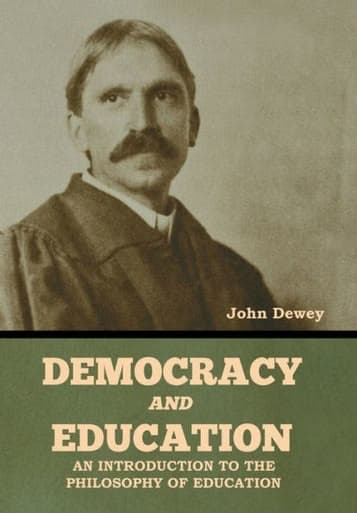
Democracy and Education: An Introduction to the Philosophy of Education
Dewey's central thesis is that education is not preparation for life but the continuous reconstruction of experience through communication, and that democracy is not merely a form of government but a mode of associated living defined by the breadth of shared interests and the fullness of free intercourse between social groups. The book's distinctive mechanism is the identification of philosophy with the general theory of education: philosophical problems arise from social conflicts that education must address, so any philosophy that severs itself from the conditions of growth and communication is empty. Education, for Dewey, has no end beyond itself—growth is the only criterion.
Key Insights
✦What is the central claim of Democracy and Education, and what does it reject?
Dewey argues that education is the continuous reconstruction of experience through communication, and that democracy is a mode of associated living defined by the extent to which interests are shared and free intercourse between groups is permitted. The book rejects two dominant traditions: the 'development from within' model that treats education as unfolding pre-existing potential, and the 'formation from without' model that treats it as external shaping. Both, Dewey argues, rest on dualisms that separate the child from the curriculum, interest from discipline, and means from ends. His alternative is growth as the sole criterion: education has no end beyond itself, and the value of any schooling lies in whether it creates a desire for continued growth and supplies the means to satisfy it.
✦What does Dewey mean by saying philosophy is 'the general theory of education'?
Dewey's most provocative claim is that philosophy has no distinctive subject-matter of its own apart from the problems of education. Philosophical inquiry arises from social and intellectual conflicts, and its function is to clarify the conditions under which those conflicts might be resolved through the reconstruction of experience—which is precisely what education does. A review in the International Journal of Ethics at the time of publication noted that Dewey's thesis is that all philosophy is at bottom social philosophy, and all social philosophy is the philosophy of education . This claim was intended to penetrate philosophies that derive from 'pure reason' or from systems fashioned for other purposes, showing that philosophical ideas are instruments whose worth is tested in the formation of dispositions and conduct.
✦How does Dewey define democracy, and why does the definition not center on government?
Dewey defines democracy as 'more than a form of government' and 'primarily a mode of associated living, of conjoint communicated experience' . The definition is deliberately abstracted from political institutions and focuses on something gradual: the extent to which a society permits free exchange and participation among its members and between itself and other groups. This allows Dewey to assess any association—a school, a workplace, a family—by two criteria: how numerous and varied are the interests consciously shared, and how full and free is the interplay with other forms of association. Democracy thus becomes a standard of measurement for all social life, not a constitutional arrangement, and education becomes the practice that cultivates the dispositions democracy requires.
✦How has the book's reception been shaped by ideological controversy?
Democracy and Education has been a flashpoint in American political culture for over a century. Senator Ben Sasse, in his 2017 book on American adulthood, called Dewey an 'aggressive atheist' and 'really a villain' who used mass public schooling to break down families and communities . On the left, Dewey is embraced as a diagnostician of democratic decline and a resource for re-creating an engaged public sphere; the John Dewey Society and scholars like Harry Boyte treat his model of democratic schooling as a method for mobilizing citizens . This polarization means the book is often read through the lens of later culture-war disputes rather than on its own terms, which can obscure Dewey's actual arguments about growth, communication, and the continuity of school and society.
✦What is the history of the book's translations, and what does that reveal about its reception?
Democracy and Education has had a complex translation history that shaped its reception differently across cultures. The first Spanish translation appeared in 1926–1927, published by Espasa Calpe in Madrid as part of a multi-volume collection of Dewey's works . Chinese translations began with Zou Enrun's 1929 version published by Commercial Press in Shanghai, followed by numerous later editions including Wang Chengxu's 1990 translation for People's Education Press . In Japan, Matsuno Yasuo's translation was published by Iwanodo in 1975 . Maura Striano's research on the book's cross-cultural reception argues that in many contexts participation was split off from deliberation and reflection, distorting Dewey's central ideas so that democratic and educational issues were separated from their philosophical and epistemological foundations .
✦How does Democracy and Education relate to Dewey's later political works like The Public and Its Problems?
Democracy and Education (1916) lays out the philosophical framework: democracy as associated living, education as growth, philosophy as the theory of education. The Public and Its Problems (1927) applies that framework to the specific problem of how a public can form and act under conditions of industrial scale and mass communication. Where the earlier book is pedagogical and reconstructive in a broad sense, the later book is diagnostic and political, asking how the communicative conditions necessary for democratic publics have been corrupted. The later work extends the earlier by showing that the educational task of forming democratic habits is not confined to schools but is a problem for the entire organization of public life—and that the 'eclipse' of the public is a failure of the communicative conditions that Democracy and Education had identified as central to growth.
Wealthy Psyche is an intellectual archive. We do not host, distribute, or sell book copies — physical or digital. We provide structured knowledge to help you think better, faster.