


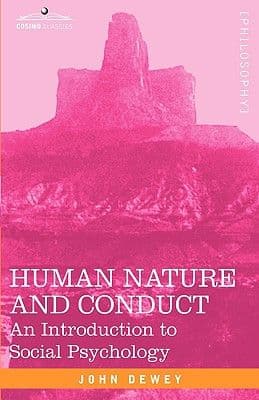
Human Nature and Conduct: An Introduction to Social Psychology
Dewey's central thesis is that morals are neither fixed in an innate human nature nor imposed by external rules, but emerge from the interplay of habit, impulse, and intelligence within social environments. Habits are social functions—shared, transpersonal modes of interaction—and conduct is the ongoing reconstruction of these habits when impulse disrupts routine and deliberation redirects action. The book's distinctive mechanism is its naturalistic moral psychology: deliberation is a 'dramatic rehearsal' of competing courses of action, and freedom is the capacity to modify acquired dispositions through intelligent inquiry rather than a metaphysical will.
Key Insights
✦What does Dewey mean when he says habits are 'social functions'?
Dewey's claim is that habits are not private physiological dispositions but modes of interaction that belong to the environment as much as to the person. Breathing and digesting, he notes, are functions of the surroundings as truly as of the organism; the same holds for acquired habits like speech or honesty. A habit of honesty exists only within a social field that sustains and responds to it. This is why moral conduct cannot be located inside individual wills: the habit of a worker, a citizen, or a parent is a transaction with institutions, customs, and expectations. Moral reform therefore requires modifying the social conditions that carry habits, not merely exhorting individuals to try harder.
✦What is 'deliberation as dramatic rehearsal,' and what does it replace?
Dewey describes deliberation not as a calculus of pleasures and pains but as an imaginative rehearsal of possible courses of action. When an impulse is blocked by conflicting habits, the agent runs through competing lines of conduct in imagination, trying out their consequences before committing to one. This process is experimental and fallible, and it engages the whole self—emotion, memory, and anticipation—not a purely rational faculty. The target of Dewey's critique is the utilitarian model of deliberation as calculation, which he charges with isolating a single 'rational' moment from the actual drama of conduct. Deliberation for Dewey is where intelligence remakes impulse into purposeful action.
✦How does Human Nature and Conduct differ from Dewey's earlier Democracy and Education?
Democracy and Education, published in 1916, treats habit largely in the context of learning and schooling: habit formation is the means by which education transmits culture and develops intelligent participation. Human Nature and Conduct, six years later, takes the concept of habit and gives it a full moral and social-psychological architecture that the earlier book presupposed but did not systematically develop. The 1922 book is less concerned with pedagogy than with the metaphysics of conduct: how impulse, habit, and intelligence interact across the whole of moral life, from the most routine custom to the most reflective reconstruction. It extends the earlier work by supplying the naturalistic moral psychology that Democracy and Education had gestured toward without unpacking.
✦Why did Dewey deny that there are separate, discrete instincts?
Dewey argued that the classification of discrete instincts—a dominant approach in the psychology of his day—was scientifically and morally misleading. What we call instincts are, on his account, original impulsive tendencies that acquire their specific character only through interaction with habits and social conditions. The same native impulse can issue in courage, obstinacy, or cruelty depending on the habits it encounters. This denial served a critical purpose: if there are no fixed instincts, then human nature is plastic and social arrangements bear responsibility for the conduct they produce. The chapter on the classification of instincts is thus a direct attack on the biological determinism that underwrote much conservative social thought in the period.
✦How has the book been received by later pragmatists and moral philosophers?
The book has been revived by neopragmatists who see it as a foundational text for a non-Marxist theory of social reconstruction. A 2001 study argues that Dewey's social psychology in Human Nature and Conduct—its account of the socially constructed self, agency, and anti-essentialism—directly influenced Rorty, Seigfried, and West, even where they diverge from him . A centennial handbook published by Cambridge University Press in 2025–2026 collects twenty-eight essays treating the book's moral psychology as a resource for contemporary dilemmas from environmental ethics to decolonial thought . A recurring criticism, however, is that Dewey's denial of a specific 'organ of moral knowledge' leaves morality without adequate guidance—a charge explored through comparison with Daoist 'knack' passages in the Zhuangzi .
✦Is the book still relevant to contemporary moral psychology?
Human Nature and Conduct anticipates several themes now central to moral psychology: the automaticity of habit, the role of emotion and impulse in moral judgment, and the social constitution of the self. Dewey's account of habit as environmentally distributed resonates with situated and embodied approaches to cognition, while his rejection of a sharp reason/emotion divide aligns with dual-process critiques of rationalist models. The Cambridge handbook explicitly frames the book's moral psychology as addressing 'today's fastest-growing field of psychology' . What remains less assimilable is Dewey's normative ambition: he wants moral psychology to guide social reconstruction, not merely to describe how people happen to judge. That ambition is precisely what some contemporary researchers find inspiring and others find methodologically suspect.
Wealthy Psyche is an intellectual archive. We do not host, distribute, or sell book copies — physical or digital. We provide structured knowledge to help you think better, faster.